

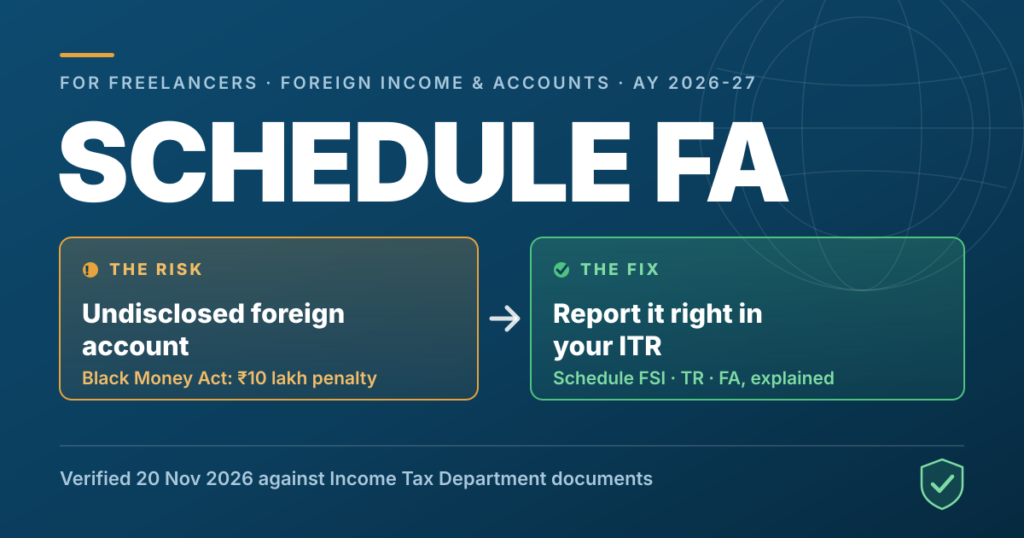
Last verified: 20 November 2026, against official Income Tax Department documents (listed at the end of this post).
Summary
This guide to Schedule FA for freelancers covers what to report, which ITR form applies, and what is confirmed about Wise and Payoneer accounts.
- If you hold a foreign account or asset, or earn foreign-source income, ITR-1 and ITR-4 are not available to you. Three independent official sources point the same way.
- The three schedules answer three different questions. Schedule FSI: where did the income arise? Schedule TR: how much foreign tax credit are you claiming? Schedule FA: which foreign accounts and assets did you hold?
- Schedule FA is driven by holdings, not income. For AY 2026-27 the reporting period is the calendar year 1 January 2025 to 31 December 2025.
- The Black Money Act, 2015 provides for a penalty of up to ₹10 lakh for non-disclosure of foreign assets. The Assessing Officer has discretion to levy it; it is not automatic.
- None of the official documents reviewed names Wise, Payoneer or PayPal in the context of Schedule FA. This post separates what is confirmed from what is not.
- The FAST-DS 2026 declaration window closes on 31 December 2026. It is covered in a separate section.
A common misconception
Many freelancers assume that once a client or platform has withheld tax such as the 30% US withholding, or advance tax has been paid, the compliance is complete. The ITR asks three separate questions: where the income arose, how much tax was paid abroad on it, and what you hold outside India. Three questions, three schedules.
| Schedule | Question it answers | Applies to | What you report | Source |
|---|---|---|---|---|
| FSI | Where did the income arise? | Residents only | Foreign-source income, tax paid abroad, relief in India | Dept Guide, Section 3 |
| TR | How much foreign tax credit? | Residents only | Country-wise summary of FSI, relief under section 90 / 90A / 91 | Dept Guide, Section 4 |
| FA | What did you hold outside India? | Residents (not required for NOR / non-residents) | Foreign accounts and assets held during the calendar year | Dept Guide, Section 5 |
| Credit form | How is the credit claimed? | Residents | AY 2026-27 guide: Form 67. From tax year 2026-27: Form 44 (Rule 76) | Dept Guide, IT Rules 2026 |
FSI and TR apply where foreign-source income and foreign tax are involved. FA is driven by holdings, not by income.
Schedule FSI and Schedule TR: foreign income and foreign tax credit
Per the Income Tax Department’s Step-by-Step Guide, Schedule FSI applies only to residents. It captures income that accrues or arises from sources outside India, and the same income must also appear in the head-wise computation of total income. The country code is the ISD code. The Taxpayer Identification Number (TIN) is the one issued by the country where tax was paid; if none was issued, the passport number is used.
Schedule TR is the country-wise summary of Schedule FSI. It shows total tax paid outside India, the relief available in India, and the section under which relief is claimed: 90, 90A or 91. For tax year 2026-27 onwards, the counterparts under the Income-tax Act, 2025 are section 159 (relief where there is an agreement with the other country) and section 160 (relief where there is no agreement).
Claiming the credit also requires a separate form. The guide for AY 2026-27 refers to Form 67. Under Rule 76 of the Income-tax Rules, 2026, the form is Form 44, applicable from tax year 2026-27. Form 44 must be furnished within 12 months from the end of the relevant tax year, and must be verified by an accountant where the foreign tax paid is ₹1 lakh or more Our guide to Form 44 and foreign tax credit walks through the claim step by step.
One point needs to be flagged: whether a given foreign client’s payment is treated as foreign-source income depends on where the services were performed and where tax was levied. This post does not decide that question. Confirm it with your chartered accountant. Working for a client in another country can also raise Permanent Establishment Risk, which is a separate question from the one here.
Which ITR form: why ITR-4 does not work
This is the biggest source of confusion for freelancers, because different sources appear to say different things. Read together, the three official sources are consistent.
| Form | Schedule FA | FSI / TR | Intended for | Source |
|---|---|---|---|---|
| ITR-1 | No | No | Not available if you hold foreign assets or income | Dept Guide, Rule 164(3) |
| ITR-2 | Yes | Yes | Individuals without business / profession income | ITR-2 form AY 2026-27 |
| ITR-3 | Yes | Form text not verified | Individuals with business / profession income | Dept FA page, Rule 164(7) |
| ITR-4 | No | Not found | Not for those holding foreign assets | ITR-4 form 2026-27, Dept Guide |
The FSI / TR layout inside ITR-3 was not among the sources reviewed, hence “not verified”.
| Source | What it says | Applicable to |
|---|---|---|
| ITR-4 form header | Not for those with assets (incl. financial interest) located outside India | AY 2026-27 |
| Dept Step-by-Step Guide | Do not use ITR-1 / ITR-4 if you hold foreign assets or income | Guide (example uses AY 2025-26) |
| Income-tax Rules 2026, Rule 164(6) | Not eligible with foreign assets, signing authority, foreign income or section 159 relief | Tax year beginning 1 April 2026 |
In practice: if you hold a foreign account or asset, ITR-4 is not an option. For the tax year beginning 1 April 2026, Rule 164(6) of the Income-tax Rules, 2026 goes further. ITR-4 is not available if you have any one of these: an asset located outside India, signing authority in an account located outside India, income from any source outside India, or a claim for relief under section 159. Whether a particular client’s payment is “income from a source outside India” is a separate legal question, covered in the note under Schedule FSI and Schedule TR above.
On ITR-3, what is confirmed is this: the Income Tax Department’s Schedule FA page states that Schedule FA applies to ITR-2, 3, 5, 6 and 7, and Rule 164(7) places individuals with business or profession income in ITR-3. The ITR-3 form text was not among the sources reviewed, so the exact FSI and TR layout inside ITR-3 has not been verified here.
Schedule FA: who must file and when
Per the guide, a resident must report all foreign assets and accounts in which they are the legal owner, beneficial owner or beneficiary. Schedule FA need not be completed by a not ordinarily resident (NOR) or a non-resident Your residency status for the year decides which side you fall on, and if two countries both claim you as a tax resident, see dual tax residency.
The Income Tax Department’s Schedule FA page words the exception slightly differently. It says the schedule is mandatory for all resident taxpayers, except individuals who are not Indian citizens and were non-residents in earlier years when the foreign asset was acquired, provided no income is derived from that asset in the current year. Both statements come from the Department. If your case is close to either exception, confirm it with your chartered accountant.
Source :- Dept Step-by-Step Guide (Section 5); ITR-2 form AY 2026-27 (Part B-TTI item 19).
Schedule FA is divided into tables. Where your holding goes depends on its nature.
| Table | What is disclosed | Illustration (for understanding only) | Key details |
|---|---|---|---|
| A1 | Foreign depository accounts | Foreign bank account | Peak balance, closing balance, gross interest |
| A2 | Foreign custodial accounts | Foreign brokerage / custodian account | Peak, closing, gross amount credited |
| A3 | Foreign equity and debt interest | Foreign shares or bonds | Initial, peak, closing value; sale proceeds |
| A4 | Cash value insurance / annuity contract | Foreign insurance contract | Cash or surrender value |
| B | Financial interest in any entity | Stake in a foreign company / LLC | Investment at cost, income accrued, where offered |
| C | Immovable property outside India | Foreign flat or land | Cost, income derived |
| D | Any other capital asset | Other foreign capital asset | Cost, income derived |
| E | Signing authority (not covered in A to D) | Foreign entity account where you are a signatory | Peak balance, whether income is taxable in your hands |
| F | Foreign trusts | Trustee / settlor / beneficiary | Income from the trust |
| G | Other foreign income not in A to F | Any other foreign-source income | Taxable or not; where offered |
Reporting period: calendar year ending 31 December (for AY 2026-27, 1 Jan 2025 to 31 Dec 2025). Foreign currency is converted at the SBI TT buying rate.
Source :- Dept Step-by-Step Guide (Tables A1 to G, Section 6) and ITR-2 form AY 2026-27.
How to prepare a foreign account entry
Table A1 asks for the institution’s name and address, account number, status, opening date, peak balance, closing balance and gross interest paid or credited during the period. A practical sequence:
- List every foreign account held at any time during the calendar year (for AY 2026-27, 1 January 2025 to 31 December 2025) in your name or with a beneficial interest, including accounts closed during the year.
- From each account statement, identify the date of the peak balance.
- Convert the peak balance (on its date) and the closing balance (as of 31 December) into rupees at the State Bank of India telegraphic transfer buying rate. This rule is in the currency conversion section of the guide.
- Select “Yes” at item 19 of Part B-TTI. The form states that Schedule FA must be completed if the answer is Yes.
- If your total income exceeds ₹1 crore, these assets also appear in Schedule AL. The guide states that reporting in Schedule FA does not replace Schedule AL, where applicable.
The worked example in the guide relates to AY 2025-26 (calendar year 2024). The AY 2026-27 form uses calendar year 2025, so do not mix the two.
Looking ahead: tax year 2026-27 onwards
The Income-tax Act, 2025 came into force on 1 April 2026 and applies from the tax year beginning that day. Returns for AY 2026-27 continue to follow the form and schedules discussed above.
Under section 263(1)(a)(ix) of the Income-tax Act, 2025, a resident (other than a not ordinarily resident) must furnish a return if, at any time during the tax year, they hold any asset located outside India (including a financial interest in an entity), have signing authority in an account located outside India, or are a beneficiary of such an asset. Section 263(1)(b) adds that this return must be furnished regardless of income or loss.
The ITR forms for tax year 2026-27 were not among the documents reviewed, so this post does not state the schedule names or reporting period for that year.
Wise, Payoneer and PayPal
This is the question freelancers ask most, and the one most often answered informally on forums. We checked it directly against the official documents.
| Question | What the official documents show | Status |
|---|---|---|
| Does the form have a foreign depository account entry? | Yes, Table A1 | Confirmed |
| Is an account held at any time in the year reportable? | Yes, “held at any time during the calendar year” | Confirmed |
| Is there a minimum balance threshold in A1? | No threshold appears in the form | Confirmed |
| Are e-money accounts depository accounts for CRS? | Yes, if it is a “specified electronic money product”, from 1 Jan 2026 (Rule 238; institution reporting) | Confirmed |
| Do any documents name Wise / Payoneer / PayPal for FA? | Not named in the form, guide, Rules or FAQs | Not confirmed |
| Does the Rs 5 lakh bank balance proviso cover e-money? | The proviso refers only to “bank accounts” | Not confirmed |
| Is an e-money account an “account with a bank” (FAST-DS Rule 3)? | The rule does not mention e-money | Not confirmed |
The CRS point concerns the institution’s reporting. It does not by itself answer your Schedule FA obligation.
The form and the guide use the term “foreign depository account”, and the test is whether the account was held at any time during the calendar year. However, none of the official documents reviewed says in terms whether a Wise, Payoneer or PayPal balance falls within that term. This post therefore does not state a yes or no.
An observation: Wise’s “proof of account details” letter provides USD account details with a US address (Wise US Inc, New York), while the letterhead is that of Wise Payments Ltd in the UK. What to enter as the institution’s name, address and country in Schedule FA therefore needs to be determined from your own account documents.
One related development: under Rule 238 of the Income-tax Rules, 2026, accounts holding specified electronic money products are treated as depository accounts for CRS purposes from 1 January 2026, and the CBDT’s CRS and FATCA guidance note treats e-money issuers as reporting financial institutions. That concerns the institution’s reporting obligations, not your Schedule FA obligation. It does indicate, however, that a route exists for e-money account data to reach the department.
Rule 238(10) defines a “specified electronic money product” by five conditions: it is a digital representation of a single fiat currency; it is issued on receipt of funds for making payment transactions; it is represented by a claim on the issuer in the same currency; it is accepted in payment by someone other than the issuer; and it is redeemable at any time at par under the issuer’s regulatory requirements.
A product made only to transfer funds is excluded, but funds held for longer than 60 days are not treated as transfer-only. Whether a particular Wise or Payoneer balance meets this definition depends on the issuer and the product, and this post does not decide it. It also concerns CRS reporting, not your Schedule FA obligation.
In this grey area, the practical step is to show your account structure (which entity, which account type) to your chartered accountant and obtain their written opinion. Receiving foreign payments also has GST and FEMA angles, which we cover in GST, FEMA and Section 58.
Consequences of non-disclosure
The Black Money (Undisclosed Foreign Income and Assets) and Imposition of Tax Act, 2015 contains separate penalty and prosecution provisions for foreign asset disclosure. They apply to a resident other than a not ordinarily resident.
| Section | When it applies | Consequence | Key point |
|---|---|---|---|
| 42 | No return furnished although foreign assets / income existed | Penalty of Rs 10 lakh (AO “may direct”) | Not applicable if aggregate bank balance did not exceed Rs 5 lakh at any time in the previous year |
| 43 | Return filed but foreign asset information omitted or inaccurate | Penalty of Rs 10 lakh (AO “may direct”) | Same Rs 5 lakh bank balance proviso |
| 49 | Wilful failure to furnish return | Rigorous imprisonment of 6 months to 7 years, and fine | No proceedings if return is furnished before the assessment year ends |
| 50 | Wilful failure to disclose foreign asset / income in return | Rigorous imprisonment of 6 months to 7 years, and fine | “Wilful” is required, but under section 54 the court presumes a culpable mental state; the Rs 5 lakh exemption is not in this section’s text |
These sections apply to a resident other than not ordinarily resident. Under section 46, a show-cause notice and hearing precede any penalty. Prosecution requires sanction under section 55.
Source :- Black Money (Undisclosed Foreign Income and Assets) and Imposition of Tax Act, 2015.
Two points deserve attention. First, the penalties under sections 42 and 43 are discretionary (“may direct”), and under section 46 a show-cause notice and a hearing must precede any penalty. Second, the ₹5 lakh exemption appears only in the provisos to sections 42 and 43, and only for “bank accounts”. It does not appear in the text of sections 49 and 50. Table A1 of Schedule FA also shows no minimum balance for disclosure.
One more distinction: Schedule FA looks at the calendar year, whereas the ₹5 lakh proviso refers to the “previous year”, which is the financial year. The two windows differ.
A note on “wilful”. Sections 49 and 50 apply to wilful failure. However, section 54 provides that in a prosecution where a culpable mental state is required, the court presumes that it exists. It is a defence for the accused to prove that they had no such mental state, and a fact is treated as proved only when the court believes it to exist beyond reasonable doubt. So “I did not know” is not an automatic answer.
If you missed Schedule FA in your AY 2026-27 return
The Finance Act, 2026 amended section 139(5) of the Income-tax Act, 1961. A revised return can now be furnished at any time before the end of the relevant assessment year or before the completion of the assessment, whichever is earlier, subject to a fee under the new section 234-I. The fee is ₹1,000 if total income does not exceed ₹5 lakh, and ₹5,000 in any other case.
The CBDT’s validation rules (The CBDT’s published validation rules for ITR-7) state that this fee applies where the revised return is filed after 31 December 2026. The wording of section 234-I itself is framed differently, so confirm the exact cut-off on the e-Filing portal or with your chartered accountant.
Whether to revise the return or to use FAST-DS, which has its own eligibility test, depends on your facts. Take your chartered accountant’s advice before choosing. This post does not cover belated or updated returns.
FAST-DS 2026: a time-bound window
This section is relevant only until 31 December 2026. The Foreign Assets of Small Taxpayers Disclosure Scheme, 2026 is in Chapter IV of the Finance Act, 2026. The Rules came into force on 16 August 2026, and the last date for a declaration is 31 December 2026. The valuation date is 31 March 2026.
| Category | What can be declared | Limit | Amount payable |
|---|---|---|---|
| 1 | Undisclosed foreign asset or undisclosed foreign income | Aggregate up to Rs 1 crore | 30% tax plus an equal amount (100% of the tax) = 60% |
| 2 | Asset acquired from income already offered to tax in India (or while non-resident) but not reported in the Schedule | Up to Rs 5 crore | Flat fee of Rs 1 lakh |
Valuation date: 31 March 2026. Last date for declaration: 31 December 2026. Immunity covers only tax, penalty and prosecution under the Black Money Act, for previous years up to 31 March 2026. Amounts paid are not refundable.
Source :- Finance Act 2026 (sections 131 to 139), FAST-DS Rules 2026 (Notification 114/2026), FAST-DS FAQs.
| Item | Value / income | Tax at 30% | Additional 100% of tax | Total |
|---|---|---|---|---|
| Foreign bank account | Rs 60 lakh | Rs 18 lakh | Rs 18 lakh | Rs 36 lakh |
| Foreign income | Rs 20 lakh | Rs 6 lakh | Rs 6 lakh | Rs 12 lakh |
| Total | Rs 80 lakh | Rs 24 lakh | Rs 24 lakh | Rs 48 lakh |
Rs 80 lakh is within the Rs 1 crore limit. A bank account is valued at the sum of deposits (Rule 3), not the balance.
Illustration from the Rules: on an Rs 80 lakh account the payable amount is Rs 48 lakh. If the order is dated 22 Sep 2026, the last date without interest is 30 Nov 2026. Payment on 17 Dec 2026 attracts one month’s interest of Rs 48,000, so the total is Rs 48,48,000.
Source :- Finance Act 2026 section 135; FAST-DS Rules 2026 (Rule 7 illustration).
Two points matter for freelancers.
Which category. Category 1 covers assets or income whose source cannot be explained, or income that was taxable but not offered to tax. Category 2 covers assets acquired from income that has already been offered to tax in India (or acquired while a non-resident) but not reported in the relevant schedule. On the text of the table in section 133, a freelancer who paid tax on their earnings but did not report a foreign account in Schedule FA is closer to Category 2. Whether this applies depends on your facts, so confirm it with your chartered accountant.
How a bank account is valued. Under Rule 3, the value of a foreign bank account is the sum of all deposits from the date of opening up to 31 March 2026, not the balance. A deposit made out of a withdrawal from the same account is excluded. Where money has flowed through an account for years, the value can be far higher than the balance, and the ₹1 crore and ₹5 crore limits apply to that value. Whether an e-money account counts as an “account with a bank” is also unsettled.
Also note: the amount paid is not refundable (section 138); immunity covers only tax, penalty and prosecution under the Black Money Act, and only for the previous year ending 31 March 2026 and earlier (section 139); and a declaration can be treated as invalid if any material particular is found to be false (section 134). The entire process is online, and Form 1 is filed on the e-Filing portal where the FAST-DS forms are also available.
Pre-filing checklist
- A list of all foreign accounts held at any time during the calendar year, including accounts closed during the year.
- The peak balance (with date) and the 31 December closing balance for each account.
- SBI TT buying rates for the correct dates.
- Where foreign tax was paid, the supporting certificate or proof, and the correct form (Form 67 or Form 44).
- The correct ITR form; where a foreign account is held, not ITR-4.
- A written opinion from your chartered accountant on how Wise, Payoneer and similar accounts are treated.
Sources
Income Tax Department: ITR-2 form AY 2026-27, ITR-4 form 2026-27, Step-by-Step Guide to Fill FSI, TR and FA Schedule, Schedule FA page (incometaxindia.gov.in, last updated 18 May 2026), FAQs on Presumptive Taxation, Guidance Note on Form 44 and Form 45, CRS and FATCA Guidance Note FAQs, FAST-DS FAQs and Form 1 user manual. Law: Finance Act, 2026 (Chapter IV), Foreign Assets of Small Taxpayers Disclosure Scheme Rules, 2026 (Notification 114/2026), Income-tax Rules, 2026, Income-tax Act, 2025 (as amended by the Finance Act, 2026), and the Black Money (Undisclosed Foreign Income and Assets) and Imposition of Tax Act, 2015.
Disclaimer
This post is for general information only. It is not tax, legal or financial advice, and the author is not a chartered accountant or tax advisor. Tax rules, forms and scheme deadlines can change, and every taxpayer’s facts are different. Before making any filing, disclosure or payment, consult your chartered accountant or a qualified tax professional and check the latest official notifications. Examples in this post are illustrative. The author accepts no liability for any loss arising from the use of this information.

Anurag Panchal
Founder & Editor at ServiceMoney.in & AllRoundUpdate.com.
I am an independent freelancer and blogger who researches money and compliance topics for freelancers. I am not a chartered accountant, lawyer or tax professional. I wrote this guide by studying public sources: the Income Tax Department’s ITR-2 and ITR-4 forms for AY 2026-27, its Step-by-Step Guide to Schedules FSI, TR and FA, the Schedule FA page, the FAST-DS FAQs and Form 1 user manual, the Finance Act, 2026 (Chapter IV), the FAST-DS Rules, 2026 (Notification 114/2026), the Income-tax Rules, 2026, the Income-tax Act, 2025, the CBDT CRS and FATCA guidance note, and the Black Money Act, 2015.
This article explains how Schedule FSI, TR and FA work for freelancers with foreign income or foreign accounts: which ITR form applies, what the Black Money Act provides, and how FAST-DS 2026 works. It also states plainly what the official documents do not confirm, such as how Wise or Payoneer balances are treated. It is for education only and is not tax or legal advice. Please consult a qualified Chartered Accountant before filing or making any disclosure.
Found an error? Please let me know and I will correct it. The date at the top of the post shows when I last checked the sources. More explainers on my YouTube channel.

