

By Anurag Panchal | Category: Global Finance | Last verified: 4 November 2026
Verified against the Income-tax Act, 2025 (as amended by the Finance Act, 2026), the Income-tax Rules, 2026 and the CBDT Guidance Note on Form 44 and Form 45. Section and rule numbers are given so you can check every point yourself.
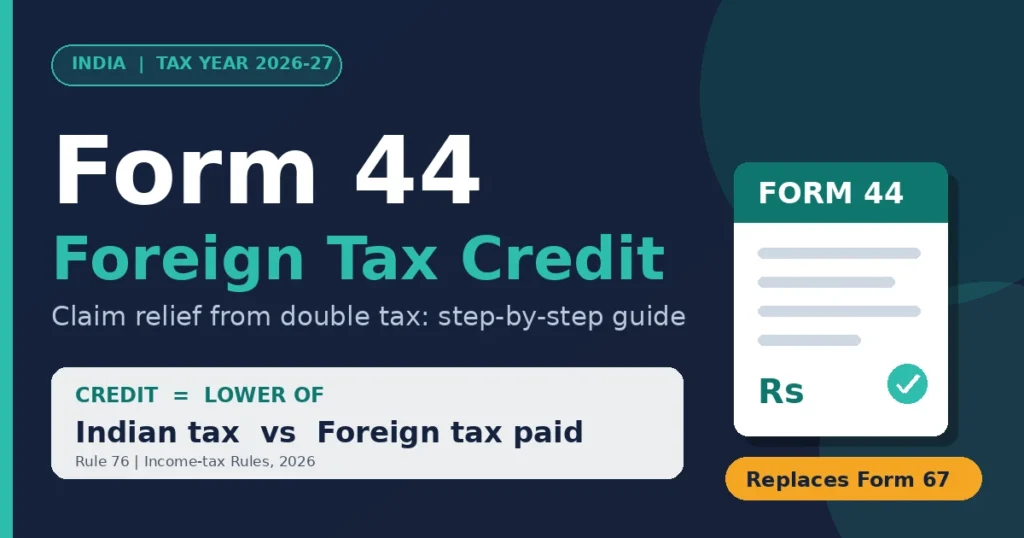
You paid tax on your foreign income abroad. India also wants tax on the same income. So who gives way? Under the Income-tax Act, 2025, the answer for a resident is Form 44 Foreign Tax Credit (FTC): the tax already paid abroad is set against your Indian tax, but only up to a limit (Rule 76), and only if you claim it correctly in Form No. 44. For income from 1 April 2026, Form 44 replaces the old Form 67.
This guide shows exactly how that works from tax year 2026-27 onwards.
Who this guide is for: residents of India who have foreign income on which tax was actually paid or deducted outside India. Who it is not for: if no foreign tax was paid (for example, nothing was deducted), there is no credit to claim. Start with our guide on How to Legally Stop 30% IRS Withholding Tax on Inbound India Invoices.
Key takeaways
- A resident is taxed in India on income from anywhere in the world (section 5(1)).
- Credit is allowed for foreign tax paid, but only against tax, surcharge and cess. Interest, fee and penalty are not creditable (Rule 76(4)).
- Credit = the lower of (a) Indian tax payable on that income and (b) foreign tax paid on that income (Rule 76(7)(a)).
- Form No. 44 and the certificate or statement of foreign tax are due within 12 months from the end of the tax year, and your return must have been filed within the time allowed under section 263(1) or 263(4) (Rule 76(12)).
- Form No. 67 is no longer the credit form under the 2026 Rules. In the new Rules, Form 67 is a different report (Rule 138).
1. Why you can be taxed twice
Under section 5(1) of the Income-tax Act, 2025, the total income of a resident includes income received in India, income that accrues in India, and income that accrues outside India. A person who is “not ordinarily resident” is taxed on foreign income only when it comes from a business controlled in India or a profession set up in India.
An individual is a resident if he or she is in India for 182 days or more in the tax year, or for 60 days or more in the tax year and 365 days or more in the four preceding years (section 6(2)).
The other country taxes the same income under its own law. That is the double tax. If your work abroad creates a taxable presence, read Permanent Establishment Risk for Freelancers.
How foreign tax credit works, step by step
Swipe left or right to see more
Source: Income-tax Act, 2025 section 5(1); Income-tax Rules, 2026 Rule 76. Verified 4 November 2026.
2. Two routes to relief: treaty or no treaty
Before you pick a route, check that you are not a resident of both countries at once. If both claim you as a resident, read Dual Tax Residency Explained, because the treaty tie-breaker decides which country gets the first right to tax you.
Country with a tax treaty with India (section 159). The Central Government can enter into treaties to give relief from double tax. Where a treaty applies, the provisions of the Act apply only to the extent they are more beneficial to you (section 159(4)). For credit, the foreign tax that counts is the tax covered by the treaty (Rule 76(3)(a)).
Country with no treaty (section 160). A resident who has paid income-tax in such a country gets a deduction from Indian tax, calculated at the Indian rate of tax or the foreign country’s rate, whichever is lower (section 160(1)). Here the foreign tax that counts is tax in the nature of income-tax as described in section 160(3)(a) (Rule 76(3)(b)).
In both cases the working method is Rule 76.
Treaty country or no-treaty country: what changes
Swipe left or right to see more
| Law | Section 159 (treaty) | Section 160 (no treaty) |
|---|---|---|
| Foreign tax that counts | Tax covered by the treaty (Rule 76(3)(a)) | Tax in the nature of income-tax as described in section 160(3)(a) (Rule 76(3)(b)) |
| Limit on relief | Credit is the lower of Indian tax and foreign tax; foreign tax above the treaty amount is ignored (Rule 76(7)(a)) | Deduction at the Indian rate or the foreign rate, whichever is lower (section 160(1)) |
| Which law prevails | Act applies only where more beneficial to you (section 159(4)) | Not applicable |
| How you claim | Rule 76 credit, Form No. 44 | Rule 76 credit, Form No. 44 |
| Extra paper | Keep a copy of the treaty where applicable (CBDT Guidance Note) | Not mentioned in the Guidance Note |
Source: Act sections 159, 160; Income-tax Rules, 2026, Rule 76; CBDT Guidance Note on Form 44 and 45.
3. Which law applies to which year
The Income-tax Act, 1961 was repealed on 1 April 2026. Income earned from 1 April 2025 to 31 March 2026 is governed by the 1961 Act and assessed in AY 2026-27. Income earned from 1 April 2026 onwards is governed by the Income-tax Act, 2025 and is assessed for Tax Year 2026-27 (CBDT FAQs on Interplay and Transition, Q1.2 and Q1.12).
This guide covers Tax Year 2026-27 onwards. For income up to 31 March 2026, the old Act’s own rules apply; the CBDT Guidance Note says Form 44 replaces the erstwhile Form 67.
Estimate How Much INR You Will Actually Receive
Before the tax calculation, check how much INR actually reaches your bank. This tool uses a daily reference exchange rate to estimate your payout. It is for planning your received money only. For Form 44, foreign tax is converted at the SBI TT buying rate, explained in the next section. This tool contains a partner link; we may earn a commission at no extra cost to you.
4. How the Form 44 Foreign Tax Credit Is Calculated
Rule 76(7)(a) gives the formula. It is computed separately for each source of income from a particular country, and the results are added up.
Credit = the lower of (A) tax payable under the Act on that income, and (B) foreign tax paid on that income.
If the foreign tax is higher than what the treaty allows, the excess is ignored when you work out (B).
Currency: convert foreign tax into rupees at the telegraphic transfer buying rate on the last day of the month immediately before the month in which the tax was paid or deducted (Rule 76(7)(b)). The rate means the State Bank of India’s buying rate (Rule 207(3)(b)).
Illustrative examples (all numbers are made up to show the method; your own “tax payable under the Act on that income” comes from your return computation):
- Case A – foreign tax is lower. Indian tax ₹3,00,000; foreign tax ₹2,00,000. Credit = ₹2,00,000. Balance Indian tax on that income = ₹1,00,000.
- Case B – foreign tax is higher. Indian tax ₹3,00,000; foreign tax ₹4,00,000. Credit = ₹3,00,000. The extra ₹1,00,000 gets no credit under this rule.
- Case C – treaty cap. Indian tax ₹3,00,000; foreign tax paid ₹4,00,000; treaty-allowed tax ₹2,50,000. The ₹1,50,000 above the treaty is ignored. Credit = ₹2,50,000. Balance Indian tax = ₹50,000.
- Conversion example. USD 2,400 foreign tax × ₹85.00 (illustrative SBI rate) = ₹2,04,000.
The credit formula with three examples
Swipe left or right to see more
If foreign tax is above the treaty amount, the excess is ignored when finding (B). Worked separately for each source of income per country (Rule 76(7)(a)).
| Case | Indian tax on that income | Foreign tax paid | Treaty-allowed tax | Credit | Indian tax still payable | Foreign tax not credited |
|---|---|---|---|---|---|---|
| A: foreign tax lower | ₹3,00,000 | ₹2,00,000 | not applicable | ₹2,00,000 | ₹1,00,000 | ₹0 |
| B: foreign tax higher | ₹3,00,000 | ₹4,00,000 | not applicable | ₹3,00,000 | ₹0 | ₹1,00,000 |
| C: treaty cap | ₹3,00,000 | ₹4,00,000 | ₹2,50,000 | ₹2,50,000 | ₹50,000 | ₹1,50,000 (ignored) |
Currency: foreign tax is converted at the SBI telegraphic transfer buying rate on the last day of the month before the tax was paid or deducted (Rule 76(7)(b)). Example: USD 2,400 × ₹85.00 = ₹2,04,000.
All figures are illustrative to show the method, not a real tax computation. Source: Rule 76(7).
5. What does not get credit
- Interest, fee or penalty. Credit is against tax, surcharge and cess only (Rule 76(4)).
- Disputed foreign tax. No credit while you dispute that tax in any manner (Rule 76(5)). If the dispute is settled, see Form 45 below.
- Credit across years. If the same foreign income is offered to tax in India over more than one tax year, credit is given across those years in the same proportion (Rule 76(2)).
6. Documents you need
Under Rule 76(10) and (11) you need Form No. 44 and a certificate or statement of the income and the tax paid. The certificate can come from the foreign tax authority, from the person who deducted the tax, or be signed by you. It is valid only with proof: a payment challan or bank counterfoil if you paid it, or proof of deduction if it was deducted. The CBDT Guidance Note also lists a copy of the relevant tax treaty where applicable, and dispute details if any. You can view the official Form No. 44 on the Income Tax Department website before you start filling it.
Form 44 and Form 45 deadlines
Swipe left or right to see more
Source: Rule 76(6),(12),(13); CBDT Guidance Note. Counting is from the rule wording; confirm the date on the portal when you file.
7. Deadlines and who must get Form 44 verified
Form 44 and certificate deadline: Form 44 and the certificate or statement under Rule 76(10)(b) must be furnished within 12 months from the end of the tax year in which the foreign income is offered to tax in India, and the return for that year must have been filed within the time given in section 263(1) or 263(4) (Rule 76(12)). Example: Tax Year 2026-27 ends on 31 March 2027, so the 12-month window runs to 31 March 2028.
If you file an updated return under section 263(6)(a), Form 44 and the certificate or statement for the income in that return must be furnished on or before the date of the updated return (Rule 76(13)).
Accountant verification: Form 44 must be verified by an accountant if the assessee is a company, or in all other cases where foreign tax paid outside India for the year is ₹1,00,000 or more (Rule 76(16)).
Documents checklist for Form 44
Swipe left or right to see more
| Document | What it is | Rule |
|---|---|---|
| Form No. 44 | Statement of foreign income and foreign tax, verified as the form requires | 76(10)(a) |
| Certificate or statement | Shows nature of income and tax paid or deducted. From the foreign tax authority, the person who deducted tax, or signed by you | 76(10)(b) |
| Proof of payment or deduction | Challan or bank counterfoil if you paid; proof of deduction if it was deducted | 76(11) |
| Copy of tax treaty | Where applicable | CBDT Guidance Note |
| Dispute details | Only if any foreign tax is in dispute | CBDT Guidance Note |
| Accountant verification | Needed if the assessee is a company, or foreign tax paid for the year is ₹1,00,000 or more | 76(16) |
Source: Income-tax Rules, 2026 Rule 76; CBDT Guidance Note on Form 44 and Form 45.
8. How to file Form 44 (step by step)
- Log in to the e-filing portal with your user ID and password.
- Go to e-File > Income Tax Forms > File Income Tax Forms.
- Select Form No. 44 (or search for it) and click “Let’s Get Started”.
- Fill in the form. It has three parts: Part A (your particulars), Part B (foreign income offered to tax in India and credit claimed) and Part C (refund of foreign tax already credited).
- Attach the documents required under Rule 76(10) and 76(11).
- Check the preview and click “Proceed to e-Verify”.
- Submit and complete e-verification.
- Save the Transaction ID and Acknowledgement Number.
Portal menus can change, so check the e-filing portal on the day you file. These steps follow the CBDT Guidance Note on Form 44 and Form 45. For common questions on who must file and when, see the official CBDT FAQs on Form 44 and Form 45.
Part C and Rule 76(14): Form 44 is also used to tell the department when a refund of foreign tax that you already claimed as credit arises, for example due to a loss carry-back or a revised return.
9. Form 45: when the foreign tax was in dispute
If credit was not claimed in Form 44 because the foreign tax was disputed, and the dispute is later settled, you file Form No. 45 within six months from the end of the month in which the dispute is finally settled. Form 44 for that tax year must already have been filed.
Furnish evidence of settlement and evidence of payment (Rule 76(6) and (15)). Rule 76(6) also requires an undertaking that no refund of that foreign tax has been or will be claimed. Where the Assessing Officer amends your assessment under section 288(1), Table Sl. No. 7, the undertaking is that no credit for that amount has been or will be claimed for any other tax year. Form 45 needs accountant verification when Form 44 for that year needed it (Rule 76(17)).
10. Common mistakes to avoid
Seven mistakes that cost you credit
Swipe left or right to see more
| Mistake | Why it goes wrong | Rule |
|---|---|---|
| Using Form 67 for Tax Year 2026-27 | In the 2026 Rules, Form 67 is an accountant’s report on adjusted total income. The credit statement is Form 44 | Rule 138; Rule 76(10)(a) |
| Claiming credit on interest, fee or penalty | Credit is only against tax, surcharge and cess | 76(4) |
| Taking the full foreign tax as credit | Credit is capped at the lower of Indian tax and foreign tax; treaty excess is ignored | 76(7)(a) |
| Using the wrong exchange rate | Use the SBI TT buying rate on the last day of the month before payment or deduction | 76(7)(b); 207(3)(b) |
| Missing the 12-month window or filing the return late | Form 44 and the certificate are due within 12 months from the end of the tax year and the return must be filed in time | 76(12) |
| Claiming disputed tax | No credit while disputed; use Form 45 after the dispute is settled | 76(5),(6),(15) |
| Skipping accountant verification | Required when foreign tax is ₹1,00,000 or more, or for a company | 76(16) |
Source: Income-tax Rules, 2026.
11. If you are outside India
This guide is for Indian residents. Many countries relieve double tax through a credit (the tax paid elsewhere is deducted from the local tax) or an exemption (the foreign income is left out of local tax). India’s method for residents is the credit under Rule 76 above. Forms, rates and deadlines differ in every country, so check your own tax authority’s rules.
Conclusion: Your Form 44 Foreign Tax Credit in Short
For a resident of India, tax paid abroad does not have to mean paying tax twice. Under Rule 76, you get credit equal to the lower of the Indian tax and the foreign tax on that income, claimed in Form No. 44 from tax year 2026-27 onwards. Keep your certificate and proof of payment ready, file your return on time, and submit Form 44 within 12 months from the end of the tax year. For income from 1 April 2026, use Form 44, not Form 67. Rules and portal menus can change, so check the Income Tax Department website on the day you file, and speak to a qualified tax professional if your case is unusual.
FAQs
Q1: Is Form 67 still used to claim foreign tax credit?
For Tax Year 2026-27 onwards, the credit statement is Form No. 44. In the 2026 Rules, Form No. 67 is an accountant’s report on adjusted total income (Rule 138). The Guidance Note says Form 44 replaces the erstwhile Form 67.
Q2: Do I have to file my return on time to claim credit?
Rule 76(12) requires the return for that year to be furnished within the time specified in section 263(1) or 263(4).
Q3: Does a resident with a foreign account have to file a return even with low income?
Section 263(1)(a)(ix) requires a return from a resident (other than not ordinarily resident) who held a foreign asset or had signing authority in a foreign account at any time in the tax year.
Q4: Do I need a chartered accountant?
Form 44 must be verified by an accountant when foreign tax is ₹1,00,000 or more or the assessee is a company. Section 515(3)(b) defines an accountant as a chartered accountant who holds a valid certificate of practice. For anything unusual, speak to a tax professional.
Disclaimer
This article is for education only and is not tax or legal advice. Rules can change after the date above. Confirm your own case with a qualified tax professional before filing.
Sources checked (last verified 4 November 2026)
- Income-tax Act, 2025 as amended by the Finance Act, 2026: sections 5(1), 6(2), 159, 160, 263(1), 263(4), 263(6), 288(1) Sl. No. 7.
- Income-tax Rules, 2026: Rule 76, Rule 75, Rule 138, Rule 207.
- CBDT FAQs on Interplay and Transition from the Income-tax Act, 1961 to the Income-tax Act, 2025: Q1.2, Q1.12.
- CBDT Guidance Note with respect to Form No. 44 and Form No. 45: Foreign Tax Credit.

Anurag Panchal
Founder & Editor at ServiceMoney.in & AllRoundUpdate.com.
I am an independent freelancer and researcher. I am not a chartered accountant, lawyer or tax professional. I wrote this guide by studying public sources published by the Income Tax Department of India: the Income-tax Act, 2025 (as amended by the Finance Act, 2026), the Income-tax Rules, 2026, the CBDT FAQs on Interplay and Transition, and the CBDT Guidance Note on Form 44 and Form 45.
This article explains how the Form 44 foreign tax credit works for Indian residents. It is for education only and is not tax or legal advice. Please consult a qualified professional before making decisions.
Found an error? Please let me know. I review this article regularly and correct mistakes. More explainers on my YouTube channel.

