

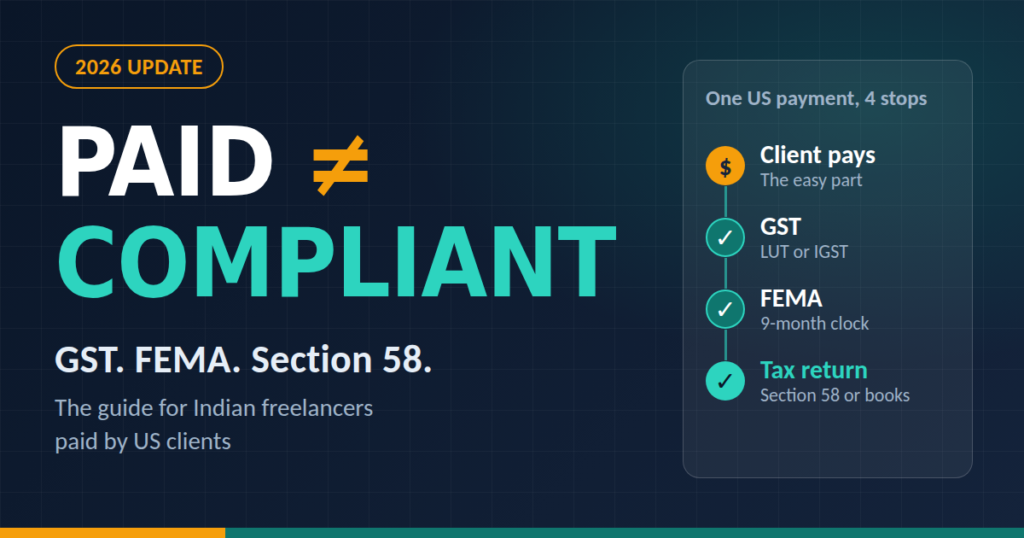
Payment from a US client in India is not the finish line. It is where three compliance regimes start asking for proof. If one export condition fails, GST can treat your invoice as a domestic supply and charge 18% IGST. If the money arrives after the FEMA deadline, now 9 months for most service invoices (12 if invoiced in INR), your bank can ask questions and restrict your future exports. And if you pick the wrong tax basis under the new Income-tax Act, 2025, you can end up paying more tax than you need to.
All three regimes changed in 2026, and many articles still quote the old rules. This guide walks you through the six checkpoints every invoice must clear and the four problems freelancers hit most, with a clear fix for each, so one clean paper trail keeps your income compliant. The 2026 changes are flagged throughout.
Key takeaways
- Three regimes, three 2026 changes: GST (30 March), the Income-tax Act, 2025 (1 April) and RBI’s export regulations (1 October).
- FEMA: realise service-export proceeds within 9 months of the invoice date (12 months if invoiced or settled in INR).
- GST: filing an LUT is a cash-flow choice. Failing the five export conditions is the real tax risk. Intermediary services can now qualify as exports.
- Income tax: Section 58 replaced 44AD, 44ADA and 44AE from tax year 2026-27. Compare your real margin with the presumptive rate before choosing.
- Foreign tax credit: Form 67 up to FY 2025-26, Form 44 after, and only if foreign tax was deducted.
What changed in 2026
← Swipe left or right to see the full diagram →
Timeline: on 30 March 2026 the GST intermediary place-of-supply rule was omitted. On 1 April 2026 the Income-tax Act, 2025 began and replaced the 1961 Act. On 5 June 2026 the FEMA realisation period was reset to 9 months. On 1 October 2026 the new RBI export regulations started, with 9 months confirmed through the 22 September 2026 amendment.
The journey of one payment from a US client in India
Every invoice passes the same six checkpoints. This sequence is the permanent part of the guide.
Before checkpoint one, there is a step on the US side. If a client withholds 30% from your invoice, you lose money before India even sees it. Here is how to stop 30% IRS withholding legally, with the right paperwork.
Problem 1: GST treats a failed export as a domestic supply
The problem. A service is zero-rated only if all five conditions hold. If one fails, it was never an export. The supply is taxable at 18% IGST, and no export refund route exists.
The fix. Test each client against the five conditions before you sign. Then pick a route: LUT, or IGST paid and refunded. Both are lawful.
Do this before your first export, not after. The LUT is filed online on the official GST portal, in Form GST RFD-11.
The five conditions for export of services (Section 2(6), IGST Act)
| Condition | What to check |
|---|---|
| Supplier in India | Registration and bank account are Indian. |
| Recipient outside India | The contracting entity is abroad, not an Indian branch. |
| Place of supply outside India | Determined under the place-of-supply rules, not by the invoice. |
| Payment in convertible foreign exchange | Or INR where RBI permits. |
| Not the same person's establishments | No billing your own foreign branch. |
← Swipe left or right to see the full table →
Two lawful export routes
| Item | LUT route | Pay IGST and claim refund |
|---|---|---|
| Cash flow | No IGST outflow | IGST paid first, refunded later |
| Paperwork | LUT each financial year | IGST in GSTR-3B, then a refund application |
| Invoice wording | Supply under LUT without payment of IGST | Supply meant for export on payment of IGST |
← Swipe left or right to see the full table →
2026 update: intermediary services. Finance Act 2026 omitted Section 13(8)(b) of the IGST Act from 30 March 2026. For intermediary services (agents, brokers and facilitators arranging supplies between others), the place of supply now follows the recipient’s location. The definition of “intermediary” is unchanged. The change is prospective, so review how earlier invoices and advances are treated.
Example. A freelancer earns ₹40,00,000 in commissions from a US platform for arranging bookings. Under the old rule this was a domestic supply, so 18% IGST (₹7,20,000) applied. For services on or after 30 March 2026, the same supply can be zero-rated if the other four conditions are met.
Problem 2: The FEMA deadline is shorter than most guides say
The problem. FEMA requires export proceeds to be realised and repatriated within a fixed period. That period moved twice within a year. Systems and templates built on 15 months are now wrong.
The fix. Record a 9-month due date against every invoice and chase early. If a payment will slip, approach your Authorised Dealer bank before the deadline.
A late payment is not always your client’s fault. Sometimes the money is simply stuck at the bank. If your transfer is held up, learn how to fix US-to-India bank holds before your 9-month clock runs out.
← Swipe left or right to see the full diagram →
Chart summary: the realisation period for service exports was 9 months until 13 November 2025, 15 months from 14 November 2025 to 4 June 2026, 9 months from 5 June to 30 September 2026, and 9 months under the new rules from 1 October 2026. For INR-invoiced exports it is 12 months from 1 October 2026. Always confirm the period applicable to your invoice date.
Do not rely on any blog, including this one, for your exact deadline. Check the latest RBI notifications and confirm the period that applies to your invoice date.
Two clocks run on every service-export invoice
| Law | Deadline | If you miss it |
|---|---|---|
| FEMA (RBI) | 9 months from invoice date | Closer scrutiny. Future exports may be restricted to advance payment or a letter of credit. |
| GST (Rule 96A, LUT, services) | 1 year from invoice date | Zero-rating can be lost and IGST may become payable. |
← Swipe left or right to see the full table →
Work to the shorter clock. Payment inside 9 months satisfies both.
This guide covers export of services. For export of goods, Rule 96A runs a different and shorter clock (the goods must be exported within 3 months of the invoice, unless extended), so do not copy this table for goods.
🇺🇸 US-to-India Cross-Border Payout Tool 🇮🇳
Estimate your INR payout using the latest reference exchange rate and typical transfer costs
Loading the latest exchange rate…
Save up to 90% on international transfer fees — claim your discount here!
Problem 3: Choosing the wrong basis of tax, under the wrong law
The problem. Income up to FY 2025-26 is taxed under the 1961 Act. Income from 1 April 2026 falls under the Income-tax Act, 2025, with tax years and new section numbers. Many freelancers also default to presumptive taxation without testing their real margin.
The fix. Cite the law that matches the year. Then compare presumptive taxation with regular books on your actual numbers.
Old law versus new law
| Item | Up to FY 2025-26 (1961 Act) | From 1 April 2026 (2025 Act) |
|---|---|---|
| Year terms | Previous year, assessment year | Tax year |
| Presumptive schemes | Sections 44AD, 44ADA, 44AE | Section 58 (one table) |
| Foreign tax credit form | Form 67 | Form 44 |
← Swipe left or right to see the full table →
Presumptive taxation versus regular books
| Item | Presumptive (Section 58) | Regular books |
|---|---|---|
| Taxable profit | 50% of receipts for professionals; a fixed percentage of turnover for business | Actual receipts less actual expenses |
| Records | No detailed books if you declare at least the presumptive income. If you declare less and your total income exceeds the basic exemption limit, books and a Section 63 tax audit apply. | Books required; audit rules apply above limits |
| Receipt limit (professionals) | ₹50 lakh, or ₹75 lakh if cash receipts are not more than 5% of gross receipts | None |
| Usually better when | Your real margin is above 50% | Your real margin is well below 50% |
← Swipe left or right to see the full table →
Example. A consultant bills ₹40,00,000 and spends ₹26,00,000. Real profit is ₹14,00,000, a 35% margin. Presumptive taxation would tax ₹20,00,000. Books would tax ₹14,00,000, but declaring less than the presumptive income brings in books and a Section 63 tax audit once your total income exceeds the basic exemption limit, so model both with your CA.
Entity type matters. Under the 1961 Act, 44ADA was open to resident individuals and partnership firms other than LLPs. Companies and LLPs compute profit on regular books. Confirm the Section 58 wording for your entity. Presumptive taxpayers pay advance tax in one instalment by 15 March.
Commission and brokerage income. The business row of the Section 58 table (the old 44AD scheme) is available only to an "eligible assessee", which excludes anyone who earns commission or brokerage income or carries on an agency business. A freelancer earning intermediary commissions should confirm whether they fall under the specified-profession row, and otherwise plan for regular books.
Want to see the exact wording? Read the official Section 58 text on the Income Tax Department website before you choose your tax basis.
Problem 4: Paying tax twice on the same income
The problem. If a foreign payer deducted tax, the same income can be taxed abroad and in India.
The fix. Claim a foreign tax credit: the lower of foreign tax paid and Indian tax on that income. File Form 67 for FY 2025-26 and earlier, even after 1 April 2026. Use Form 44 for later income. Keep the tax receipt and foreign tax ID.
File before the return due date. A 2026 ITAT Pune ruling treated a late Form 67 as a curable lapse, but do not plan around it. If nothing was deducted, there is nothing to claim.
Compliance calendar
Compliance calendar
| When | Action |
|---|---|
| Before the first export each financial year | Furnish the LUT, or plan to pay IGST and claim refund. |
| Every invoice | Add the correct export wording. Log the 9-month FEMA due date. |
| Every receipt | Collect the FIRC or eFIRA and match it to the invoice. |
| By 15 March | Pay advance tax in one instalment if you use presumptive taxation. |
| Before the return due date | Choose Section 58 or books. File Form 67 or 44 if foreign tax was deducted. |
← Swipe left or right to see the full table →
Update log. 30 Mar 2026: GST intermediary rule omitted. 1 Apr 2026: Income-tax Act, 2025 begins. 22 Sep 2026 (effective 1 Oct): FEMA realisation set at 9 months, 12 for INR-invoiced exports. Edit the 2026 update paragraphs, the diagrams and the key takeaways when a notification changes any of these.
Conclusion
Each regime asks for the same proof: foreign money arrived for a service delivered outside India. One clean paper trail answers all three. Keep a contract naming the foreign entity, an invoice with the correct export wording, and a FIRC or eFIRA matched to that invoice.
Three decisions then shape your outcome every year. First, choose your GST route, LUT or IGST with refund. Second, choose your tax basis, presumptive or books, by testing your real margin. Third, review your structure as income grows, because the right entity changes both the tax basis and the compliance load.
The rules moved sharply in 2026 and will move again. Build the habit, not just the checklist: record each invoice, match each receipt, and review the rules every quarter.
Frequently asked questions
Does having a US client mean 30% US withholding applies?
Not automatically. When you perform the work entirely from India, US tax law generally treats the fee as foreign-source income, so the 30% default usually does not apply merely because the client is American. Give your client or platform a correctly completed Form W-8BEN (for individuals) or W-8BEN-E (for companies and LLPs) so they hold your foreign status on record. If you ever perform services physically in the US, the analysis changes and you should take advice.
Is an LUT mandatory for exporting services?
No. An LUT lets you export without paying IGST. The alternative is to charge IGST and claim a refund. A registered person furnishes the LUT on the GST portal in Form GST RFD-11, before exporting, and files it for each financial year.
Do I need GST registration if I only earn export income?
That depends on your aggregate turnover and the registration rules that apply to you, which this guide does not settle. An LUT is available only to a registered person. If you are unregistered, ask your CA whether registration is required or advisable before your income scales.
Do Wise, Payoneer and PayPal receipts count as foreign exchange?
Receipts through banks and payment platforms are generally accepted as convertible foreign exchange, provided you hold the FIRC or eFIRA for each receipt. Confirm which document your platform issues and whether it can be matched to the invoice.
What if my client pays after 9 months?
Speak to your Authorised Dealer bank before the deadline, because the bank can consider extensions or reductions in prescribed cases. A late receipt can also affect GST zero-rating under the LUT route, where payment is expected within one year of the invoice date. Keep written evidence of your follow-ups.
Which law applies to the return I file this year?
Income earned up to FY 2025-26 (assessment year 2026-27) is assessed under the Income-tax Act, 1961, so Section 44ADA and Form 67 still apply. Income earned from 1 April 2026 falls under the Income-tax Act, 2025, with Section 58 and Form 44.
Can a company or LLP use presumptive taxation?
Under the 1961 Act, Section 44ADA was available to resident individuals and partnership firms other than LLPs, while companies and LLPs computed profit on regular books. Check the Section 58 wording for your entity before relying on it.
Do I need Form 67 or Form 44 if my client deducted nothing?
No. Foreign tax credit applies only where tax was actually paid or deducted abroad on the same income.
I earn commission for arranging deals with foreign clients. Did anything change?
Yes. From 30 March 2026 the place of supply for intermediary services follows the recipient's location, so qualifying services to overseas clients can be zero-rated. The definition of intermediary is unchanged, so check how your contract and services are classified.
Disclaimer
Last verified: 13 October 2026. This article is general information for education. It is not tax, legal, accounting or investment advice, and it does not create a professional relationship between you and the publisher. Tax, GST and FEMA rules, forms and section numbers change often and may be interpreted differently on your facts. Some provisions of the Income-tax Act, 2025 and the 2026 RBI regulations are still being clarified in practice.
Confirm every rule against the official RBI, CBIC and Income Tax Department notifications, and consult a Chartered Accountant or tax professional before acting. The publisher accepts no liability for decisions made solely on the basis of this article.

Anurag Panchal
Founder & Chief Legal Strategist at ServiceMoney.in & AllRoundUpdate.com.
I specialize in Cross-Border B2B Routing & Algorithmic Compliance Defense. My mission is to neutralize arbitrary **US-to-India Bank Holds** and secure cross-border current account inflows under **FEMA, LRS, and RBI master directions**.
Architectural Philosophy: We eliminate legacy SWIFT intermediary leakage and manual regulatory friction by converting volatile international wires into instant domestic clearing events via **Wise Business Engine APIs** and automated purpose code bindings.
Explore our FinTech Compliance Hub for technical blueprints and API workflows today.

