

1. The Compliance Asymmetry: US Outbound Treasury vs. Indian Inbound AD Rails
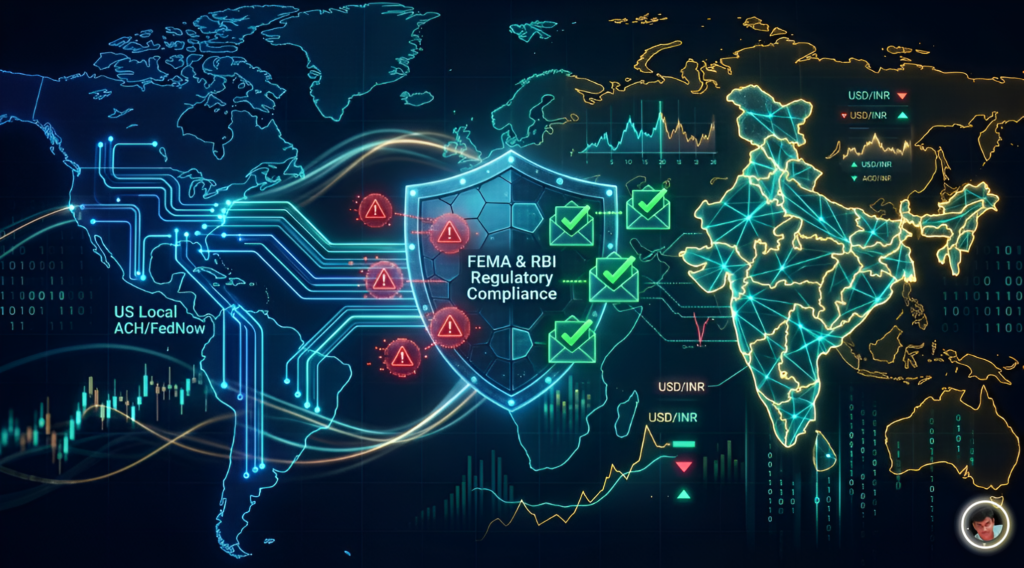
When a US enterprise initiates a cross-border corporate payout to an Indian SaaS vendor, digital agency, or remote engineering firm, structural friction occurs at the destination gateway. For global finance leaders, the sudden appearance of unexpected US-to-India Bank Holds is not just an operational bottleneck—it is an invisible drain on corporate capital, leaving hundreds of thousands of dollars locked in regulatory limbo while domestic receiving nodes remain frozen. This systemic delay is rarely driven by legitimate financial irregularities; instead, it is fueled by a profound compliance asymmetry between Western outbound disbursement architectures and India’s hyper-defensive, automated inbound banking ecosystem.
The core psychological frustration for enterprise treasury teams lies in navigating a black box of opaque compliance workflows where transactions vanish without clear status updates. While US compliance teams routinely misinterpret destination-side frameworks, the catastrophic operational failure stems from legacy core banking systems trying to police a post-2026 automated tax environment. Under current Reserve Bank of India (RBI) mandates, the Foreign Exchange Management Act (FEMA) Liberalised Remittance Scheme (LRS) cap of $250,000 strictly governs outbound personal transactions. Yet, outdated risk-scoring heuristic engines deployed by Indian Authorized Dealer (AD) Category-I banks systematically misapply these thresholds—blindly treating high-volume corporate current account receipts as restricted outflows, throwing false-positive AML flags, and forcing legitimate commercial capital into a multi-week manual audit loop.
This operational nightmare is severely amplified by purpose code misalignment, where routing cross-border software development payouts under generic consulting headers trips compliance wirewires in India’s modern automated tax networks. However, solving these persistent US-to-India Bank Holds does not lie in filling out endless manual declarations or chasing bank managers; it requires completely decentralizing the legacy SWIFT network. By shifting to a programmatic local clearing dispatch framework that leverages encrypted domestic routing rails mapped natively via deep API webhooks, modern treasuries can bypass correspondent delays entirely. This architectural shift guarantees that complex foreign exchange settlements clear as instant local receipts, neutralizing regulatory tripwires before they can ever trigger a destination-side hold.
Technical Context: This routing vulnerability is closely linked to broader geopolitical screening protocols. Enterprise networks processing multi-currency corridors should review our architecture on deploying a 2-Layer API Routing framework to systematically neutralize concurrent OFAC sanctions risk alongside destination-side friction.
2. Legacy Pipeline Breakdown & The SWIFT Leakage Tax
To understand why traditional channels fail, we must deconstruct the operational mechanics of a legacy US-to-India SWIFT wire.
A traditional transfer involves a multi-hop intermediary network:
- The US sender initiates a Fedwire or ACH transfer via their commercial bank.
- The funds route through an intermediary correspondent bank in New York (e.g., JPMorgan Chase, BNY Mellon) using standard MT103 messaging protocols.
- The correspondent bank deducts intermediary lifting fees and applies an unannounced proprietary foreign exchange markup before pushing the remainder across international fiber-optic lines.
- The funds land at the destination Indian AD bank (e.g., HDFC, ICICI, SBI).
At this stage, the destination bank is legally mandated under FEMA and Anti-Money Laundering (AML) / Combating the Financing of Terrorism (CFT) guidelines to halt the transaction. The Indian recipient is locked out of the funds until they manually furnish underlying invoices, Master Service Agreements (MSAs), and complete digital declarations equivalent to Form 15CA and 15CB reporting standards.
Quantifying SWIFT Leakage
For enterprise treasury teams, this legacy pipeline creates invisible capital erosion known as the “SWIFT Leakage Tax”:
- Intermediary Correspondent Fees: Ranging from $15 to $50 per hop, deducted invisibly before the wire hits the destination node.
- Non-Interbank FX Spreads: Hidden markup spreads ranging from 1.5% to 4.5% above the interbank mid-market rate.
- Reconciliation Discrepancies: Because the net amount received in INR never matches the exact gross amount on the US accounts payable (AP) invoice, enterprise ERP systems (such as NetSuite or SAP) throw automated reconciliation errors, forcing manual intervention from accounting personnel.
Treasury Alert :- The financial penalties of legacy routing are not unique to the USD corridor. Inbound Euro pipelines face matching structural erosion, forcing enterprise treasury architects to execute specialized MiCA Euro EMTs strategies to bypass correspondent banking leakage across European transaction flows.
Is Your Bank Silently Skimming Your US-to-India B2B Payouts?
Legacy SWIFT infrastructure thrives on hidden fee deductions and inflated FX spreads. Before executing your next corporate remittance, benchmark your corridor exposure below:
For US Enterprise CFOs
Quantify the exact hidden markup spread your bank is stripping from your Indian vendors’ hard-earned invoices.
For Indian SaaS & Agencies
Deploy this estimator directly to your US clients to demonstrate how manual bank holds delay your corporate liquidity.
🇺🇸 US-to-India Cross-Border Payout Tool 🇮🇳
Compare real-time exchange rates and hidden transfer fees
Treasury Standard: While SWIFT infrastructure bleeds margins via lifting fees, domestic modern networks have shifted to instant clearing. To optimize liquidity before conversion, US entities should benchmark their internal payout velocity against the new FedNow Service Rails to establish baseline domestic dispatch costs.
3. The Regulatory Antidote: Programmatic Local Clearing Dispatch
To eliminate this operational drag, enterprise treasuries must shift away from legacy SWIFT networks toward local automated clearing infrastructure. This architecture maps ACH, FedNow, or SEPA on the US source side directly to domestic NEFT, RTGS, and IMPS clearing nodes in India.
The Legal and Technical Architecture
This model utilizes an authorized cross-border intermediary network (such as Wise Business API integrations) that operates under specialized regulatory licenses (e.g., Electronic Money Institution frameworks globally, paired with FEMA-compliant Authorized Dealer partner banks in India).
Treasury Benchmark: Legacy SWIFT Pipeline vs. Programmatic Local Clearing
| Performance Metric | Legacy SWIFT Network (Traditional Routing) |
Programmatic Local Clearing (Automated ACH/API Nodes) |
|---|---|---|
| Intermediary Lifting Fees | $15 to $50 per transactional hop (Deducted) | $0.00 (Zero Intermediary Leakage) |
| FX Margin Spread | 1.5% to 4.5% opaque markup above mid-market | True Mid-Market Rate (0.0% to 0.5% max spread) |
| Regulatory Hold Risk (FEMA) | Critical Risk (Heuristic triggers & manual audits) | 0% Risk (Pre-cleared via localized domestic rails) |
| e-FIRC / FIRA Generation | 7 to 14 Business Days (Manual banking ledger reconciliation) | Instant (Automated push via real-time API Webhooks) |
| ERP Reconciliation Rate | High Discrepancies (Forced manual adjusting entries) | 0% Failure (Programmatic matching via Invoice Hashes) |
Instead of pushing an international wire across borders, the process works as follows:
- Source Leg: The US enterprise executes a domestic ACH or FedNow transfer to the intermediary’s local US bank account. This transaction clears instantly or same-day with zero international wire fees.
- Consolidated Batch Settlement: The intermediary aggregates cross-border corporate liabilities and executes consolidated bulk foreign exchange settlements through institutional treasury channels at true mid-market rates.
- Destination Leg: The local Indian partner entity of the intermediary disburses funds via domestic clearing rails (NEFT/RTGS) directly into the beneficiary's current account.
Due Diligence: Choosing the underlying rails requires balancing statutory compliance with true mid-market FX rates. Before selecting your primary outbound partner, audit our deep-dive analysis on FinCEN Compliance parameters to benchmark institutional security across the leading cross-border provider networks.
Crucially, because the final payout originates from a domestic Indian bank account utilizing local clearing infrastructure, it satisfies Indian AD bank compliance parameters natively. The transaction appears as a local inbound commercial receipt, bypassing the automated cross-border flags that plague legacy SWIFT wires and guaranteeing zero manual intervention or arbitrary account freezes.
4. Automating Disposal Scheduling and e-FIRC Fiat
Moving to automated local clearing infrastructure programmatically streamlines documentation and reporting.
Under Indian regulatory frameworks, every inbound commercial remittance must be backed by a valid Electronic Foreign Inward Remittance Certificate (e-FIRC) and Foreign Inward Remittance Advice (FIRA) to satisfy Goods and Services Tax (GST) zero-rating requirements and Income Tax audits.
API-Driven Compliance Automation
Modern infrastructure handles this via deep API webhooks:
- Purpose Code Binding: During invoice generation or payment scheduling on the US enterprise platform, the specific RBI Purpose Code (e.g., P0802 for software services) is bound to the transaction payload.
- Automated Document Generation: Upon local clearing settlement in India, the intermediary's compliance engine automatically generates the required digital documentation and links it to the transaction identifier.
- Seamless Tax Compliance: The Indian receiver automatically receives verifiable e-FIRCs and FIRAs within their dashboard, satisfying GST and corporate tax compliance without requiring the US treasury team to manage complex international tax reporting or manual data collection.
5. Technical Summary & Treasury Audit
Enterprise CFOs and treasury architects must recognize that legacy SWIFT rails for recurring B2B payouts are financially inefficient and regulatory liabilities. By transitioning to local automated clearing networks, organizations eliminate hidden FX spreads, eradicate SWIFT leakage, and establish absolute predictability in cash flow timing.
6. Advanced Technical FAQ Section
Q1: How does local clearing impact IRS Form 1099-NEC/MISC reporting for US entities paying Indian contractors?
Answer: Utilizing an authorized cross-border intermediary structure modifies the reporting obligations for US payors. Because the US entity is making a domestic payment to a registered corporate entity or regulated intermediary (which acts as the merchant of record or payment processor for the international leg), standard IRS Form 1099 reporting requirements for foreign-sourced income earned outside the US by non-resident aliens (NRIs) performing services outside the US generally do not apply, provided the appropriate W-8BEN or W-8BEN-E documentation is on file. Treasury teams must still maintain robust audit trails confirming foreign status to satisfy IRS withholding exemptions.
Q2: Why do automated Indian AD bank flags treat recurring B2B SaaS payouts identically to capital account transactions under outdated core banking setups?
Answer: Legacy core banking systems (CBS) deployed by many traditional Indian AD banks utilize rigid heuristic rule engines programmed decades ago when inbound capital flows were heavily restricted. These systems often trigger automated holds on any high-frequency or high-value inbound transaction that does not immediately match simple retail or trade export profiles. They conflate corporate current account service receipts with capital account inflows governed by the LRS or Foreign Direct Investment (FDI) caps, requiring manual compliance intervention until updated to recognize dynamic API-driven purpose code tags.
Q3: Can webhooks fully substitute manual Purpose Code declaration under current RBI guidelines?
Answer: Yes, provided the intermediary operates under an approved arrangement with an Indian AD Category-I bank that supports programmatic data submission. When structured data—including exact invoice hashes, service descriptions, and verified RBI Purpose Codes—is transmitted via secure API webhooks at the time of payment initiation, it populates the electronic regulatory filing automatically. This fulfills the reporting requirements of the Export Data Processing and Monitoring System (EDPMS) without manual intervention by the recipient.
Q4: What happens to the payment flow if a local domestic node (NEFT/RTGS) fails post-clearance?
Answer: If an Indian domestic clearing node rejects a transaction post-clearance (due to dormant account status, KYC mismatches, or incorrect beneficiary IFSC codes), the domestic rail automatically triggers an electronic reversal code back to the local intermediary clearing account. The intermediary's exception-handling workflow flags the payload, notifies the US treasury team via webhook with the precise failure reason code, and holds funds in a secure, segregated safeguarding account pending beneficiary account remediation or amendment.
Audit Security: Mitigating cross-border classification risk requires strict adherence to corporate withholding mandates. Treasury teams must ensure their compliance matrix strictly cross-references the official IRS Form W-8BEN-E Guidelines to legally sustain tax-exempt distributions for non-US operations.
7. Strategic Conclusion: Shifting from Legacy Friction to Programmatic Scale
The cross-border liquidity corridor between the United States and India remains one of the fastest-growing yet structurally choked financial pipelines in modern global trade. For enterprise finance leaders, global CFOs, and high-growth tech founders, continuing to rely on legacy SWIFT architectures is no longer a viable operational strategy. The compounding operational drain—characterized by unpredictable US-to-India Bank Holds, structural LRS/FEMA algorithmic misclassifications, and invisible correspondent banking leakage—acts as a silent tax that actively erodes enterprise capital and forces accounting workflows into a state of persistent manual intervention.
Resolving this multi-billion-dollar friction point does not require filling out more manual bank declarations or scaling internal accounts payable teams. Instead, it requires a fundamental infrastructure shift: decoupling your treasury dispatch from antiquated banking networks and routing funds exclusively through programmatic local clearing pipelines. Shifting to an API-driven, consolidated clearing framework seamlessly bridges the compliance asymmetry between the West and India. By binding precise trade purpose codes (like P0802) directly to automated payment payloads, modern enterprises can natively neutralize destination-side banking tripwires before they can ever freeze incoming corporate receipts.
Ultimately, automation is the only sustainable mechanism to future-proof international corporate distributions under the strict compliance mandates governing the post-2026 financial landscape. By executing a decentralized local injection strategy, treasury architects can guarantee absolute cash flow predictability, automate real-time e-FIRC generation for their vendors, and permanently transform a highly sensitive cross-border friction point into a streamlined, instant, and frictionless clearing event.
7. Professional Legal Disclaimer
Disclaimer: This article is published on servicemoney.in for architectural analysis, operational benchmarking, and regulatory commentary purposes only. It does not constitute formal legal, tax, or treasury advice. Enterprise finance leaders and compliance counsels must evaluate their specific corporate structures, cross-border transaction volumes, and contractual obligations alongside qualified legal advisors before altering their global payout infrastructure.

Anurag Panchal
Founder & Chief Legal Strategist at ServiceMoney.in & AllRoundUpdate.com.
I specialize in Cross-Border B2B Routing & Algorithmic Compliance Defense. My mission is to neutralize arbitrary **US-to-India Bank Holds** and secure cross-border current account inflows under **FEMA, LRS, and RBI master directions**.
Architectural Philosophy: We eliminate legacy SWIFT intermediary leakage and manual regulatory friction by converting volatile international wires into instant domestic clearing events via **Wise Business Engine APIs** and automated purpose code bindings.
Explore our FinTech Compliance Hub for technical blueprints and API workflows today.

