

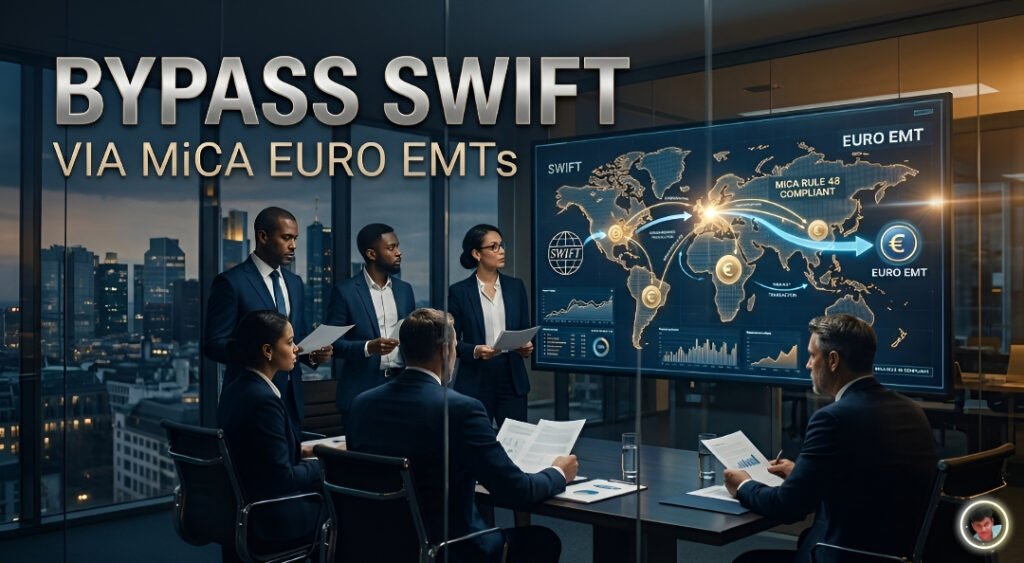
1. THE UNSPOKEN B2B PROBLEM & REGULATORY ENFORCEMENT
Global founders must quickly adapt as European corporate finance teams in France and Germany reject traditional cross-border SWIFT wires and standard offshore stablecoins for B2B invoices. Following the strict implementation of the European Union’s digital asset frameworks, corporate buyers now require fully authorized MiCA Euro EMTs to settle international liabilities legally without facing tax penalties.
Corporate legal teams must audit the regulatory text defining asset classifications under new digital asset laws. Review the official framework directly on the ESMA MiCA Interactive Single Rulebook to confirm the strict operational mandates imposed on electronic money issuers inside the European Union.
For an EU-based corporate client, paying a non-EU vendor using any non-compliant asset triggers immediate violations of European AML (Anti-Money Laundering) directives and strict corporate tax deduction bans. CFOs in Frankfurt and Paris face severe regulatory audits, corporate fines, and direct liability if accounts payable departments disburse funds through unauthorized channels. Consequently, invoices tied to legacy rails face extended compliance holds, while non-regulated token transfers are outright blocked by corporate banking partners.
Enforcement by AMF and BaFin
France’s AMF (Autorité des marchés financiers) and Germany’s BaFin (Bundesanstalt für Finanzdienstleistungsaufsicht) maintain strict oversight on corporate balance sheets handling digital assets. Under MiCA, both regulators aggressively penalize EU enterprises that interact with non-compliant, algorithmic, or offshore-issued stablecoins. Any commercial disbursement made to a non-EU entity via an unauthorized token is flagged as an illicit capital outflow, stripping the French or German payer of corporate tax-deductible expense status and inviting forensic tax audits.
The Reverse Solicitation Risk Trap
Non-EU founders often mistakenly believe they can bypass EU licensing by accepting tokens directly. However, if a non-EU vendor actively markets digital asset invoicing to French or German corporate entities without a MiCA-authorized passported license, it violates anti-touting laws. Under MiCA’s strict interpretation, “Reverse Solicitation” cannot be claimed if the non-EU provider maintains active digital outreach, landing pages, or automated onboarding targeted at EU jurisdictions. This exposes the corporate client to immediate regulatory breach notifications.
2. THE MECHANICS OF THE LEAK
| Features | Legacy SWIFT | Multi-Currency Accounts (Wise / Neobanks) | MiCA-Compliant Euro Stablecoins (EURC / EURCV) |
|---|---|---|---|
| Settlement Speed | 2 to 5 Business Days | 1 to 2 Business Days | Instant (Sub-second execution) |
| Hidden Costs / Slippage | 3% to 5% (Intermediary fees + FX markups) | 0.5% to 1.5% (FX spread + payout fees) | Near-zero network fees (< $0.01 per transaction) |
| MiCA Legal Status in EU | N/A (Fiat rail) | Regulated as Electronic Money Institutions | Fully Authorized & Compliant E-Money Tokens (EMTs) |
| Reconciliation Effort | High (Manual matching of bank statements) | Medium (API exports, CSV mapping) | Automated (Smart contract event logging / ERP sync) |
Before auditing Web3 assets, corporate entities must evaluate traditional remittance channels. Read our deep-dive analysis on Wise vs. PayPal FinCEN Compliance to audit hidden currency markup spreads and legacy tracking restrictions impacting international business accounts.
3. REVENUE IMPACT SIMULATION (FINANCIAL BLOCK)
To quantify the wealth destruction caused by legacy financial rails, consider a mid-sized B2B enterprise processing €500,000 annually in cross-border inbound revenue from France and Germany to a non-EU operating entity over a 3-year horizon (€1,500,000 cumulative volume).
- Legacy SWIFT / Wise Total Projected 3-Year Leakage:
- Intermediary correspondent bank fees and FX markups averaging 3.5%: €52,500
- Weekend holding penalties, lifting fees, and bad-rate execution spreads: €9,000
- Manual accounts receivable reconciliation hours (valued at $50/hr across 120 hours annually): €18,000
- Total Legacy Leakage: €79,500
- MiCA-Compliant Euro Stablecoin Total Projected 3-Year Cost:
- Base blockchain network gas fees (L2 execution infrastructure): €150
- Institutional gateway and custody subscription fees: €3,600
- Instant programmatic liquidation spreads: €1,500
- Total Web3 Infrastructure Cost: €5,250
- Net Mathematical Margin Recovered: By cutting legacy intermediary leakage and adopting fully regulated Euro stablecoin rails, the enterprise achieves a net margin recovery of €74,250 over three years directly to the bottom line.
MiCA Stablecoin Integration Pros & Cons
MiCA Euro Stablecoin Pros
- **Sub-second settlement speed** with immediate liquidity availability.
- **Near-zero network fees** dropping operational transaction costs below $0.01.
- **100% compliant e-money status** approved by France’s AMF and Germany’s BaFin.
- **Zero FX slippage** as invoices are mathematically settled 1:1 in Euro tokens.
- **Automated ERP reconciliation** via direct cryptographic event log mapping.
Implementation Risks & Cons
- Requires initial institutional setup with a licensed gateway instead of simple retail wallets.
- Strict anti-touting laws prevent marketing these options to EU clients without specific license compliance.
- Systemic counterparty de-pegging risks during extreme macroeconomic market volatility.
- Requires custom API integrations to align blockchain tokens with Germany’s strict GoBD accounting rules.
- Initial setup friction for non-EU founders adapting to European digital asset compliance tracking.
4. THE LOGICAL DIAGRAM
[MiCA-Compliant B2B Settlement Architecture]
│
├── Step 1: Non-EU Founder Invoice Issued
│   └── Smart invoice generated with EU VAT and compliant metadata.
│
├── Step 2: Regulated Gateway Routing
│   └── Processed via Circle Mint / Licensed EMT Infrastructure.
│
├── Step 3: Instant EU Client Wallet Settlement
│   └── Sub-second execution from corporate institutional custodian.
│
└── Step 4: Automated Ledger & ERP Reconciliation
    └── GoBD-aligned immutable audit trail synced directly to Xero/NetSuite.
Moving transaction flows away from legacy wires requires understanding licensed smart contract infrastructure. Review the developer ecosystem and minting structures via Circle EURC Stablecoin Documentation to explore how fully reserved e-money tokens manage 1:1 Euro liquidity on public blockchains.
5. THE STEP-BY-STEP COMPLIANCE BLUEPRINT
Executing compliant, cross-border euro stablecoin settlements requires an institutional framework rather than a retail crypto setup. Non-EU founders must establish a structured, audited pipeline.
- Establish a Regulated Gateway Account: Set up an institutional account with a MiCA-authorized issuer or compliant B2B payment gateway (such as Circle Mint or licensed enterprise crypto payment processors) that holds explicit Electronic Money Token (EMT) issuance licenses in the EU.
- Issue Smart Invoices with Compliance Metadata: Generate B2B invoices denominated in compliant Euro stablecoins (e.g., EURC or Société Générale’s EURCV), attaching the corporate entity’s legal identifiers, EU VAT numbers, and explicit settlement wallet addresses.
- Execute Client Wallet-to-Wallet Transfer: The French or German client initiates the payment from their corporate institutional custodian wallet directly to your gateway wallet, ensuring complete cryptographic traceability and instant finality.
- Automated Bookkeeping & GoBD Alignment: To satisfy strict European accounting standards (such as Germany’s GoBD, which mandates immutability and complete audit trails), integrate your gateway API directly with cloud ERPs like NetSuite or Xero. Every transaction logs an immutable timestamp, hash, and fiat-equivalent valuation at the exact second of receipt.
Direct API integration with modern cloud accounting architectures mandates tight defensive data controls. Study our advanced defense blueprint on Rule 88C/88D Ledger Reconciliation to bullet-proof your business enterprise ledger systems against upstream supply chain data friction.
- Controlled Liquidation or Routing: Instantly route the funds to your primary operating currency or hold them in yield-bearing, short-term European sovereign instruments via your licensed institutional account without triggering local capital gains tax flags.
Managing high-volume B2B payouts introduces immediate corporate treasury allocation questions. Examine the systemic growth data via Circle EURC Global Integration Reports to cross-reference multi-billion dollar transaction volumes and approved cross-border banking reserve custody standards.
6 INSTITUTIONAL RISK MANAGEMENT & LIQUIDITY TRAPS
CFOs transitioning to Web3 settlement architectures must mitigate underlying operational vulnerabilities through strict programmatic safeguards.
- De-Pegging & Automated Stop-Loss Mitigation: Even fully collateralized Electronic Money Tokens (EMTs) carry systemic counterparty risks during severe European macroeconomic volatility. Treasury managers must configure automated programmatic liquidation algorithms that instantly convert stablecoin inflows into sovereign fiat cash reserves if secondary market liquidity pools drop beneath strict deviation thresholds.
Protecting treasury liquidity requires managing both cryptographic volatility and local banking operational hazards. Review our strategic framework on Overturning Sec 83 CGST Account Freezes to safeguard corporate CC/OD facilities against aggressive algorithm-led revenue blockages.
- Smart Contract Audits & Third-Party Counterparty Risk: Utilizing third-party payment routers introduces potential smart contract vulnerability vectors. Enterprises must restrict settlement flows exclusively to audited, direct-to-issuer infrastructures (such as Circle Mint or tier-one institutional bank-backed digital assets) to eliminate intermediary custody failure risks.
7. COUNTRY-SPECIFIC TAKEAWAYS
- US LLC Founders: Collect euro-denominated revenue from European enterprise clients without opening a physical brick-and-mortar European branch, completely avoiding foreign corporate tax residency traps while maintaining pristine IRS reporting paper trails.
- Indian Exporters / IT Agencies: Bypass the 3% to 5% FX markup and delayed multi-currency clearing houses. By partnering with RBI-compliant cross-border payment partners that integrate with these gateways, funds can be cleanly converted and settled into local Indian bank accounts with automated FIRC/eBRC generation.
- Australia / UK Founders: Eliminate multi-currency banking bottlenecks, correspondent bank delays, and arbitrary weekend FX holding penalties, ensuring predictable cash flow and instant liquidity on global balance sheets.
Conclusion & Roadmap for 2027–2028
Institutional Web3 rails have officially transcended speculative retail use cases to become the baseline standard for friction-free European corporate trade. By adopting MiCA-compliant Euro stablecoin workflows, non-EU founders can permanently eliminate SWIFT degradation, achieve cryptographic finality, and protect net margins across global operations.
Q1: Can non-EU founders safely accept stablecoin payments from European corporate clients under MiCA?
Yes, but only if the stablecoin used is a fully compliant Electronic Money Token (EMT) authorized within the EU, such as EURC or EURCV. Utilizing unbacked or offshore algorithmic stablecoins for EU B2B transactions violates European AML directives, triggers immediate tax deduction bans for the European payer, and results in payment blocks by institutional banking partners.
Q2: How does this impact Indian and non-EU exporters dealing with French and German clients?
Traditional cross-border wires via SWIFT eat up 3% to 5% in FX markups and intermediary fees, alongside 2 to 5 business days of clearing delays. By shifting to MiCA-compliant Euro stablecoin rails integrated with compliant cross-border gateway partners, Indian and global agencies can achieve instant settlement, eliminate currency leakage, and receive automated, audit-ready documentation (like FIRC/eBRC equivalents) for local tax compliance.
Q3: What is the “Reverse Solicitation” risk that non-EU vendors must avoid?
Reverse solicitation means a client reaches out to a non-EU service provider entirely on their own initiative. Non-EU founders often mistakenly think they can bypass EU licensing by accepting tokens directly. However, if a non-EU vendor actively runs digital marketing, landing pages, or automated onboarding targeted at French or German enterprises without a passported license, it breaches anti-touting laws and exposes their corporate clients to regulatory penalties.
Disclaimer (Mandatory Legal & Financial Disclaimer)
Disclaimer: The information provided in this article is for educational and informational purposes only and does not constitute legal, tax, or financial advice. Regulatory frameworks such as the European Union’s Markets in Crypto-Assets (MiCA) regulation, AMF, and BaFin guidelines are complex and subject to continuous legal updates. Readers, corporate founders, and cross-border exporters should consult with qualified legal counsel, certified chartered accountants (CAs), or licensed financial advisors before altering their corporate treasury, invoicing, or cross-border settlement workflows.

Anurag Panchal
Founder & Chief Editor at ServiceMoney.in & AllRoundUpdate.com.
I specialize in EU MiCA-Compliant Cross-Border B2B Stablecoin Architecture & Regulatory Tax Frameworks. My mission is to help global founders bypass SWIFT friction and execute instant, legal enterprise settlements under strict European guidelines.
Advisory Philosophy: We decode modern Web3 financial corridors by balancing institutional E-Money Token (EMT) standards, automated ERP reconciliation, and multi-jurisdictional compliance to secure maximum bottom-line recovery.
Explore our Compliance & Tech Hub for deep-dive technical breakdowns and financial models.

