

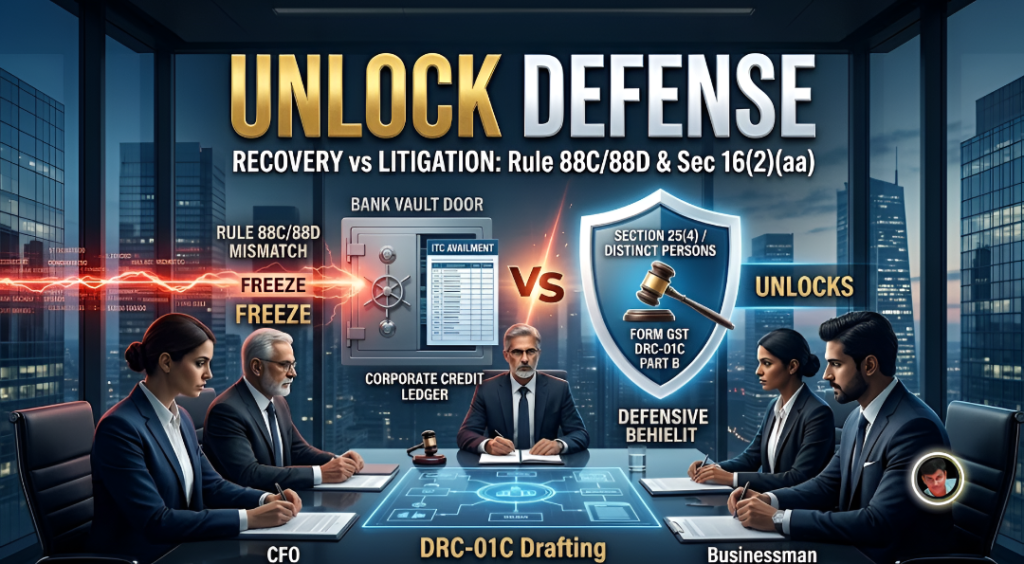
Section 1: The Statutory Rigidity of Section 16(2)(aa) vs. The Inter-State Supply Chain Friction
1.1 The Legislative Shift: From Rule 36(4) Tolerances to Absolute Statutory Alignment
Under the framework of Rule 88C/88D & Sec 16(2)(aa), The statutory architecture governing the availment of Input Tax Credit (ITC) underwent a structural shift with the enforcement of Section 16(2)(aa) of the Central Goods and Services Tax (CGST) Act, 2017, notified with effect from January 1, 2022. Prior to this insertion, the tax administration attempted to restrict unmatched ITC through progressive iterations of Rule 36(4) of the CGST Rules, 2017. These administrative measures introduced capped provisional credit tolerances—initially 20%, subsequently reduced to 10%, and ultimately 5% of the eligible credit reflected in FORM GSTR-2A.
Rule 36(4) Eras (Historical Tolerances)
├── 20% Provisional Buffer (Oct 2019 - Dec 2019)
├── 10% Provisional Buffer (Jan 2020 - Dec 2020)
└── 5% Provisional Buffer (Jan 2021 - Dec 2021)
             │
             ▼
Statutory Override: Section 16(2)(aa) [w.e.f. 01-01-2022]
├── 0% Tolerance / Absolute Matching Mandate
├── Non-Obstante Clause Supremacy
└── Automated Lockstep: GSTR-1 ──► GSTR-2B ──► GSTR-3B
The validity of Rule 36(4) remained perpetually vulnerable to judicial challenge on the grounds of subordinate legislation exceeding the parent statute, as the unamended Section 16(2) contained no statutory mandate requiring real-time reflection of invoices by the supplier as a pre-condition for credit entitlement. To cure this legislative void, Parliament introduced Section 16(2)(aa), establishing an absolute statutory bar:
Section 16(2)(aa): “Notwithstanding anything contained in this section, no registered person shall be entitled to the credit of any input tax in respect of any supply of goods or services or both to him unless—the details of the invoice or debit note referred to in clause (a) has been furnished by the supplier in the statement of outward supplies and such details have been communicated to the recipient of such invoice or debit note in the manner specified under section 37.”
By deploying a non-obstante clause within Section 16(2), the legislature completely dismantled all working capital cushions previously afforded by Rule 36(4). The legal effect of Section 16(2)(aa) read with Section 37(1) and Rule 60(7) is to transform FORM GSTR-2B into a static, mandatory statutory ledger.
Unlike the dynamic FORM GSTR-2A, FORM GSTR-2B locks on the 14th of every month. Consequently, any timing mismatch, clerical discrepancy, or procedural delay by a supplier in executing FORM GSTR-1 automatically strips the recipient of their statutory right to claim ITC in that tax period. The statute no longer tolerates commercial friction; credit eligibility is now contingent on absolute, real-time data alignment within rigid monthly cut-offs.
1.2 The Fiction of “Distinct Persons”: Statutory Mandate vs. Multi-State Operational Realities
The application of Section 16(2)(aa) to internal supply chains creates severe operational friction. Under the scheme of the CGST Act, multi-state corporate entities do not operate as a single taxable unit. By virtue of Section 25(4) read with Section 25(5), establishments of a single legal entity registered in different States or Union Territories are treated as “Distinct Persons”:
| Statutory Provision | Legal Characterization | Operational Impact |
| Section 25(4) | A person who has obtained or is required to obtain more than one registration shall be treated as distinct persons for each such registration. | Internal stock transfers between branches in different states are legally treated as inter-state taxable supplies under Entry 2 of Schedule I. |
| Section 25(5) | An establishment of a person who has obtained registration in a State and another establishment in another State are distinct persons. | Cross-charging, management fee allocations, and physical inventory shifts trigger mandatory IGST invoices under Section 31. |
Because inter-state stock transfers are categorized as taxable supplies under Schedule I, the Head Office (HO) acting as a supplier and the Branch Office (BO) acting as a recipient must execute self-supplies through IGST tax invoices. However, unlike arm’s-length third-party transactions—where financial consideration actually flows—inter-branch transfers represent internal allocations of working capital, raw materials, or finished goods.
When Section 16(2)(aa) is enforced against Distinct Persons, the fiction of separate legal identity forces internal operating units to adhere to the same rigid matching constraints as independent commercial counterparties. The recipient branch cannot claim IGST paid on incoming inventory transfers unless the originating branch has finalized its FORM GSTR-1 within the statutory timeline.
This creates an irreconcilable conflict between corporate supply chain management and statutory tax compliance:
| Supply Chain Execution = Statutory Tax Ledger Synchronization |
While physical goods move fluidly across state borders driven by logistics requirements, tax credit velocity is strictly bound to automated portal cut-offs.
1.3 System-Driven Enforcement: The Mechanics of Rule 88C, Rule 88D, and Rule 59(6)
The enforcement of Section 16(2)(aa) has been fully automated through system-driven portal compliance algorithms, removing human quasi-judicial assessment from initial tax enforcement:
[ GSTR-1 vs. GSTR-3B Mismatch ]
│
▼
[ System Triggers Rule 88C ]
└─► Form GST DRC-01B Issued
│
┌──────────────────────────────┴──────────────────────────────┐
▼                                                             ▼
[ Pay / Explain in 7 Days ]                   [ Non-Compliance / Delay ]
│                                                             │
▼                                                             ▼
[ Case Closed ]                               [ Rule 59(6)(d) Invoked ]
                                               └─► Outward Filing Blocked
                                                              │
                                                              ▼
                                              [ Cascading Rule 88D Mismatch ]
                                               └─► Form GST DRC-01C Issued
                                                              │
                                                              ▼
                                              [ Rule 59(6)(e) Invoked ]
                                               └─► Recipient Branch Blocked
Rule 88C & FORM GST DRC-01B (Output Mismatch Engine)
Inserted via Notification No. 26/2022-Central Tax, Rule 88C establishes an automated monitoring system for variances between the outward tax liability declared in FORM GSTR-1 and the tax paid via FORM GSTR-3B.
Where the portal algorithm detects that the tax liability in FORM GSTR-1 exceeds the amount paid in FORM GSTR-3B by a pre-determined system threshold, Part A of FORM GST DRC-01B is automatically generated and served on the taxpayer. The statute mandates a strict 7-day window within which the taxpayer must either:
- Pay the differential tax liability along with applicable interest under Section 50 via FORM GST DRC-03; or
- File a detailed explanation in Part B of FORM GST DRC-01B justifying the variance.
Rule 88D & FORM GST DRC-01C (Input Credit Mismatch Engine)
Inserted via Notification No. 38/2023-Central Tax, Rule 88D creates an automated mechanism for credit over-availment. The system compares the ITC availed in FORM GSTR-3B against the eligible credit auto-populated in FORM GSTR-2B.
If the ITC claimed exceeds the GSTR-2B limit beyond the configured threshold, Part A of FORM GST DRC-01C is generated. Like Rule 88C, the recipient is bound by an absolute 7-day deadline to either reverse the excess credit or submit a structural reconciliation explaining the variance.
Automated Blocking under Rule 59(6)(d) & Rule 59(6)(e)
The administrative bite of Rules 88C and 88D lies in their link to Rule 59(6) of the CGST Rules. If a taxpayer fails to respond to FORM GST DRC-01B or FORM GST DRC-01C within the mandated 7-day period:
- Rule 59(6)(d) automatically locks the portal, preventing the taxpayer from furnishing details of outward supplies in FORM GSTR-1 or using the Invoice Furnishing Facility (IFF).
- Rule 59(6)(e) enforces a similar complete block for pending DRC-01C proceedings.
This automated architecture operates without manual human review. The system does not issue a traditional Show Cause Notice under Section 73 or Section 74, nor does it afford an oral hearing before executing the digital block.
1.4 The Domino Effect: How Head Office Mismatches Lock Up Multi-State Branch Operations
When an enterprise operates across multiple states as Distinct Persons, the combination of Section 16(2)(aa), Rule 88C, Rule 88D, and Rule 59(6) creates a multi-state cascading operational freeze:
[ Head Office: State A ]                      [ Branch Office: State B ]
 Form GSTR-1 (Outward Transfer)                 Receives Goods & Invoices
        │                                             │
        ▼                                             ▼
 Drafts GSTR-3B (Cash Deficit)                 Claims IGST Credit in GSTR-3B
(Fails to file within 7 Days)                  (Relying on HO Invoices)
        │                                             │
        ▼                                             ▼
 Rule 88C Triggered (DRC-01B Issued)           GSTR-2B Blocked / Unmatched
        │                                             │
        ▼                                             ▼
 Rule 59(6)(d) Locks HO GSTR-1                 Rule 88D Triggered (DRC-01C)
        │                                             │
        ▼                                             ▼
 HO Cannot Bill Third Parties                  Branch Blocked under Rule 59(6)(e)
        │                                             │
        └──────────────────────┬──────────────────────┘
                               │
                               ▼
                 System-Wide Supply Chain Paralysis
Step 1: The Originating Discrepancy at Head Office (State A)
Consider a scenario where the Head Office (HO) in State A issues IGST stock transfer invoices to its Branch Office (BO) in State B totaling ₹10 Crore in a given month. The HO files its FORM GSTR-1 on the 11th, correctly reflecting this ₹10 Crore outward IGST liability.
However, due to a temporary liquidity constraint or an unadjusted cash flow bottleneck, HO delays filing its FORM GSTR-3B for that tax period, or files it by paying only part of the liability.
Step 2: Immediate Execution of Rule 88C at HO
The portal algorithm detects an immediate variance between HO’s FORM GSTR-1 (₹10 Crore liability) and FORM GSTR-3B (₹0 paid).
The system instantly issues FORM GST DRC-01B to HO. If HO cannot clear the ₹10 Crore tax demand within 7 days, Rule 59(6)(d) triggers automatically. The portal locks HO’s account, preventing it from filing subsequent FORM GSTR-1 statements. HO is now digitally barred from generating outward billing for both internal inter-state transfers and external third-party commercial sales.
Step 3: Cascading Inter-State Trigger under Section 16(2)(aa) & Rule 88D at Branch (State B)
Simultaneously, the failure of HO to complete its FORM GSTR-3B or the administrative lock on its GSTR-1 prevents the corresponding IGST credit from populating into BO’s static FORM GSTR-2B in State B for the subsequent cycle.
BO, having physically received the stock and dispatched processed goods to retail customers, claims the ₹10 Crore IGST credit in its FORM GSTR-3B based on the physical tax invoices held under Section 16(2)(a).
The portal algorithm identifies this transaction:
| BO GSTR-3B (Claimed – BO GSTR-2B (Reflected)} = ₹10 Crore Mismatch |
The system automatically issues FORM GST DRC-01C to BO under Rule 88D.
Step 4: Multi-State Enterprise Lockout
Because BO cannot compel HO to clear its underlying cash liquidity issue in State A within 7 days, BO cannot provide a “reconciliation” that satisfies the automated portal parameters for Rule 88D Part B.
Consequently, Rule 59(6)(e) executes against BO in State B.
BO’s portal account is locked, preventing it from issuing FORM GSTR-1 for its own local customers. Within 14 days of an initial working capital delay at a single location, an enterprise’s multi-state supply chain experiences systemic failure:
- No branch can issue outward tax invoices;
- Logistics halt due to an inability to generate E-Way Bills dependent on active outward reporting;
- Working capital turns into locked inventory across all operating divisions.
1.5 Legal Synthesis: Systemic Excesses vs. Constitutional & Statutory Jurisprudence
The enforcement scheme executed through Rules 88C, 88D, and 59(6) raises fundamental constitutional and statutory questions regarding procedural due process and quasi-judicial overreach.
Non-Compliance with Principles of Natural Justice (Audi Alteram Partem)
The automated lockout of a registered entity’s primary business functionality via algorithm-driven portal rules violates the fundamental doctrine of Audi Alteram Partem. The Supreme Court has repeatedly affirmed that any administrative or quasi-judicial action imposing adverse civil consequences must provide a reasonable opportunity to be heard.
Under the Rule 88C/88D framework:
- An algorithmic notification issued with a rigid 7-day compliance window does not constitute a valid quasi-judicial hearing.
- The system applies absolute blocks automatically upon the passage of 168 hours without human intervention, judicial discretion, or evaluation of underlying commercial realities (such as stock transfer valuations between Distinct Persons).
Misuse of Summary Recovery & Provisional Attachment Rules
Field formations routinely use unresolved DRC-01B and DRC-01C automated mismatches as an excuse to initiate recovery proceedings under Section 79, or to execute provisional bank account attachments under Section 83.
Before departmental officers trigger summary garnishee actions against your distinct entities, litigators must establish an immediate statutory barrier under Section 79. If your enterprise is currently facing an aggressive DRC-13 bank attachment, review our battle-tested operational guide on Stopping Rule 88C bank freezes to arrest unilateral recovery procedures before filing your tribunal defenses.
This procedure bypasses the statutory adjudication mechanisms mandated by Parliament under Section 73 or Section 74. Rules 88C and 88D are subordinate procedural rules; they cannot supersede the statutory requirement to issue a formal Show Cause Notice, allow a 30-day response window, and pass an adjudicating order under Section 75.
Automated System Lockouts (Rules 88C/88D)
│
▼
[ Direct Section 79 Bank Freezes ]
(ILLEGAL)
│
▼
Violates Statutory Precedents:
│
┌──────────────────────────────┴──────────────────────────────┐
▼                                                             ▼
Section 73/74 Mandatory Adjudication             *Radha Krishan Industries* Mandate
  (Requires SCN + 30-Day Window)                   (Provisional Attachment Requires
                                                   Objective Material, Not Algorithms)
Rebuttal via M/s Radha Krishan Industries v. State of Himachal Pradesh & Ors (2021) 5 SCC 771
The execution of automated, system-driven provisional attachments or recovery threats following Rule 88C/88D mismatches directly violates the principles established by the Supreme Court in Radha Krishan Industries.
The Supreme Court laid down explicit limits governing extraordinary recovery and attachment powers:
- Draconian Nature of Power: Provisional attachment under Section 83 is a draconian power. It cannot be used as a routine administrative tool to force settlement of unadjudicated mismatches.
- Requirement of Tangible Material: The power to attach bank accounts or assets can only be exercised if the Commissioner forms an opinion based on tangible material showing that the taxpayer is attempting to defeat revenue recovery. An automated algorithm flag generated by portal mismatches does not constitute “tangible material.”
- Application of Mind vs. Algorithmic Automation: The formation of opinion under Section 83 is a quasi-judicial process requiring subjective satisfaction grounded in objective facts. delegating this function to an automated algorithm under Rule 88C/88D, followed by automated garnishee notices under Section 79, violates the statute.
- Preservation of Business Operations: The Supreme Court explicitly held that the exercise of provisional attachment powers must strike a balance between protecting revenue and preserving the taxpayer’s ability to run their business. Shutting down an enterprise’s operations across multiple states by blocking GSTR-1 and freezing operational bank accounts over internal stock transfer mismatches destroys the business, defeating the object of the law.
Jurisdictional Overreach on Distinct Persons
Treating inter-state transfers between Distinct Persons under Section 25(4) as arms-length commercial defaults ignores the economic reality of a single legal entity.
While the GST law creates a statutory fiction of separate taxable persons for compliance purposes, that fiction cannot be stretched to treat internal accounting timing gaps as tax evasion.
Enforcing automated recovery measures against a branch under Rule 88D because its head office experienced a system-driven block under Rule 88C represents an unconstitutional restriction on the right to carry on trade and business guaranteed under Article 19(1)(g) of the Constitution of India. The subordinate rules fail to accommodate the statutory interplay between Section 16(2)(aa) and Section 25, creating a mechanism that penalizes one operating unit for administrative delays at another.
1.6 Statutory Synthesis & Analytical Summary
+------------------------------------------------------------------------------------------------------------------------+
| STATUTORY PROVISION / RULE    | LEGAL MECHANISM                       | OPERATIONAL IMPACT ON DISTINCT PERSONS        |
+------------------------------------------------------------------------------------------------------------------------+
| Section 16(2)(aa)             | Absolute ITC matching mandate via     | Zero tolerance for inter-branch timing        |
|                               | FORM GSTR-2B; overrides Rule 36(4)    | gaps; credit denied to branch if HO           |
|                               | historical buffers.                   | GSTR-1/3B cycle is incomplete.                |
+-------------------------------+---------------------------------------+-----------------------------------------------+
| Section 25(4) & 25(5)         | Statutory fiction of "Distinct        | Internal inventory shifts categorized as      |
|                               | Persons" for multi-state entities.    | taxable supplies under Schedule I; subject    |
|                               |                                       | to full third-party matching rigors.          |
+-------------------------------+---------------------------------------+-----------------------------------------------+
| Rule 88C & FORM DRC-01B       | Automated 7-day notice for GSTR-1 vs  | HO GSTR-1 locked under Rule 59(6)(d) if       |
|                               | GSTR-3B output liability variance.    | unanswered; halts outward billing and         |
|                               |                                       | inter-state stock transfers.                  |
+-------------------------------+---------------------------------------+-----------------------------------------------+
| Rule 88D & FORM DRC-01C       | Automated 7-day notice for GSTR-3B vs | Branch ITC blocked under Rule 59(6)(e);       |
|                               | GSTR-2B credit claim variance.        | creates cascading compliance shutdown         |
|                               |                                       | across recipient units.                       |
+-------------------------------+---------------------------------------+-----------------------------------------------+
| Rule 59(6)(d) & 59(6)(e)      | System-driven digital lockout of      | Denies procedural due process; operates       |
|                               | FORM GSTR-1 / IFF filing.             | without human intervention or oral hearing.   |
+-------------------------------+---------------------------------------+-----------------------------------------------+
| Section 83 / Section 79       | Provisional attachment & garnishee    | Direct violation of *Radha Krishan Industries*|
| (As Applied to 88C/88D)       | recovery actions based on algorithm   | ratio when triggered automatically without    |
|                               | flags.                                | quasi-judicial adjudication under Sec 73/74.  |
+------------------------------------------------------------------------------------------------------------------------+
Section 2: The Operational Paralysis of Rule 59(6) and The Jurisdictional Errors in Invoking Section 83 Provisional Attachments for Inter-Branch Timing Gaps
2.1 The Mechanics of Automated Execution: Rule 59(6) as an Extra-Judicial Enforcement Mechanism
Rule 59(6) of the CGST Rules, 2017 operates as a digital enforcement mechanism that bypasses conventional administrative due process. Under traditional tax administration, restricting a registered entity’s right to conduct business requires a formal administrative order, explicit statutory authorization, and adherence to the principles of natural justice. Rule 59(6) alters this paradigm by embedding execution directly into the portal architecture.
Automated Trigger under Rule 59(6)
│
▼
┌──────────────────────────────┴──────────────────────────────┐
▼                                                             ▼
Rule 59(6)(d): Unresolved DRC-01B             Rule 59(6)(e): Unresolved DRC-01C
(Output Mismatch > 7 Days)                    (Input Mismatch > 7 Days)
│                                                             │
└──────────────────────────────┬──────────────────────────────┘
                               │
                               ▼
Execution of Automated Digital Block
├── GSTR-1 / IFF Access Suspended
├── E-Way Bill Generation Intercepted (Rule 138E)
└── Working Capital Frozen Across Distinct Persons
The statutory mechanics of this blocking engine are triggered automatically upon the expiration of prescribed timelines:
- Rule 59(6)(d): Mandates that a registered person shall not be allowed to furnish details of outward supplies of goods or services or both in FORM GSTR-1 or using the Invoice Furnishing Facility (IFF), if they have not responded to FORM GST DRC-01B (issued under Rule 88C for output liability mismatch) within the statutory 7-day period, either by paying the differential tax or by filing an explanation in Part B.
- Rule 59(6)(e): Enforces an identical digital ban on FORM GSTR-1/IFF if the taxpayer fails to respond to FORM GST DRC-01C (issued under Rule 88D for Input Tax Credit over-availment mismatch) within 7 days.
Field officers often misinterpret automated portal discrepancies as absolute, undisputed tax liabilities to jump straight to recovery. To counter such summary proceedings, tax professionals should leverage official administrative safeguards like CBIC recovery guidelines, which mandate granting taxpayers a fair hearing before invoking direct recovery channels under Section 79.
The operational reality of Rule 59(6) is its self-executing nature. The block is applied by automated portal algorithms without requiring an officer to issue a Show Cause Notice, consider mitigating commercial factors, or execute a formal quasi-judicial order.
When applied to inter-branch transactions between Distinct Persons under Section 25(4), this mechanism creates severe operational disruptions. If the Head Office (HO) is blocked from filing FORM GSTR-1 due to an automated Rule 59(6)(d) trigger, it cannot generate tax invoices or log outward stock transfers on the GST Network.
Consequently, the physical movement of goods between states comes to a halt under Rule 138E of the CGST Rules, which automatically blocks E-Way Bill generation when outward tax declarations are restricted. The statute thus elevates an unadjudicated electronic data variance into an immediate stoppage of enterprise logistics.
2.2 Constructive De Facto Injunctions: Violation of Article 19(1)(g) and Due Process
The automated blocking of FORM GSTR-1 under Rule 59(6) functions as a constructive de facto injunction on trade. By denying a corporate entity the legal ability to issue tax invoices and generate E-Way Bills, the state effectively halts the taxpayer’s business operations.
CONSTITUTIONAL CONFLICT

Subordinate Legislation                                   Fundamental Right
[ Rule 59(6) CGST Rules ]                 vs.           [ Article 19(1)(g) ]
• Automated Algorithm                                     • Right to Practice Profession /
• Zero Human Intervention                                   Carry on Business & Trade
• Instant Operational Injunction                          • Can only be restricted via
                                                            "Reasonable Restrictions" (Art 19(6))
This enforcement model creates fundamental constitutional friction:
1. Abrogation of Procedural Due Process (Audi Alteram Partem)
The doctrine of procedural due process requires that before any administrative body inflicts civil consequences—specifically the suspension of business operations—the affected party must receive:
- A formal notice specifying the grounds of default;
- An opportunity to inspect the adverse material; and
- A meaningful personal hearing before an impartial adjudicator.
Rule 59(6) dispenses with these procedural safeguards. The system applies the electronic block automatically at midnight of the 7th day following the issuance of FORM GST DRC-01B or DRC-01C. The system does not evaluate whether the mismatch stems from an actual tax leakage or a timing difference in inter-branch stock transfers.
The Supreme Court has consistently held that executive instructions or subordinate rules cannot bypass the fundamental requirement of natural justice. In Oryx Fisheries Private Limited v. Union of India (2010) 13 SCC 427, the Apex Court established that any administrative order passed without adhering to audi alteram partem is void ab initio. By delegating the power of business injunction to an automated portal algorithm, Rule 59(6) operates outside these constitutional protections.
2. Unreasonable Restriction under Article 19(6)
While Article 19(6) of the Constitution permits the State to impose reasonable restrictions on the fundamental right to trade guaranteed under Article 19(1)(g), such restrictions must satisfy the test of proportionality. A restriction is disproportionate if the administrative objective could be achieved through less draconian means without crippling the enterprise.
The statutory objective of Rules 88C and 88D is the prevention of revenue leakage and the early detection of tax evasion. However, shutting down an entire multi-state supply chain over an unadjudicated internal stock transfer variance is disproportionate.
The revenue’s interests are secured by statutory recovery provisions (Sections 73, 74, and 79) following proper adjudication. Denying a registered entity the right to invoice its customers and move inventory across state lines converts a preliminary compliance variance into an absolute prohibition on trade, violating the constitutional guarantees of Article 19(1)(g).
2.3 Jurisdictional Overreach: Misapplication of Section 83 to Inter-Branch Timing Differences
As field formations seek to accelerate recovery targets, revenue officers increasingly invoke Section 83 of the CGST Act (Provisional Attachment) against enterprise bank accounts immediately after Rule 88C or 88D system flags are generated. This practice represents a severe jurisdictional error.
JURISDICTIONAL PATHWAY OF SECTION 83

[ Automated System Flag ] ──► Rule 88C / 88D Mismatch
│
▼
[ INVALID SHORTCUT ]
Direct Section 83 Attachment
(Jurisdictional Overreach)
│
▼
[ STATUTORY MANDATE ]
Section 73 or 74
│
▼
Issuance of Formal SCN
│
▼
Adjudication Order
│
▼
Opinion Formation Based on Tangible Material
│
▼
VALID SECTION 83 ATTACHMENT
(Only to Protect Revenue)
The Statutory Architecture of Section 83
Section 83(1) of the CGST Act (as amended by the Finance Act, 2021) provides:
Section 83(1): “Where, after the initiation of any proceeding under Chapter XII, Chapter XIV or Chapter XV, the Commissioner is of the opinion that for the purpose of protecting the interest of the government revenue, it is necessary so to do, he may, by order in writing, attach provisionally any property, including bank account, belonging to the registered person…
The exercise of jurisdiction under Section 83 requires specific statutory prerequisites:
- Pending Proceedings: There must be an active, legally instituted proceeding under Chapter XII (Assessment), Chapter XIV (Inspection, Search, Seizure), or Chapter XV (Demands and Recovery – specifically Sections 73 or 74).
- Opinion Formation: The Commissioner must personally form an opinion based on tangible material evidence.
- Necessity Threshold: The attachment must be strictly necessary to protect revenue, meaning there exists a demonstrable risk that the taxpayer will dissipate assets or abscond.
Automated portal algorithms do not merely trigger Rule 88D system flags; they frequently originate from broader scrutiny algorithms under Section 61. If your multi-state compliance network is inundated with automated scrutiny alerts, leverage our strategic framework for Fixing recurring ASMT-10 notices to permanently immunize your audit trail against algorithmic department traps.
The Error of Treating System Flags as “Proceedings”
Rules 88C and 88D fall under Chapter X (Returns) of the CGST Rules, 2017. An automated alert generated via FORM GST DRC-01B or DRC-01C does not constitute the initiation of statutory proceedings under Chapter XII, XIV, or XV.
Field officers commit a jurisdictional error when they treat an unresolved system mismatch as a summary determination of tax liability, using it to trigger provisional bank attachments under Section 83.
An automated reconciliation gap between Distinct Persons does not equate to tax evasion. Inter-branch transactions (such as the transfer of raw materials or capital assets from a Head Office in Maharashtra to a manufacturing plant in Gujarat) are self-supplies under Schedule I. A delay in matching GSTR-1 with GSTR-2B between these units is an internal accounting alignment issue, not a fraudulent dissipation of assets.
2.4 The Judicial Imperative: Deconstructing Radha Krishan Industries and Judicial Benchmarks
The application of Section 83 to internal timing gaps directly conflicts with the binding ratio decidendi laid down by the Supreme Court in M/s Radha Krishan Industries v. State of Himachal Pradesh & Ors (2021) 5 SCC 771, as well as subsequent High Court rulings.
+------------------------------------------------------------------------------------------------------------------------+
| JUDICIAL BENCHMARK            | LEGAL PRINCIPLE / RATIO DECIDENDI     | APPLICATION TO INTER-BRANCH ATTACHMENTS        |
+------------------------------------------------------------------------------------------------------------------------+
| Radha Krishan Industries      | • Provisional attachment is a           | • Automated portal flags (DRC-01B/C)  |
| (2021) 5 SCC 771              |   "draconian power"                   |   do not constitute "tangible material."       |
|                               | • Requires personal, subjective       | • Internal stock transfer timing gaps   |
|                               |   satisfaction grounded in objective, |   are not evidence of asset dissipation.       |
|                               |   tangible material.                  |                                                |
|                               | • Cannot be used to disrupt running    |                                                |
|                               |   business operations or acts as      |                                                |
|                               |   coercive recovery.                  |                                                |
+-------------------------------+---------------------------------------+-----------------------------------------------+
| Proex Fashion Pvt. Ltd. v.    | • Section 83 cannot be invoked during   | • Rule 88C/88D automated notices are    |
| Delhi High Court (2021)       |   preliminary inquiries before formal |   preliminary compliance alerts, not          |
|                               |   statutory SCN issuance under        |   adjudicated demands under Sec 73/74.         |
|                               |   Section 73/74.                      |                                                |
+-------------------------------+---------------------------------------+-----------------------------------------------+
| Valerius Fabrics v. State     | • The power under Section 83 is not   | • Freezing operational bank accounts    |
| of Gujarat (2019) GLH (3) 14  |   to be exercised routinely; dual     |   over inter-branch credit mismatches          |
|                               |   burden on Revenue to prove tax      |   destroys corporate liquidity without         |
|                               |   demand AND risk of absconding.      |   legal basis.                                 |
+------------------------------------------------------------------------------------------------------------------------+
1. The Doctrine of Subjective Satisfaction Based on Tangible Material
In Radha Krishan Industries, the Supreme Court established clear limits on the exercise of power under Section 83:
“The power to order a provisional attachment of the bank accounts of a taxable person is draconian in nature… The formation of opinion by the Commissioner must be based on tangible material showing that the taxable person is likely to defeat the demand. An opinion formed without tangible material is vulnerable to judicial review.”
An algorithm-driven variance flag produced by the GSTN portal under Rule 88C or 88D does not satisfy the requirement of “tangible material.” The portal measures raw data differences; it does not analyze commercial context, stock movement ledgers, or inter-branch accounting entries.
When a Revenue Commissioner issues an attachment order under Section 83 relying solely on a system-generated DRC-01B or DRC-01C report, they commit a jurisdictional error by substituting an automated computer metric for their personal, statutory duty of subjective satisfaction.
2. Prohibition Against Disrupting Business Operations
The Supreme Court explicitly cautioned against using Section 83 to freeze operational bank accounts in a manner that paralyzes a commercial entity:
“The exercise of the power of provisional attachment must strike a balance between the interest of the revenue and the interest of the taxable person… The power should not be exercised in a manner that renders the business of the taxable person completely unviable.”
Freezing the primary working capital or operational bank accounts of an enterprise due to an unresolved inter-branch stock transfer credit gap under Rule 88D violates this judicial mandate.
When a branch office in State B is stripped of its bank account liquidity because its Head Office in State A has an unadjusted Rule 88C mismatch, the department effectively shuts down the business without passing an adjudication order. This converts Section 83 from a protective statutory tool into an unauthorized method of coercive recovery.
3. Prematurity in the Absence of Formal Adjudication
This principle was reinforced by the High Court of Delhi in Proex Fashion Pvt. Ltd. v. Government of India (2021), where the Court held that provisional attachment cannot be sustained when issued during preliminary inquiries, before a formal determination of tax liability is initiated via a Show Cause Notice under Section 73 or Section 74.
Automated alerts under Rules 88C and 88D are preliminary electronic reconciliation requests. They do not constitute an adjudicated assessment. Initiating Section 83 attachments at the DRC-01B/C stage bypasses statutory due process, rendering such attachment orders ultra vires Section 83 and legally unsustainable.
Statutory authorities cannot invoke draconian provisions like bank freezing without establishing a clear subjective satisfaction based on tangible, independent evidence. When fighting unlawful inter-branch account freezes, senior litigators rely heavily on the binding ratio from the landmark Supreme Court provisional attachment ruling, which establishes that automated algorithm flags alone can never justify summary asset attachments.
2.5 Strategic Legal Remedies and Writs Against Operational Arrest
When a multi-state enterprise encounters operational paralysis due to automated Rule 59(6) portal blocks combined with Section 83 bank attachments, standard administrative remedies often prove inadequate due to the system’s automated nature.
Practitioners must deploy targeted legal remedies before the High Courts under Article 226 of the Constitution of India.
HIGH COURT LITIGATION STRATEGY (ARTICLE 226)
│
▼
┌───────────────────────────────┼───────────────────────────────┐
▼                               ▼                               ▼
      Writ of Certiorari               Writ of Mandamus                   Interim Stay / Injunction
 (To Quash Sec 83 Attachment)     (To Unblock GSTR-1/Rule 59)          (Operational Relief)
• Challenge lack of SCN           • Direct portal access restoration   • Mandate account unfreezing
• Expose reliance on algorithms   • Assert violation of Art 19(1)(g)     against bank guarantee or
• Cite *Radha Krishan* ratio      • Establish procedural overreach       verifiable stock audit
1. Ground for Seeking a Writ of Certiorari (Quashing Section 83 Orders)
Litigators should petition the High Court for a Writ of Certiorari to quash provisional attachment orders executed against bank accounts following Rule 88C/88D alerts, advancing the following legal grounds:
- Absence of Statutory Jurisdiction: Demonstrate that no formal proceeding under Chapter XII, XIV, or XV was pending at the time the attachment order was executed, rendering the order coram non judice.
- Failure of Independent Mind Application: Establish that the Commissioner relied entirely on portal mismatch notifications without examining inter-branch delivery challans, tax invoices, or GSTR-2B reconciliation ledgers, violating the core ratio of Radha Krishan Industries.
- Breach of Natural Justice: Highlight that the bank attachment was executed without serving a prior notice to show cause against attachment or providing an opportunity for a personal hearing.
2. Ground for Seeking a Writ of Mandamus (Unblocking Portal Access under Rule 59(6))
To restore business operations, practitioners should seek a Writ of Mandamus directing the tax administration and the GST Network (GSTN) to unblock FORM GSTR-1 and E-Way Bill generation capabilities:
- Violation of Fundamental Rights: Argue that the automated execution of Rule 59(6)(d)/(e) without human review constitutes an unreasonable restraint on trade under Article 19(1)(g).
- Reconciliation of Distinct Persons: Submit a verified statutory reconciliation demonstrating that the variance flagged under Rule 88C/88D represents an inter-branch transaction between Distinct Persons under Section 25(4), where the underlying tax liability is revenue-neutral to the exchequer across states.
- Proportionality and Operational Survival: Demonstrate that blocking outward invoice generation destroys the corporate entity’s ability to discharge ongoing tax liabilities, creating an irreconcilable statutory paradox where the state demands tax while simultaneously blocking the mechanism to pay it.
3. Requesting Interim Operational Relief
Pending the final hearing of the Writ Petition, litigators should move an application for interim relief requesting:
- Immediate unfreezing of operational bank accounts subject to the enterprise maintaining a minimum specified balance or submitting a corporate guarantee covering the contested variance;
- Direction to the GSTN to manually override the automated Rule 59(6) portal block, enabling the immediate issuance of FORM GSTR-1 and E-Way Bills for third-party commercial transactions; and
- Consolidation of inter-state Rule 88C and Rule 88D notices before a single jurisdictional authority to prevent conflicting administrative actions across multiple states.
2.6 Analytical Synthesis: Statutory Mechanics vs. Legal Defenses
+------------------------------------------------------------------------------------------------------------------------+
| ADMINISTRATIVE STEP / RULE    | SYSTEMIC / STATUTORY ACTION           | EXPOSURE & LEGAL DEFENSE STRATEGY              |
+------------------------------------------------------------------------------------------------------------------------+
| Rule 59(6)(d) / (e) Execution  | Automated digital block on GSTR-1 /   | Challenge under Article 19(1)(g) & Natural     |
|                               | IFF after 7 days of DRC-01B/C.        | Justice; file Writ of Mandamus showing         |
|                               |                                       | inter-branch revenue neutrality.               |
+-------------------------------+---------------------------------------+-----------------------------------------------+
| Rule 138E Interception         | E-Way Bill generation suspended       | Demonstrate collateral damage on physical     |
|                               | automatically following GSTR-1 block. | logistics; seek High Court interim stay to    |
|                               |                                       | prevent factory shutdowns.                    |
+-------------------------------+---------------------------------------+-----------------------------------------------+
| Section 83 Attachment Trigger  | Revenue executes bank account freezes | Challenge as *ultra vires* Section 83; invoke |
|                               | relying on unresolved portal alerts.  | *Radha Krishan Industries* due to lack of     |
|                               |                                       | pending Chapter XV proceedings.               |
+-------------------------------+---------------------------------------+-----------------------------------------------+
| Distinct Person Application    | Portal treats HO-Branch stock shifts  | Re-characterize mismatch via statutory        |
| (Section 25(4))                 | as third-party tax evasion defaults.  | reconciliation under Schedule I; prove absence|
|                               |                                       | of revenue risk across multi-state entities.  |
+-------------------------------+---------------------------------------+-----------------------------------------------+
| Article 226 Judicial Review    | High Court writ jurisdiction against  | Deploy targeted Writs of Certiorari &         |
|                               | extra-judicial portal lockouts.       | Mandamus to dismantle automated enforcement   |
|                               |                                       | and restore trade.                            |
+------------------------------------------------------------------------------------------------------------------------+
Section 3: The Part B Jurisdictional Defense Framework for Form GST DRC-01C — Formulating the Technical Template to Challenge Rule 59(6) Compliance Locks on Cross-Branch Stock Transfers
3.1 The Dual Satisfaction Mandate: Substantive Statutory Rights under Section 16(2)(b) vs. Procedural Matching
The statutory mechanism governing the entitlement to Input Tax Credit (ITC) rests upon the cumulative fulfillment of the conditions precedent enumerated under Section 16(2) of the CGST Act, 2017.
In the operational context of inter-state stock transfers between “Distinct Persons” under Section 25(4), the tax administration routinely conflates the procedural matching framework introduced via Section 16(2)(aa) with the substantive, fundamental entitlement to credit established under Section 16(2)(b).
SECTION 16(2) DUAL SATISFACTION MANDATE
│
▼
┌───────────────────────────────┴───────────────────────────────┐
▼                                                               ▼
  SUBSTANTIVE RIGHT: Section 16(2)(b)                            PROCEDURAL LEDGER: Section 16(2)(aa)
• Actual receipt of goods / services                           • GSTR-1 reflection by supplier
• Corroborated by E-Way Bills & Delivery Challans              • Auto-population into GSTR-2B
• Substantive physical movement complete                       • Subject to automated timing gaps
│                                                               │
└───────────────────────────────┬───────────────────────────────┘
                                │
                                ▼
               INTER-BRANCH STOCK TRANSFER REALITY
• Tax secured via internal ledger entries (Schedule I)
• Substantive compliance complete at Recipient Branch
• Procedural mismatch CANNOT extinguish substantive right
1. The Primacy of Physical Possession under Section 16(2)(b)
Section 16(2)(b) mandates that no registered person shall be entitled to the credit of any input tax unless the taxable person has actually received the goods or services or both. Where a recipient branch in State B takes physical custody of inventory transferred from a Head Office or manufacturing plant in State A under cover of a Tax Invoice issued pursuant to Rule 46 read with Section 31, and supported by validly generated E-Way Bills under Rule 138, the substantive requirement of law stands fully satisfied.
Denying ITC on inter-branch stock transfers purely due to portal timing variances violates fundamental constitutional protections. Before submitting your Part B defense, ensure your legal grounds are anchored in the Principles of natural justice, preventing administrative algorithms from overriding substantive statutory entitlements.
The physical receipt of goods, backed by undeniable logistics records, establishes the consummation of the taxable event under Schedule I. The transaction is documented through:
- Mandatory E-Way Bills reflecting verified RFID toll gate scans;
- Physical Lorry Receipts (LR) / Goods Receipt Notes (GRN);
- Material Inward Registers verified at the destination warehouse; and
- Inter-branch stock transfer accounting entries under Indian Accounting Standard (Ind AS) 2.
2. The Legal Doctrine of Substantive Rights vs. Procedural Requirements
The statutory scheme of Section 16(2) cannot be interpreted in a manner where a purely procedural matching requirement under Section 16(2)(aa) completely extinguishes a substantive statutory right accrued under Section 16(2)(b). It is a settled canon of statutory interpretation, as affirmed in Formica India Record v. Collector of Central Excise (1995) Supp (3) SCC 552, that procedural provisions are handmaidens of justice and cannot be deployed to defeat substantive statutory benefits conferred by Parliament.
Substantive Compliance (Sec 16(2)(b)) + Tax Neutrality (Sec 25(4)) ──► Superior to ──► Procedural Matching (Sec 16(2)(aa))
Where the supplier branch (Head Office) has issued a valid tax invoice under Section 31 and physical possession has passed to the recipient branch under Section 16(2)(b), the entitlement to ITC crystallizes in favor of the recipient unit.
A temporary administrative delay or a timing mismatch in the supplier’s FORM GSTR-1 submission—often caused by internal accounting reconciliation bottlenecks—does not negate the factual reality of the supply. The exchequer cannot rely on an automated data transmission gap to treat a fully documented, physical inter-branch movement of goods as an unadjudicated tax evasion liability.
3. Anti-Automation Jurisprudence: Challenge to Rule 59(6) Lockouts Operating Ultra Vires to the Act
The automated execution of Rule 59(6)(e), which denies a registered entity the right to furnish details of outward supplies in FORM GSTR-1 upon the passage of 7 days from the issuance of FORM GST DRC-01C, constitutes a severe form of extra-judicial administrative overreach.
ANTI-AUTOMATION JURISPRUDENCE

PARENT STATUTE                                         SUBORDINATE RULES
[ CGST Act, 2017 ]                                   [ CGST Rules, 2017 ]
       │                                                      │
       ├── Sec 73/74: Mandatory SCN & Hearing                 ├── Rule 88D: Automated DRC-01C Notice
├── Sec 75(4): Personal Hearing Mandate                ├── Rule 59(6)(e): 7-Day Automated Block
└── Sec 75(12): Summary Recovery Limit                 └── Rule 138E: Automated Logistics Freeze
       │                                                      │
       └───────────────────────────┬──────────────────────────┘
                                   │
                                   ▼
                      DOCTRINE OF ULTRA VIRES
          • Subordinate Rules CANNOT Override Parent Statute
          • Automated System Algorithms CANNOT Bypass Sec 75(4)
1. The Statutory Mandate of Sections 73, 74, and 75(4)
The CGST Act provides a complete statutory code for the determination of tax unpaid, short paid, or input tax credit wrongly availed or utilized. Under Sections 73 and 74, Parliament has mandated that any adverse determination of tax liability must be preceded by:
- The issuance of a formal Show Cause Notice (SCN);
- A statutory 30-day window to submit a written defense; and
- The compulsory granting of an opportunity of personal hearing under Section 75(4), which states:
Section 75(4): “An opportunity of hearing shall be granted where a request is received in writing from the person chargeable with tax or penalty, or where any adverse decision is contemplated against such person.”
Rule 59(6)(e) overrides these statutory guarantees. By permitting an automated portal algorithm to execute a digital lockout of FORM GSTR-1 without issuing a formal SCN under Section 73/74 and without providing an oral hearing under Section 75(4), the subordinate rule operates ultra vires to the parent Act.
2. Misapplication of Section 75(12) and its Proviso
The revenue frequently attempts to justify automated enforcement by relying on Section 75(12) of the CGST Act, which permits self-assessed tax declared in returns to be recovered directly under Section 79 without initiating Section 73/74 proceedings. However, this administrative justification ignores the explicit Proviso to Section 75(12) inserted via the Finance Act, 2021, read with Clarificatory Instruction No. 01/2022-GST dated January 7, 2022:
SECTION 75(12) PROVISO REALITY

Section 75(12) General Rule                   Section 75(12) Proviso (Instruction 01/2022)
Direct recovery of unpaid self-               Recovery CANNOT be initiated automatically for
assessed tax via Section 79.                  GSTR-1 vs 3B variances without providing
                                              an opportunity to explain commercial gaps.
The exchequer itself has clarified that where a variance between GSTR-1 and GSTR-3B arises due to bona fide timing gaps, clerical errors, or inter-branch accounting adjustments, field officers cannot proceed directly to recovery under Section 79.
Revenue officers routinely distort Section 75(12) to execute summary recovery without issuing a mandatory show cause notice. To construct an unassailable legal shield against this administrative overreach, examine our procedural analysis on unilateral DRC-01B recovery defense, which details how CBIC Instruction 01/2022 neutralizes coercive tax demands.
They are legally bound to afford an opportunity of explanation. Automated portal blocks under Rule 59(6) violate the spirit of Instruction No. 01/2022 by executing automated operational freezes before any quasi-judicial evaluation of the taxpayer’s explanation takes place.
3. Violation of the Doctrine of Administrative Discretion
An administrative authority vested with statutory powers must exercise independent judgment. Delegating the power to suspend business functionality to an automated computer script violates the fundamental administrative law doctrine against non-delegation of judicial function (Delegatus non potest delegare). An algorithm cannot evaluate legal defenses, assess commercial revenue neutrality between Distinct Persons, or apply principles of statutory interpretation.
Executing a digital lockout via Rule 59(6) constitutes an unconstitutional abdication of quasi-judicial duty, rendering the automated lockout legally invalid.
3.3 Exhaustive Legal Template: Form GST DRC-01C Part B Response for Distinct Persons
Below is a technical legal draft designed to be filed in Part B of FORM GST DRC-01C on the GST Portal. This template establishes a legal defense for inter-branch stock transfers between Distinct Persons under Section 25(4), creating a paper trail for subsequent Writ proceedings under Article 226 if the system applies an automated Rule 59(6)(e) block.
FORM GST DRC-01C — PART B
REPLY TO INTIMATION OF DIFFERENCE IN INPUT TAX CREDIT (ITC) AVAILED IN FORM GSTR-3B VIS-À-VIS FORM GSTR-2B
To,
The Proper Officer / Assistant Commissioner of Central Tax / State Tax,
[Jurisdictional Range & Division Address],
[GSTIN of Recipient Branch]: [Insert Branch GSTIN]
Reference: System-Generated Intimation Reference No.: [Insert DRC-01C Reference Number] Dated: [Insert Date]
SUBJECT: SUBMISSION OF TECHNICAL & STATUTORY OBJECTIONS UNDER RULE 88D READ WITH SECTION 16(2), SECTION 25(4), AND SECTION 75(4) REGARDING INTER-BRANCH STOCK TRANSFERS BETWEEN DISTINCT PERSONS
Respected Sir/Madam,
The Registered Person, M/s [Insert Corporate Name] (hereinafter referred to as the “Recipient Branch”), holding GSTIN [Insert Branch GSTIN], submits this formal reply in Part B of FORM GST DRC-01C in response to the system-generated intimation issued under Rule 88D of the CGST Rules, 2017.
The differential Input Tax Credit (ITC) of ₹ [Insert Amount] flagged in Part A of FORM GST DRC-01C represents a temporary data variance arising entirely from internal inter-state stock transfers executed between Distinct Persons under Section 25(4) of the CGST Act, 2017. The Recipient Branch submits that there is zero revenue loss to the exchequer, the tax stands fully paid by the legal entity, and the differential credit is backed by substantive compliance under Section 16(2)(b).
1. FACTUAL & STATUTORY CONTEXT: REVENUE NEUTRALITY ACROSS DISTINCT PERSONS
1.1 The Recipient Branch in the State of [Insert Recipient State] is an operational unit of M/s [Insert Corporate Name], which holds its Head Office / Supplier Unit in the State of [Insert Supplier State] under GSTIN [Insert Supplier GSTIN] (hereinafter referred to as the “Supplier Unit”).
1.2 By virtue of Section 25(4) read with Section 25(5) of the CGST Act, 2017, the Supplier Unit and the Recipient Branch are legally categorized as “Distinct Persons”. During the tax period under consideration ([Insert Tax Period]), the Supplier Unit executed internal inventory transfers of raw materials/finished goods to the Recipient Branch under Schedule I (Entry 2) of the CGST Act, 2017, against Tax Invoices issued under Section 31 read with Rule 46.
1.3 The details of the inter-branch supply transactions giving rise to the flagged GSTR-3B vs GSTR-2B differential are summarized below:
+-----------------------------------------------------------------------------------------------------------------------------------+
| Tax Period  | Invoice No. & Date | Supplier GSTIN (State A) | Recipient GSTIN (State B) | IGST Amount (₹) | E-Way Bill No. & Date | Physical Receipt Date (GRN) |
+-----------------------------------------------------------------------------------------------------------------------------------+
| [Month]     | [Inv #]            | [GSTIN A]                | [GSTIN B]                 | [₹ Amount]      | [EWB #]               | [GRN Date]                  |
+-------------+--------------------+--------------------------+---------------------------+-----------------+-----------------------+-----------------------------+
| [Month]     | [Inv #]            | [GSTIN A]                | [GSTIN B]                 | [₹ Amount]      | [EWB #]               | [GRN Date]                  |
+-------------+--------------------+--------------------------+---------------------------+-----------------+-----------------------+-----------------------------+
| TOTAL       |                    |                          |                           | ₹ [Total]       |                       |                             |
+-----------------------------------------------------------------------------------------------------------------------------------+
2. SUBSTANTIVE SATISFACTION OF SECTION 16(2)(b) & PHYSICAL RECEIPT OF GOODS
2.1 The Recipient Branch affirms that all goods transferred under the aforementioned Tax Invoices were physically received, inspected, and brought into the stock ledger of the Recipient Branch in State B. The physical movement of goods is corroborated by:
- Verified E-Way Bills logged under Rule 138 with active RFID toll gate scan logs;
- Goods Receipt Notes (GRN) / Inward Stock Register logs attached herewith as Annexure-A; and
- Transporter Lorry Receipts (LR) attached herewith as Annexure-B.
2.2 The Recipient Branch has fully satisfied the statutory mandate of Section 16(2)(b) of the CGST Act, 2017. The right to claim Input Tax Credit accrued upon the physical receipt of goods accompanied by valid tax paying documents under Section 16(2)(a).
A temporary data transmission delay by the Supplier Unit in filing its FORM GSTR-1, or a portal auto-population delay in FORM GSTR-2B, cannot override the substantive entitlement to credit conferred by Parliament under Section 16(2)(b).
3. ZERO REVENUE JEOPARDY & ABSENCE OF TAX EVASION INTENT
3.1 The underlying transactions represent self-supplies between units of the same legal entity. The Supplier Unit in State A has declared the corresponding IGST output tax liability in its internal books of accounts and has discharged/is discharging the liability through its tax returns.
3.2 Under the scheme of multi-state GST accounting, any IGST paid by the Supplier Unit in State A is fully available as ITC to the Recipient Branch in State B. The transaction is 100% revenue neutral to the exchequer. The tax exchequer is secured, as the funds remain within the single corporate entity’s tax ecosystem.
There is no third-party leakage, no fraudulent invoice generation, and no risk to revenue recovery. The ratio of the Hon’ble Supreme Court in M/s Radha Krishan Industries v. State of Himachal Pradesh (2021) 5 SCC 771 applies with full force: draconian enforcement measures cannot be invoked where there is no objective material establishing an intent to defeat the revenue.
4. LEGAL CHALLENGE TO AUTOMATED BLOCKING UNDER RULE 59(6)(e) & DENIAL OF NATURAL JUSTICE
4.1 The Recipient Branch submits this explanation under protest to protect its statutory rights. If this response is not processed manually by the Proper Officer, the GSTN portal algorithm will automatically execute Rule 59(6)(e) upon the expiration of 7 days, locking the Recipient Branch from filing FORM GSTR-1 and generating E-Way Bills.
4.2 The Recipient Branch submits that blocking FORM GSTR-1 via an automated portal algorithm without human review, without issuing a formal Show Cause Notice under Section 73 or Section 74, and without providing an opportunity of personal hearing under Section 75(4), is ultra vires to the CGST Act, 2017 and violates the fundamental principles of Natural Justice (Audi Alteram Partem).
4.3 The Recipient Branch places reliance on the binding ratio of the Hon’ble Supreme Court in Oryx Fisheries Pvt. Ltd. v. Union of India (2010) 13 SCC 427, which holds that any administrative action entailing adverse civil consequences passed without a meaningful hearing is void ab initio. An automated algorithm cannot execute a constructive injunction on trade guaranteed under Article 19(1)(g) of the Constitution of India.
5. PRAYER & FORMAL DEMANDS
In light of the factual position and legal submissions set forth above, the Recipient Branch formally prays that the Proper Officer be pleased to:
- ACCEPT this explanation filed under Part B of FORM GST DRC-01C as full and final compliance, and drop further proceedings under Rule 88D;
- RECORD that the flagged variance represents a bona fide inter-branch stock transfer between Distinct Persons under Section 25(4) with zero revenue risk;
- ISSUE AN IMMEDIATE INSTRUCTION to the GSTN Portal Helpdesk to ensure that no automated portal lock is executed under Rule 59(6)(e) against the Recipient Branch’s GSTIN [Insert Branch GSTIN]; and
- GRANT AN OPPORTUNITY OF PERSONAL HEARING under Section 75(4) of the CGST Act, 2017, before taking any adverse administrative, coercive recovery, or portal-blocking action against the Recipient Branch.
VERIFICATION
I, [Insert Name of Authorized Signatory], working as [Insert Designation, e.g., Head of Tax / Authorized Signatory] of M/s [Insert Corporate Name], do hereby verify and declare that the contents of this reply are true and correct to the best of my knowledge, legal advice, and official records. Nothing material has been concealed therefrom.
For M/s [Insert Corporate Name] — Recipient Branch
(Authorized Signatory)
Name: [Insert Name]
Designation: [Insert Designation]
Date: [Insert Date]
Place: [Insert Location]
List of Enclosures:
- Annexure-A: Copies of Tax Invoices, Delivery Challans, and GRN Logs;
- Annexure-B: Copies of E-Way Bills with RFID Verification Logs & Lorry Receipts;
- Annexure-C: Inter-Branch Stock Reconciliation Ledger between GSTIN A and GSTIN B;
- Annexure-D: Copy of Clarificatory Instruction No. 01/2022-GST dated January 7, 2022.
3.4 Operational Synthesis & Defense Strategy
+------------------------------------------------------------------------------------------------------------------------+
| DEFENSE LEVER                 | STATUTORY / JUDICIAL ANCHOR           | STRATEGIC FUNCTION IN FORM DRC-01C PART B      |
+------------------------------------------------------------------------------------------------------------------------+
| Substantive Rights Primacy    | Section 16(2)(b) read with Rule 46    | Establishes that physical receipt of goods     |
|                               | & Rule 138 (E-Way Bills).             | overrides procedural matching delays under     |
|                               |                                       | Section 16(2)(aa).                             |
+-------------------------------+---------------------------------------+-----------------------------------------------+
| Revenue Neutrality Defense   | Section 25(4) & Schedule I (Entry 2)  | Proves zero loss to exchequer; inter-branch   |
|                               | Distinct Persons doctrine.            | transfers remain within single entity tax     |
|                               |                                       | ledger.                                       |
+-------------------------------+---------------------------------------+-----------------------------------------------+
| Natural Justice Challenge     | Section 75(4) read with *Oryx         | Constructs legal basis to challenge automated |
|                               | Fisheries* precedent.                 | Rule 59(6)(e) blocks as *ultra vires* due to  |
|                               |                                       | lack of personal hearing.                     |
+-------------------------------+---------------------------------------+-----------------------------------------------+
| Provisional Protection Ratio  | *Radha Krishan Industries* (2021)     | Strikes down pre-adjudication bank            |
|                               | 5 SCC 771.                            | attachments and recovery threats under         |
|                               |                                       | Section 79/83.                                |
+-------------------------------+---------------------------------------+-----------------------------------------------+
| Instruction 01/2022 Shield    | CBIC Clarificatory Instruction        | Barriers field officers from executing        |
|                               | No. 01/2022-GST (Sec 75(12)).         | summary recoveries on bona fide timing        |
|                               |                                       | variances.                                    |
+------------------------------------------------------------------------------------------------------------------------+


