

The Invisible Trap
As an investor, founder, or tax practitioner, you have likely mastered the art of responding to a GST Section 61 Notice (ASMT-10). You receive the notice, gather documents, upload replies, and the case is closed.
Over the past 12 months, while analyzing compliance workflows, I’ve noticed a disturbing trend. Good businesses with clean books are getting trapped in recurring ASMT-10 notices. The frustration I hear from founders isn’t about paying taxes; it’s about explaining the same genuine transaction to a machine, over and over again. We realized the core issue isn’t human error—it’s an architectural flaw in how data is submitted.
Understanding GST ASMT-10 Notices
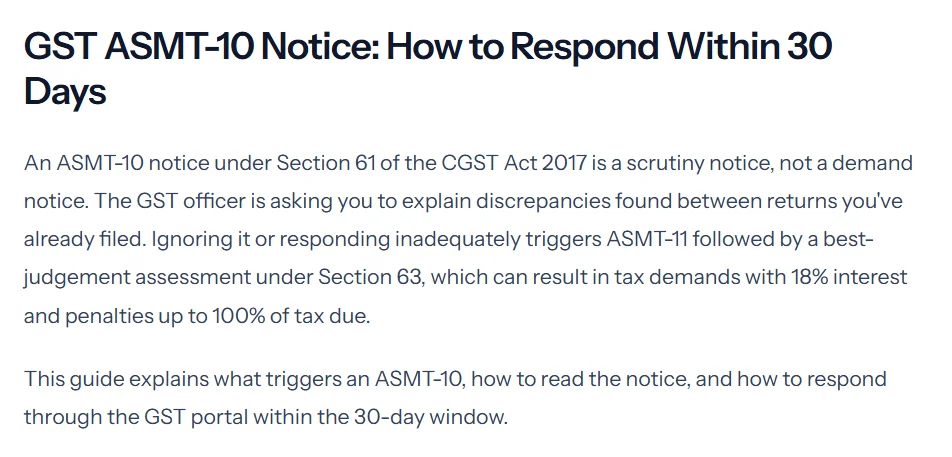
Caption :- A quick guide on the regulatory nature of ASMT-10 scrutiny notices. Source: taxgarden.in
But is it really closed?
We are living in an era of Algorithmic Tax Administration. The GST backend (BIFA – Business Intelligence and Fraud Analytics) is no longer a passive database; it is an AI-driven engine that continuously re-evaluates past returns against current trends. We are witnessing The Digital Evidentiary Void. This occurs when businesses provide factually correct data but fail to provide contextual metadata. Consequently, the AI flags the same transaction again 6–12 months later, leading to a perpetual state of scrutiny.
This blog deconstructs why Submission-Only compliance is failing and how you can build an Immutable Audit Trail to neutralize automated scrutiny permanently.
Part 1: The Problem – Why The AI Algorithm Hates Static Data
I often see businesses treating the GST portal like a digital dustbin—just dumping PDFs and Excel sheets. But the BIFA engine doesn’t read documents; it reads data parameters. The harsh reality I discuss in my consulting sessions is this: If you don’t wrap your transaction in a ‘Compliance Memo’ that justifies the commercial intent, the AI will default to viewing it as an anomaly.
- Context Decay: The system sees a high ITC claim. The AI cannot link the invoice to the business milestone or the specific contract it belongs to.
- Temporal Disconnect: AI checks your GSTR-2B (Current) against GSTR-1 (Historical). If the documentation didn’t stamp the intent at the time of the transaction, the AI flags the discrepancy as a new anomaly.
- The Closed Fallacy: A case marked disposed in the portal only means the human officer accepted your reply at that moment. It does not mean the algorithm has been trained to ignore that transaction in the future.
Global tax authorities are already shifting to automated assessments, and India is catching up fast. To understand the broader shift in AI-driven tax scrutiny, notice how the backend logic is evolving to track real-time revenue patterns, making ‘static compliance’ a thing of the past.
Part 2: 5 Formulas for Immutable Compliance
To move from Submission-Only to Strategic Compliance, you must adopt these proprietary frameworks.
The Context-Transaction Link (CTL)
CTL Calculation
Parameter Details:
- • CTL = Total Computed Limit.
- • I = Initial Value.
- • P = Primary Addition.
- • M = Miscellaneous/Modified Value.
Where:
- I (Invoice): The base document.
- P (Proof of Payment/Receipt): The banking trail.
- M (Metadata/Memo): A structured narrative explaining the commercial exigency of the transaction.
- Application: Never upload a raw invoice without an attached Compliance Memo explaining why this expense is necessary for your revenue generation.
The Contemporaneous Evidence Coefficient (CEC)
CEC Calculation
Parameter Details:
- • CEC = Creation-to-Transaction Ratio.
- • Date of Creation = The date the entry/record was generated.
- • Date of Transaction = The actual date of the business transaction.
- If CEC = 1, the evidence is Contemporaneous (created at the time of the event).
- If CEC > 1, the evidence is Constructed (created during a dispute).
- Strategy: Always maintain a Compliance Dossier for every high-value transaction (> ₹10 Lakhs) at the time of booking. The AI gives a higher trust score to CEC=1 documents.
Global tax authorities are rapidly shifting toward automated backend systems. To see how major economies are adopting AI-driven tax scrutiny policies, notice how international standards are moving beyond manual audits to predictive data modeling.
The GST Variance Sensitivity (GVS)
GVS Calculation
Parameter Details:
- • GVS = GST Variance Score (%).
- • Σ(ITC Input – GSTR-2B) = Sum of differences between book ITC and GSTR-2B data.
- • Total Taxable Turnover = Aggregate taxable value of supplies.
- If GVS > 0.5%, your firm is in the High-Risk AI Bucket. You must proactively explain this variance in your notes before the system flags it.
ITC Usage and Section 50 Interest
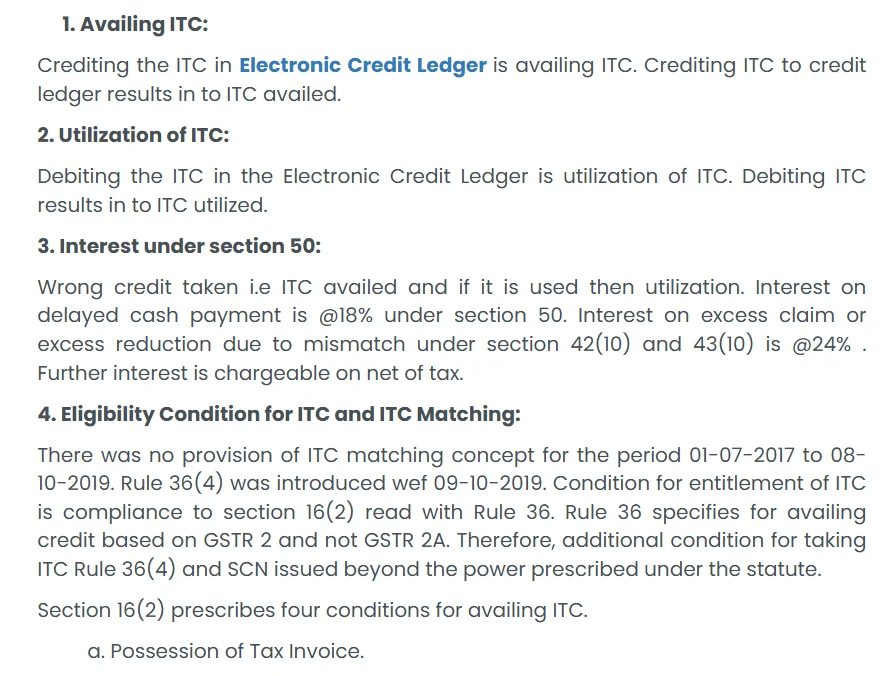
Caption :- Explanation of ITC utilization rules and interest implications under Section 50.Source: taxguru.in
The Rule 37A Compliance Buffer
R37A Calculation
Parameter Details:
- • R37A = Rule 37A Compliance Variance.
- • Input Tax Credit Reclaimed = ITC amount reclaimed by the taxpayer.
- • Tax Paid by Supplier = The actual tax amount paid by the respective supplier.
- Law requires reversal if the supplier hasn’t paid. The formula identifies the Reclaim Window. Ensure your software flags this before it hits the 3B filing date to avoid the AI’s Non-Compliance Trigger.
GST Rule 37A Explained

Caption :- Legal requirements for reversing ITC if the supplier fails to pay tax. Source: CBIC GST Portal
The ROI-to-Tax Efficiency Ratio (RTER)
RTER Calculation
Parameter Details:
- • RTER = Return-to-Tax Efficiency Ratio.
- • Net Profit After Tax = The final profit earned after accounting for all taxes.
- • Total GST Paid = The cumulative GST liability paid during the period.
- Anomalous drops in this ratio trigger AI alerts for Under-reporting of sales. Always have a Trend Justification memo ready when this ratio fluctuates beyond 15%.
              |
              |
      ________v________
     |                 |          ________v________
     | LAYER 1: INPUTS |         |                 |
     | [ERP/Tally]     | <-(M)-> | LAYER 2: PRE-   |
     | [Invoices/Ledg] |         | FILING GATE     |
     |_________________|         | [GVS Check]     |
              |                  |_________________|
              |___________________________|
                                    |
                             _______v_______
                            |               |
                            | LAYER 3: THE  |
                            | AI INTERFACE  |
                            | [BIFA: Engine]|
                            |_______________|
                                    |
              ______________________|______________________
             |                      |                      |
      _______v_______        _______v_______        _______v_______
     | THE VOID      |      | THE ARCHI-    |      | THE WHITE-    |
     | (Failed)      |      | TECTURE       |      | LIST (Logic)  |
     | Static Uploads|      | (CTL + CEC)   |      |               |
     |_______________|      |_______________|      |_______________|
While our CTL formula secures your current filings, don’t forget the foundation. Most AI-generated notices are actually triggered by Section 16(2) failures. Before the algorithm scrutinizes your returns, ensure your supply chain is sanitized; otherwise, even perfect formulas won’t save you from a reversal notice.
Part 3: Representative Scenario – The Perpetual Notice Loop
The Scenario: A fast-growing E-commerce startup (Founder-led) was receiving recurring ASMT-10 notices for Mismatch in ITC vs. Revenue for 3 consecutive years.
The Old Approach: They replied by uploading the same invoice every time a notice arrived.
The Void Problem: The AI re-triggered the notice because the company didn’t explain their Aggressive Customer Acquisition model, which involved heavy marketing spends (high GST outflows) with deferred revenue (low GST inflows).
The Strategic Solution: We applied the CTL and RTER formulas. They provided a Business Context Memo (CTL) that explained why marketing expenses were essential to their revenue model. They also mapped their RTER ratio to show that their tax payments were consistent with industry benchmarks for Growth-Stage companies.
The Result: The notice chain was broken. The AI logic now recognizes those expenses as Strategic Operational Expenditure rather than Tax Evasion Risks.
ITC Mismatch Scenarios in GST
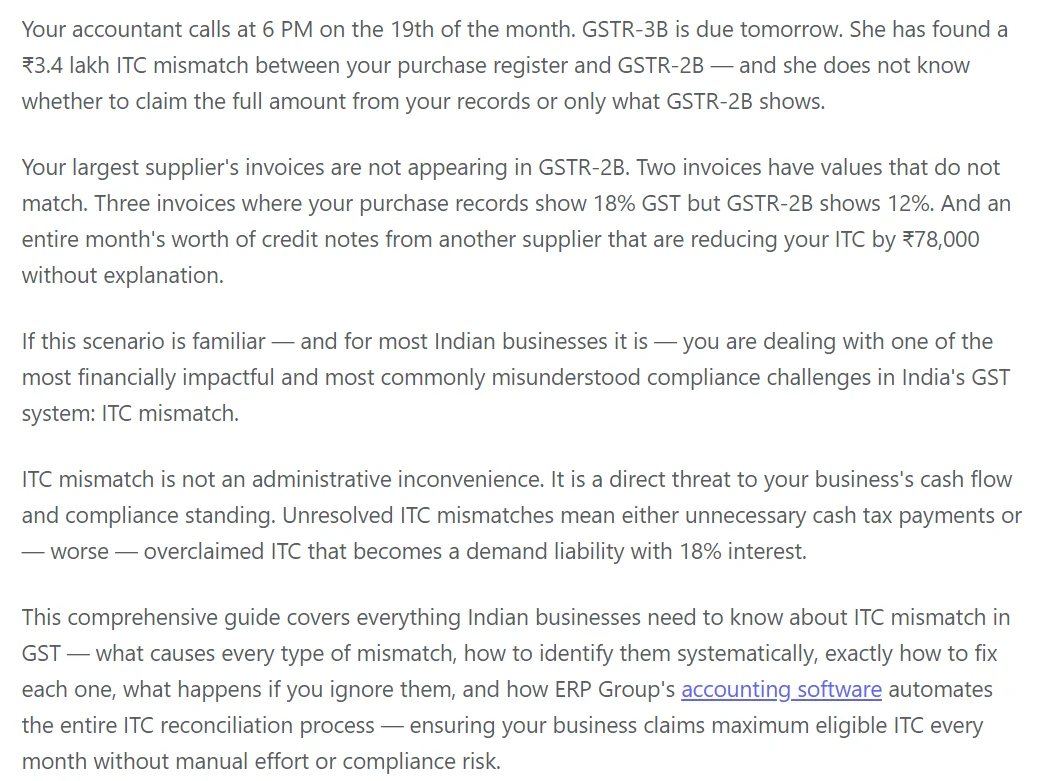
Caption :- Real-world example of common ITC reconciliation challenges for businesses. Source: erpgroup.in
Based on common scrutiny patterns observed in high-growth startups during FY 2025-26.
During a recent workflow optimization session with an E-commerce founder, the core friction point was obvious. They had massive marketing spends (high GST outflows) mapped against deferred revenue. To the human eye, it’s aggressive customer acquisition. To the AI, it’s an ITC mismatch. Instead of just re-uploading invoices, we changed their submission architecture. We attached a ‘Customer Acquisition Cost (CAC) vs. LTV’ rationale. By translating their business model into data the portal could contextualize, the recurring notice loop stopped.
Calculation Breakout for the E-commerce Startup:
- Total Revenue: ₹10 Cr.
- Marketing Spend: ₹2 Cr (GST @ 18% = ₹36 Lakhs).
- AI Logic (Pre-Optimization): The system saw a high ITC claim (₹36 Lakhs) but low tax liability (due to growth-stage losses). The AI triggered a Flag at GVS = 3.6\%.
- After applying CTL/RTER: We demonstrated the RTER (Ratio) was industry-standard for a Series-B funded startup. We attached the Customer Acquisition Cost (CAC) vs. Lifetime Value (LTV) report as Metadata.
- Result: The AI’s logic flow was bypassed by the human officer, who accepted the report as Business Justification, effectively neutralizing the AI’s automated Notice-Trigger mechanism.
The game has changed with the new invoice management system. If you aren’t tracking your IMS compliance status proactively, you’re just waiting for a demand notice to land. Use this to bridge the gap between your purchase register and the portal’s dynamic data.
| Scrutiny Trigger (AI Alert) | Primary Root Cause (The ‘Why’) | Proactive Mitigation Action (The ‘How’) |
| ITC-to-Turnover Mismatch | Aggressive growth/deferred revenue | Attach ‘Industry Benchmark’ memo + RTER justification. |
| High RCM/Unregistered ITC | Supply chain fragmentation | Maintain ‘Supplier Compliance Scorecard’ with R37A checks. |
| Inconsistent Business Nature | Misaligned HSN classification | Tag transactions with CTL (Context-Transaction Link) in ERP. |
| Input Tax Credit Discrepancy | Temporary supplier default | Log ‘Contemporaneous Evidence’ to prove bona-fide transaction. |
Part 4: My Tally Workflow as an S.O.P (Standard Operating Procedure)
Strategic Implementation for Law Firms and CFOs
If you are a Chartered Accountant or a legal advisor, you should no longer treat ASMT-10 as a firefighting task. You must transition your clients to Compliance-by-Design. Here is how to institutionalize the Digital Evidentiary approach:
| Document Type | Data Point to Capture | Retention Logic (Legal Backup) |
| Commercial Intent Memo | Business purpose of expense | Section 61(1) ‘Related Particulars’ compliance. |
| Payment Trail (Digital) | UTR/NEFT Reference ID | Proves Section 16(2) compliance (Payment to supplier). |
| Contemporaneous Log | Date-stamped internal approval | Defeats ‘Fabricated Evidence’ claim by AI/Officer. |
| Vendor Compliance Report | GSTR-2B filing status of vendor | Satisfies Rule 37A & Section 16(4) provisions. |
- The Pre-Filing Diagnostic (PFD): Before submitting GSTR-3B, run your data through the GVS Formula (GVS > 0.5\%). If the variance is triggered, generate a Voluntary Disclosure Memo before the department sends a notice. This shifts the AI’s classification from Tax Evasion Risk to Transparent Taxpayer.
- The Metadata Ledger Implementation: In Tally Prime or your ERP, create a custom field under the ‘Narration’ or ‘Remarks’ section for every journal entry exceeding ₹5 Lakhs. Use this field to store the CTL (Context-Transaction Link). This ensures that when the AI audits the ledger, it reads the Business Purpose directly from your books.
- The Scrutiny Readiness Scorecard: Assign a score to every client based on their historical notice frequency.
- High Risk: 0–3 months of Void data.
- Safe: >12 months of CTL-tagged data.
- Action: Move High-Risk clients to a quarterly Audit Trail Review session.
- If your business model is focused on hyper-growth, you must understand how deferred revenue recognition impacts your tax profile. Aligning your internal books with industry-standard accounting practices is the only way to ensure your GVS score remains within the ‘safe’ zone.
I don’t just recommend this theoretically. In building out robust financial architectures, I strictly enforce a ‘Meta-Ledger’ rule in Tally Prime. For any expense over ₹5 Lakhs, the Narration field isn’t just for bank transaction IDs anymore. It must contain a one-line commercial justification. It adds 30 seconds to the data entry process, but saves weeks of legal drafting when the AI algorithm comes knocking.
Stop believing that a system-validated return is an audit-proof return. Many firms fall into the Deemed Acceptance Fallacy, assuming the department has nothing to question. Real compliance begins when you stop trusting the automated green tick and start verifying the underlying statutory evidence.
Part 5: The Legal Foundation (The ‘Why’ Behind the Logic)
Aligning with Section 61 & The Evidence Act
It is crucial to justify this approach under the existing legal framework:
- Section 61(1) of the CGST Act: The law states, The proper officer may scrutinize the return and related particulars furnished by the registered person. Note the word particulars. By providing contextual memos (CTL), you are legally fulfilling the requirement to provide related particulars that the AI currently lacks.
Section 61 of CGST Act Scrutiny

Caption :- Statutory provision for the scrutiny of GST returns by the proper officer. Source CBIC GST Portal
- Section 165 of the Indian Evidence Act: Section 61(1) aur Section 73/74 Our framework aligns with the ‘Principles of Natural Justice,’ ensuring that the taxpayer provides ‘related particulars’ to proactively satisfy the Officer’s mandate under Section 61(1).
Calcutta High Court GST Judgment
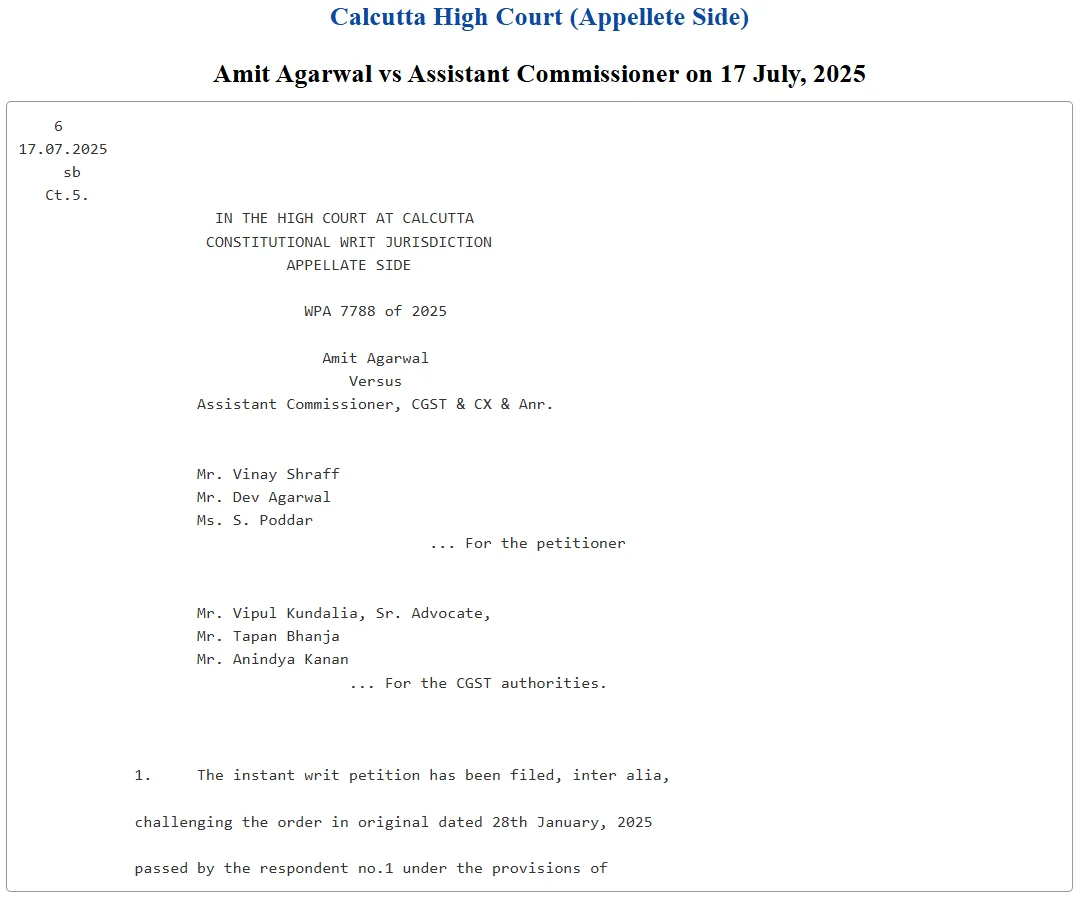
Caption :- Extract from Calcutta High Court order concerning GST notice disputes. Source: Calcutta High Court
Conclusion
Submission-Only compliance is the primary reason why growing businesses stay under the shadow of the GST Department. To build a robust brand and ensure business continuity, you must transition to Evidentiary Compliance. By documenting the intent behind every tax move, you are not just responding to a notice; you are building an audit-proof wall around your company’s financial health.
🛡️ Tired of Audit Notices?
Stop working in “Functional Silos.” Use my Immutable Compliance Toolkit to harmonize your Tally/ERP data and build an audit-proof trail before the next notice triggers.
- ✅ Stop “Notice Loops”: Use CTL & CEC formulas to explain business intent *before* the AI flags you.
- ✅ Outsmart the BIFA Algorithm: Master the RTER Justification to neutralize automated tax alerts.
- ✅ Audit-Defense Checklist: Get the exact framework I use to institutionalize “Compliance-by-Design.”
GET MY AUDIT-PROOF TOOLKIT (FREE)
🚀 Join 100+ Founders & CAs using this framework. No sign-up required.
GST Offense Penalty Structure
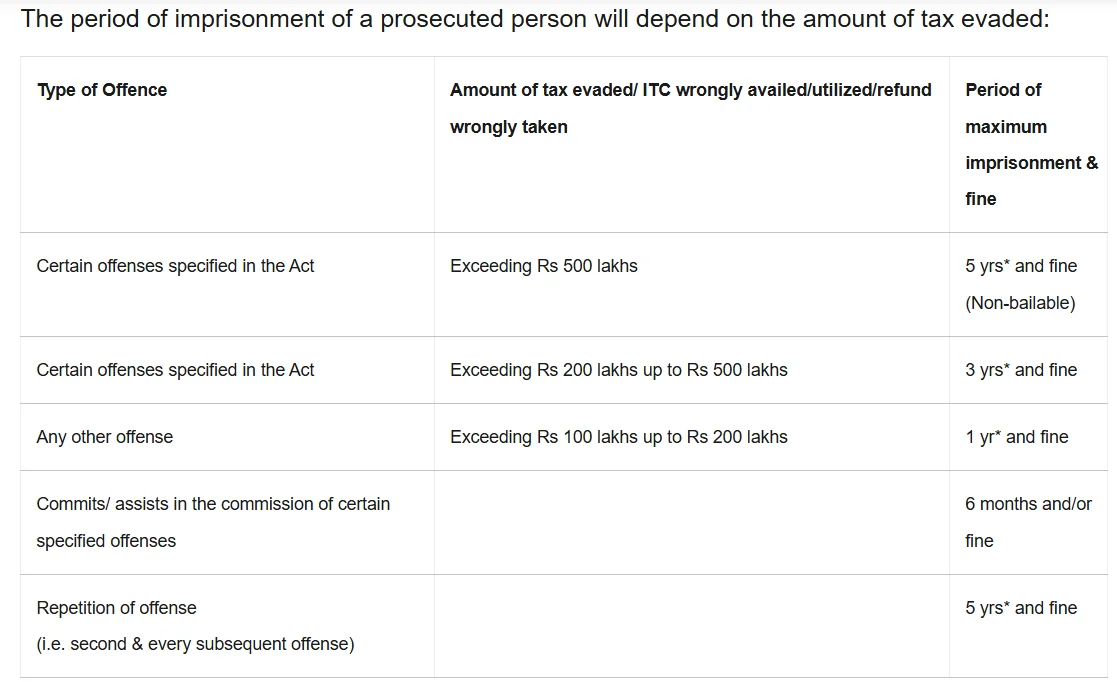
Caption :- Table detailing the imprisonment and fine structure for various GST offenses. Source: avalara.com
FAQ
Q1: Does this require additional software?
No. It requires a change in Data Governance. Use your existing ERP (Tally Prime/SAP) to tag transactions with a Compliance Memo field.
Q2: Can the Tax Officer reject my Contextual Memo?
Under Section 61, the officer is empowered to scrutinize returns and must consider the explanations furnished. By providing a structured CTL Memo, you move from “mere submission” to “Statutory Documentation.” An officer can challenge your business logic, but they cannot ignore documented commercial intent, effectively shifting the burden of proof back to a reasoned investigation.
Q3: How does this prevent future AI scrutiny?
When you provide structured data, the human officer adds a Reasoning Note into the system. This note acts as a whitelist for the AI, preventing future triggers for the same transaction.
Disclaimer
This blog is for educational purposes only and reflects professional analysis of GST administration. It does not constitute formal legal advice. Tax laws are subject to frequent notifications; please consult your tax counsel before implementing significant changes in your compliance framework.

Anurag Panchal
Founder & Chief Editor of ServiceMoney.in & AllRoundUpdate.com.
I specialize in Immutable Compliance Architecture. My mission is to bridge the gap between raw data and government portals using Logic-Gate Engines (CTL + CEC). I empower businesses to transform traditional filing into Automated Fiscal Fortresses.
The Core Engine: We don’t just file; we engineer compliance that makes ASMT-10 notices obsolete through predictive triangulation.
Follow my Compliance Hub to deploy these high-integrity frameworks in your own business operations.


