

The Indian tax landscape has shifted from ‘Officer-Led Scrutiny‘ to ‘Algorithm-Led Enforcement’, making Section 61 GST Compliance the ultimate 2026 battleground. For CFOs and MDs, the real threat isn’t a human auditor—it’s the GSTN’s ‘Ghost Liability’ algorithm. Discover how to neutralize these automated ASMT-10 triggers before they escalate into Section 74 penalties.
Note :- I remember back in 2024, I spent two sleepless nights resolving an ASMT-10 for a client because their system flagged a ₹12 Lakh mismatch that was purely a bank-sync error. Looking at the screen, I realized—this wasn’t a tax officer; it was a cold, unfeeling algorithm misinterpreting a standard business transaction.
This is the ‘Automated Audit’ Trap. If you are a high-value entity, you are being watched not by eyes, but by code.
1. What is the Automated Audit Trap? (The ‘Ghost’ Phenomenon)
The Automated Audit Trap occurs when the GSTN’s risk-profiling engine, acting under Section 61, identifies a ‘statistical anomaly’ between your filings (GSTR-1, 2B, 3B, E-invoices).
The Core Problem: The system does not understand Business Reality. It only understands Data Alignment.
ASMT-10 Trigger Scenarios
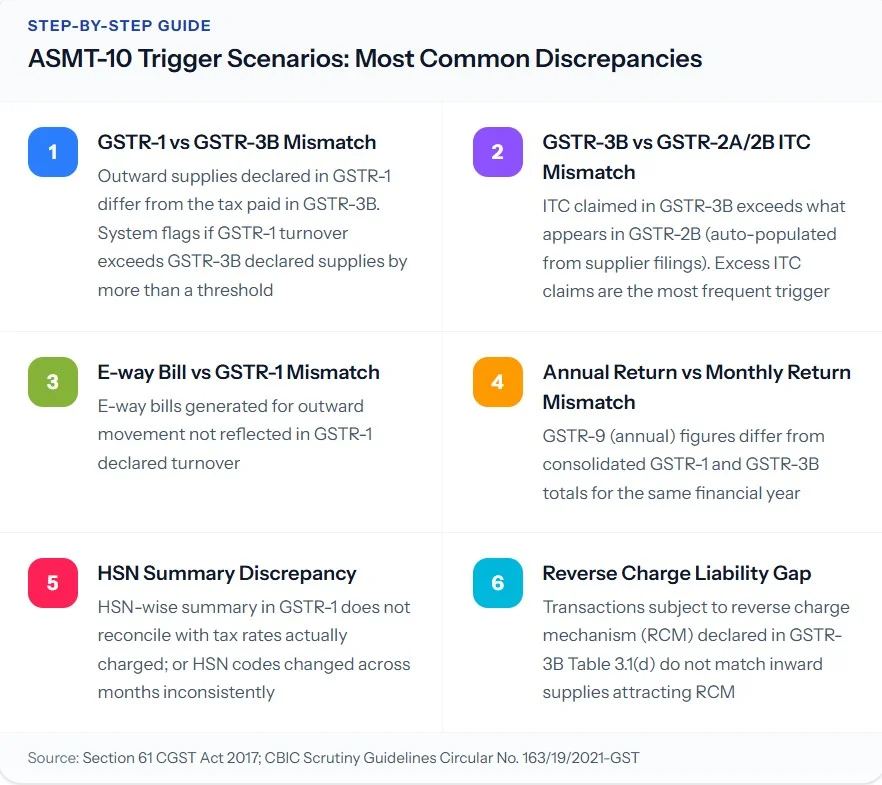
Caption: Common discrepancies that trigger automated GST scrutiny notices. Source Section 61 CGST Act; CBIC Guidelines.
- The Trap: When the system identifies a discrepancy, it auto-generates an ASMT-10. Because the system is programmed for ‘Efficiency,’ it often classifies these mismatches as ‘Suppression of Facts’ (the gateway to Section 74), even if the error is a clerical mistake. This creates a ‘Ghost Liability’—a tax demand on your dashboard that doesn’t exist in actual commerce but exists in the virtual ledger.
The algorithm follows specific logic gates to flag taxpayers. To understand the risk parameters the engine uses for these triggers, refer to the official CBIC portal guidelines to see how your returns are assessed.
Reasons for GST Notices
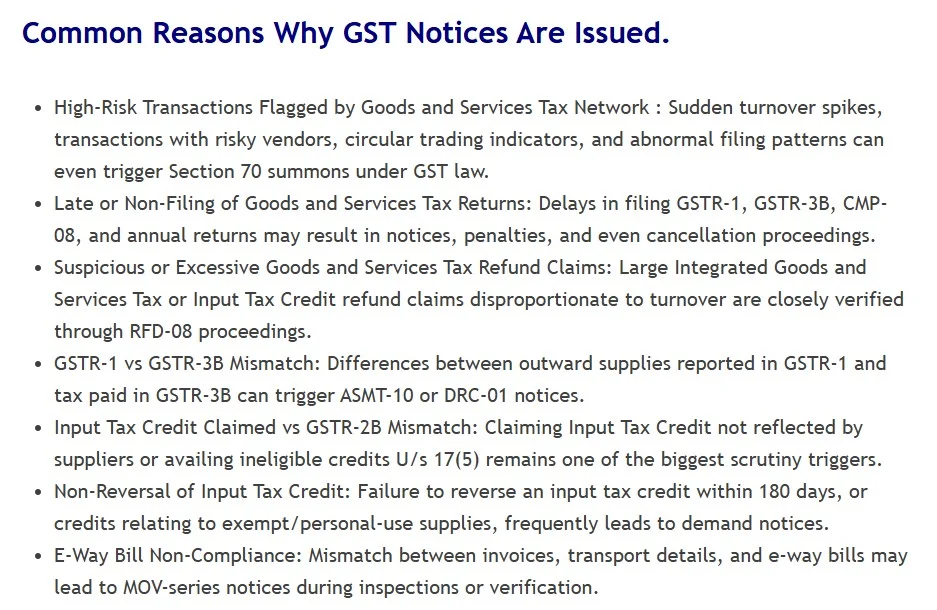
Caption: Essential checklist of compliance failures leading to formal GST demand notices. Source GST Portal Guidelines.
The Ground Reality :- When you talk to field officers, they often admit they don’t even know why the system triggered a specific notice. They are just following the ‘Automated Flag’ protocol. This shift has turned us tax professionals from ‘Consultants’ into ‘Data Interpreters’ for a machine we cannot argue with.
2. Why Your Current Compliance Strategy is Failing (The ‘Data-Blind’ Gap)
Most firms are failing because they rely on ‘Post-Filing Reconciliation.’ Smart audience, realize this: by the time you reconcile your data after filing, the AI has already generated the flag.
GST Risk Management Framework
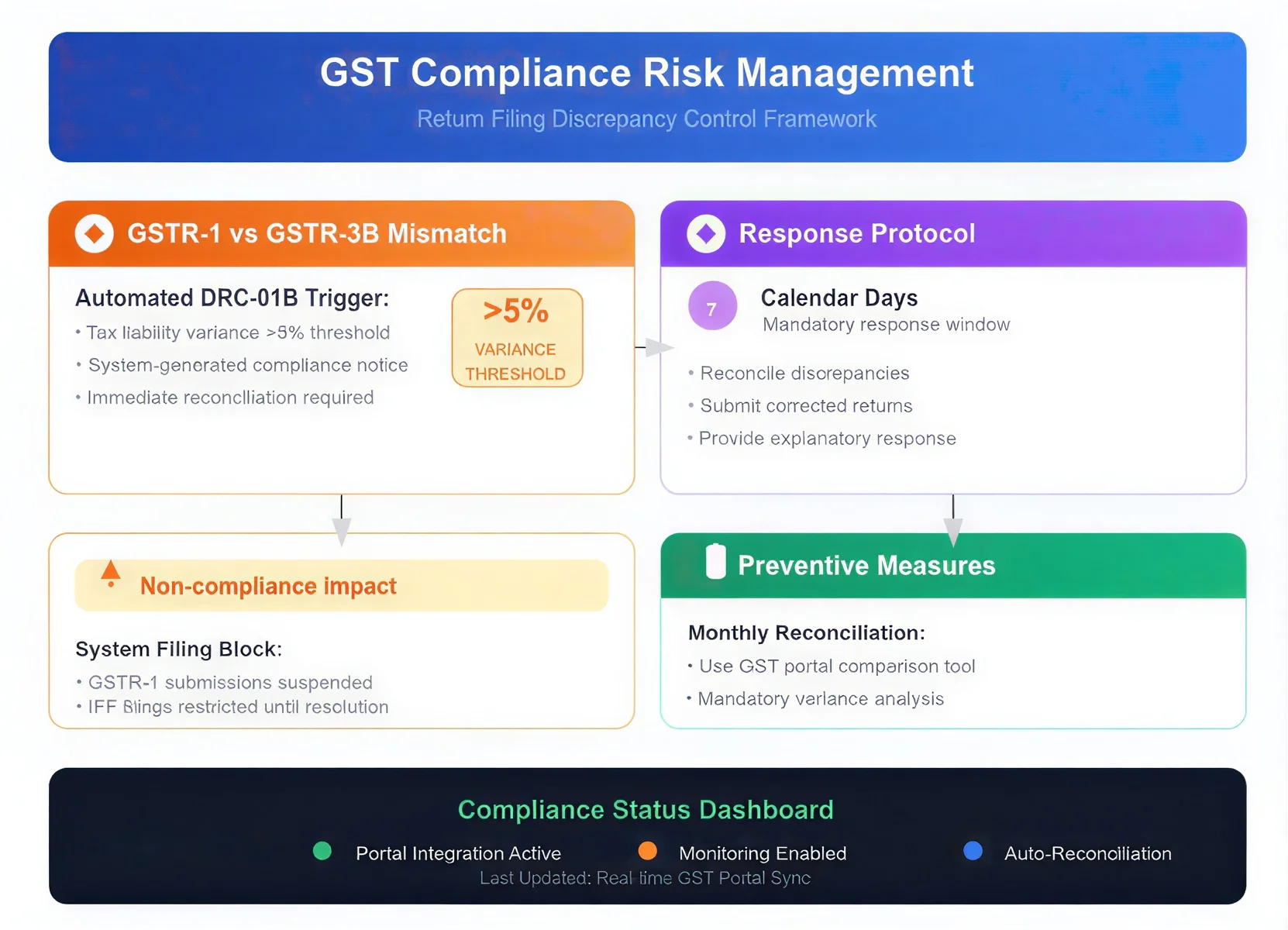
Caption: Systematic approach to managing return filing discrepancies and preventive measures. Source GST Portal Sync.
The 4 Pillars of Failure:
- The E-Invoice-to-3B Latency: The system flags any invoice dated in Month X but reported in Month X+1 as a ‘deemed revenue leakage’ if not accompanied by a digital trail.
- Credit Note Mismatch: If a Credit Note is issued against a transaction reported in a previous financial year, the system flags it as ‘unauthorized reversal’ under Section 74.
- The RCM Phantom: The system treats all import services as ‘liable for RCM’ by default. If your ledger doesn’t explicitly mark these as ‘Non-Taxable/Exempt’ via a specific HSN-code mapping, the AI flags it as ‘Tax Evasion.’
- Vendor Risk Contagion: Under the new IMS (Invoice Management System), if your supplier has a ‘high volatility’ status, your valid ITC is flagged as ‘Risk-ITC’ by the algorithm before you even claim it.
3. The ‘Architectural Defense’ (Original Technical Formulas)
To beat the algorithm, you must speak its language. Use these 4 proprietary frameworks:
Formula A: The ‘Transaction-Time’ Integrity Ratio
Time-to-Report (TTR) Ratio
Parameter Details:
- • TTR = Time-to-Report Ratio.
- • Invoice Date = The date recorded on the invoice.
- • Reporting Date = The date when the transaction was reported.
- Application: If your TTR is consistently >1, you are a ‘High-Risk Profile.’ Strategy: Automate your ERP to block any invoice generation if the reporting window exceeds 24 hours.
Formula B: The ‘Ghost-Liability’ Buffer Check
ITC Buffer Variance (G_Buff)
Parameter Details:
- • GBuff = ITC Buffer Variance.
- • ∑(ITC2B) = Total ITC available in GSTR-2B.
- • ∑(ITCClaimed) = Total ITC actually claimed in GSTR-3B.
- • Annual Turnover = Total annual business turnover.
- Application: Keep your ITC variance within 0.5%. If the variance is higher, attach a ‘Reconciliation Annexure’ (Form ASMT-11) before receiving a notice.
Formula C: The ‘HSN-Tax-Matrix’ Validation
Tax Matrix Reconciliation
Parameter Details:
- • MatrixTax = Tax Reconciliation Variance.
- • Sales = Gross sales value for specific HSN codes.
- • HSN_Rate = Applicable GST tax rate for the HSN.
- • Paid_Tax = Total tax amount actually paid.
- Application: Ensure that every HSN code has a fixed tax rate mapped in the backend. 90% of notices occur because of ‘wrong HSN classification’ flagged by the AI.
Formula D: The ‘Pre-SCN’ Audit Trail
Audit Trail Integrity
Parameter Details:
- • AuditTrail = Integrity metric for a recorded action.
- • Documented_Reason = The clear justification for the entry or adjustment.
- • Date_Stamp = The chronological timestamp when the action occurred.
- Application: Every time you skip an invoice or defer a credit, generate a ‘Digital Note’ (internal ledger entry). This is your primary defense under the ‘Principle of Natural Justice’ if a Section 73 notice arrives.
The Compliance Lifecycle: From Data Integrity to Legal Defense
The Compliance Data Chain
💡 Pro Tip: Stage 5 is your critical intervention point to override automated machine labels with human evidence.
Pro-Tip for Proactive Compliance:
Most audits are won or lost at Step 2 (Logic-Gate Triangulation). If your ERP does not perform a real-time ‘Pre-Filing Reconciliation’ against GSTR-2B before hitting the submit button, you are intentionally leaving your tax profile vulnerable to the AI’s ‘Ghost Liability’ trap. Invest in a real-time reconciliation API today—it is cheaper than the cost of one Section 74 penalty.
Building a defense against a machine requires understanding how data ingestion works. If you’re serious about mastering your ERP’s interaction with the GSTN, you should analyze the technical standards for E-Invoicing to ensure your data trail is algorithm-proof.
The GSTN Algorithmic Scrutiny Architecture: A Technical Workflow
To master compliance, one must visualize the GSTN portal not as a filing website, but as a Recursive Data-Integrity Engine. The following architecture map explains how your data traverses the system’s logic gates.
[ RAW DATA INPUT : API/ERP/LEDGER ]
               |
               v
[ LOGIC-GATE ENGINE ] --------------------------> (Triangulation: E-Invoice vs GSTR-1 vs 2B)
       |                                          |
       |                                          | [Validation Check]
       |                                          v
       |                                  [ FAIL CONDITION? ]
       |                                          |
       |                   +----------------------+----------------------+
       |                   |                                             |
       |           [ RECURSIVE RISK LOOP ]                       [ SIGNAL: ANOMALY ]
       |                   |                                             |
       |                   |----> (Deep Packet Inspection)              |----> (System classifies as
       |                   |                                                     "Potential Fraud")
       |                   |                                             |
       |                   +----------------------<----------------------+
       |                                          |
       |                                          | [Correction Applied]
       |                                          v
[ PASS STATE ] <----------------------------------+
       |
       | [Data Integrity Verified]
       v
[ ENFORCEMENT NODE ] ---------------------------> [ ASMT-10 AUTOMATED TRIGGER ]
       |
       |---> [ OFFICER DASHBOARD ]
             |
             |---> [ AUDIT ACTION : MANUAL REVIEW ]
                   |
                   |---> [ FINAL DETERMINATION / NOTICE ISSUED ]
Deep-Depth Commentary on the Map:
- The Recursive Nature: Most professionals assume GSTN checks happen only during filing. In reality, the architecture operates as a Recursive Filter. The system constantly re-evaluates your Risk Score whenever any new data point (E-way bill, ITC amendment) is ingested.
- The Black Box Trap: Once your data enters the Recursive Risk Loop due to a failed Logic-Gate, you are effectively pre-convicted by the algorithm. The only way to break this loop is by triggering a Reconciliation Override (ASMT-11) before the system escalates your status to Section 74 – Fraud.
4. The Algorithm Shadow : Beyond Section 61
GSTN does not merely perform static data matching; it employs Behavioral Analytics. Every entity has a hidden ‘Trust Score’ within the portal.
- The Insight (Compliance Fatigue): If your organization consistently nears the filing deadline or exhibits erratic reporting patterns, your ‘Trust Score’ drops. The system then lowers its threshold for triggering a Section 61 notice.
- The Consequence: When the system ‘Red Flags’ your profile, it doesn’t just trigger an ASMT-10. It often places a silent hold on your Input Tax Credit (ITC) flow. You are penalized with liquidity constraints before you even receive a notice. This systemic Compliance Fatigue is the invisible wall slowing down high-growth companies.
Don’t let AI-driven scrutiny become a recurring headache. If your ITC is being flagged at the source, you are likely missing critical law requirements. Before tackling the ASMT-10, ensure your Section 16(2) defense is bulletproof.
5. The Zero-Tolerance Reconciliation (Formulaic Precision)
Smart compliance is no longer about accuracy; it is about variance management. The AI engine is hard-coded to trigger notices if your financial data drifts beyond a micro-threshold.
The ‘Tax-Gap’ Variance Formula:
Liability Variance
Parameter Details:
- • Variance = Deviation between paid and accrued liability relative to turnover.
- • LiabilityPaid = Total tax liability actually paid.
- • LiabilityAccrued = Total tax liability theoretically accrued.
- • Turnover = Total business turnover during the period.
- The Threshold: Our analysis of portal behavior suggests that if this variance exceeds 0.01%, the AI algorithm auto-flags the return for Potential Under-reporting.
- The Strategy: Do not wait for the system to identify this gap. If a variance exists due to accounting adjustments, you must attach a Reconciliation Annexure to your monthly filings. By proactively explaining the gap, you bypass the AI’s fraud detection trigger entirely.
A 0.01% variance is enough to trigger a notice. Don’t let your profits bleed silently due to hidden tax gaps. Plug the holes in your records by decoding the ITC leakage trap before the system does it for you.
6. The Hidden Trap of RCM on Imported Services
A significant portion of ASMT-10 notices currently stem from the Reverse Charge Mechanism (RCM) on imported services.
- The Problem: Many firms pay the tax but fail to map it correctly across Table 3.1(d) (Inward supplies liable for RCM) and Table 4 (ITC reversal). The AI sees the payment in the bank but fails to find a matching entry in the ITC claim, flagging it as Unexplained Cash Outflow.
RCM Compliance Mistakes
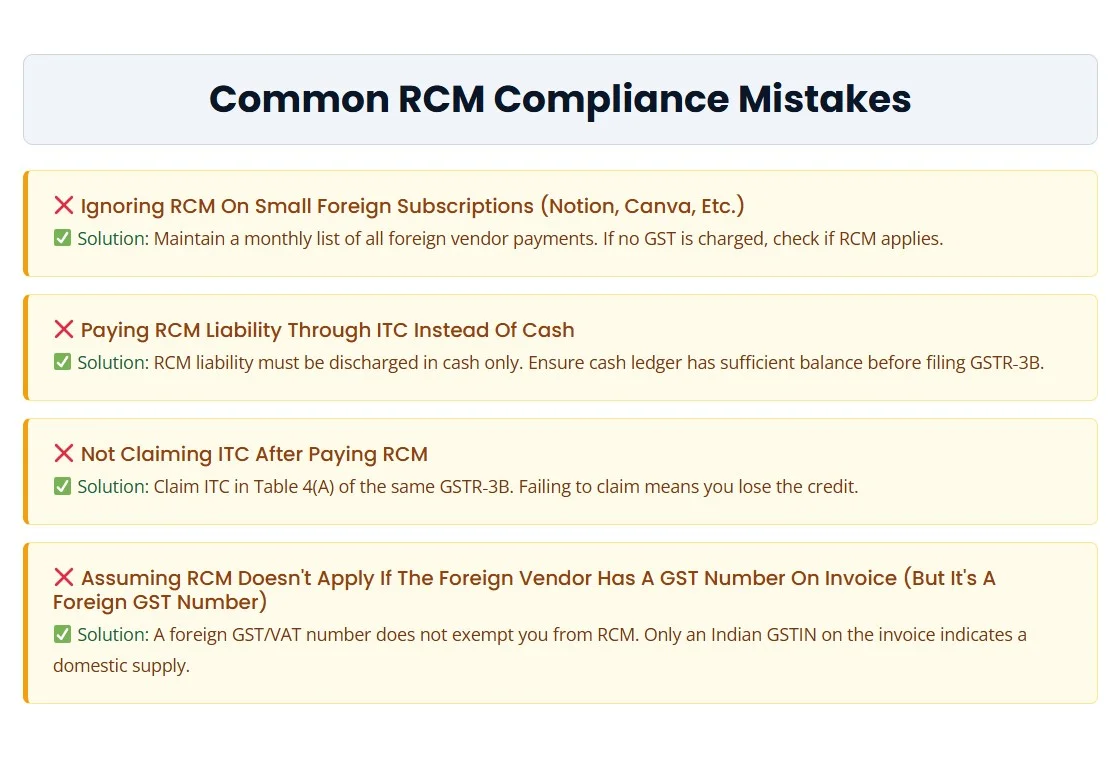
Caption: Strategic fixes for recurring RCM compliance errors on foreign service imports. Source: disytax.com Analysis.
- The Pro-Solution (Mirror Accounting): Implement Mirror Accounting. For every RCM liability, create a corresponding ‘dummy’ entry in your ledger that forces the system to recognize the RCM credit alongside the tax discharge. This synchronization ensures the AI sees a complete, closed-loop transaction, removing it from the Scrutiny Queue.
The algorithm monitors your entire supply chain, not just RCM. Manual checks aren’t enough; you must master the new invoice ecosystem. Review our IMS compliance guide to stop the system from labeling your invoices as ‘Risk-ITC
7. The Legal Shield Strategy: Doctrine of Substantial Compliance
When an ASMT-10 arrives, most professionals respond with a clerical correction. Do not do this. This is a trap that often escalates the issue to Section 74 (fraud/willful suppression).
Substantive vs Procedural GST
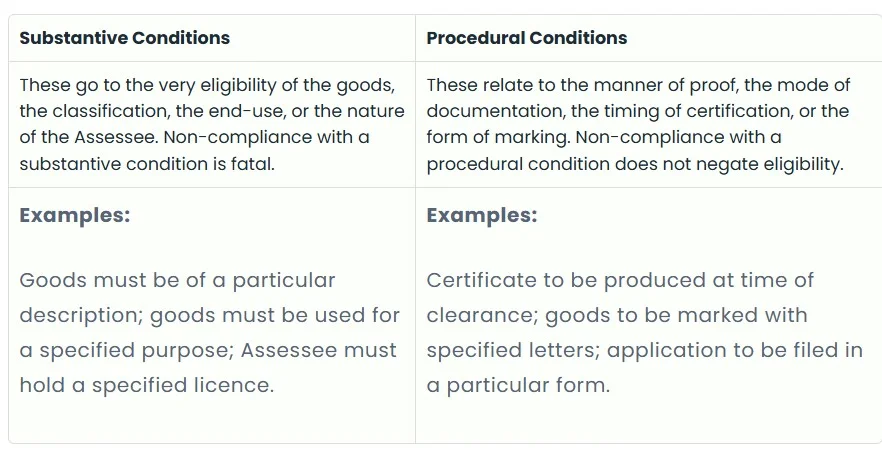
Caption: Distinguishing legal conditions to build a stronger defense against notices. Source Judicial Precedents.
- The Strategy: Utilize the ‘Doctrine of Substantial Compliance.’ If your error is technical rather than substantive (i.e., no actual tax leakage occurred), your ASMT-11 response must argue that the spirit of the law has been met.
- The Defense: Cite established judicial precedents that favor ‘Natural Justice’ over ‘Mechanical Precision.’ By framing your response as a legal memorandum rather than an accounting apology, you compel the assessing officer to exercise human judgment, which effectively overrides the system’s fraud flag.
8. Summary: Proactive Governance Checklist
| Risk Vector | AI Trigger Metric | Proactive Defense |
| Trust Score Erosion | Filing Latency (>48hrs) | Automate Filing Calendar |
| Tax-Gap Variance | Δ > 0.01% | Pre-emptive Reconciliation Annexure |
| RCM Mismatch | Table 3.1(d) vs Table 4 | Mirror Accounting Protocols |
| Section 74 Risk | Generic ASMT-11 Reply | Legal Memorandum (Natural Justice) |
Tax compliance is a rapidly evolving target in 2026. For high-growth firms, aligning internal processes with international tax governance frameworks is now the only way to stay ahead of automated enforcement.
9. Real-World Case Study: The ‘Deferred Credit’ Trap
The Case: A manufacturing giant received an ASMT-10 for ₹45 Lakhs in Input Tax Fraud.
The AI Logic: Vendor A reported the sale in April, but the client claimed ITC in July due to a receipt delay. The system flagged the 3-month gap as ‘False Credit.’
The Solution: Instead of a generic reply, the lawyer submitted a ‘Supply-Chain Reconciliation Flowchart’ (Gate Pass, E-Way Bill transit time, and GRN).
Result: The officer recognized the ‘Economic Substance’ over the ‘Systemic Flag.’ The liability was dropped in 7 days without moving to Section 74.
When I presented the physical ‘Gate Pass’ to the officer, he literally smiled and said, ‘I know it’s legitimate, but you have to explain it to the system, not me.’ That day, I realized—the machine needs manual guidance.
Frequently Asked Questions (FAQ)
Q: Can we ignore the AI-generated flags?
No. An ignored flag is interpreted by the GSTN as ‘Silent Admission.’ You must address every anomaly in the ‘Additional Information’ column of your filings.
Q: Is there a way to ‘Pre-Clear’ my profile?
Yes, by maintaining a ‘Compliance Scorecard’ using the GSTN’s ‘My Ledger’ feature. A clean record lowers your weight in the algorithm’s risk-profiling.
Conclusion: The New Rules of the Game
The Automated Audit is not going away. It is the future of taxation. For the smart audience—investors and business owners—the goal is no longer to avoid audits, but to ‘Pre-empt the Algorithm.’ Treat your GST portal as a living, breathing entity. Monitor it, audit it, and above all, provide the context that the machine lacks.
Example:
Struggling with unexplained ASMT-10 notices? Don’t let the algorithm dictate your tax liability. [Click here to download our Pre-Audit Checklist] or contact us for a professional deep-dive audit.
Disclaimer: This content is for high-level professional interpretation based on the current GST framework. It does not replace independent legal counsel. Tax laws are dynamic; ensure your ERP-GST integration is reviewed by a qualified professional every quarter.

Anurag Panchal
Founder & Chief Editor of ServiceMoney.in & AllRoundUpdate.com.
I architect Automated Compliance Workflows and IMS Reconciliation Protocols to eliminate GST system gaps. My focus is Pre-emptive Audit Defense—building the data-chains that neutralize Section 74 notices before they reach your dashboard.
My Methodology: Data Intake ➔ Logic-Gate Triangulation ➔ Automated Audit Shield.
Explore my Compliance Hub for actionable strategies to master your business’s fiscal integrity.


