

In the modern GST landscape, the Invoice Management System (IMS) has replaced the traditional, passive GSTR-2B process. For accountants, CAs, and business owners, this is not just a software update; it is a shift from data reporting to legal accountability, governed strictly by Rule 16(4aa) & Sec 73/74. If you don’t master the interaction between IMS and these underlying statutory sections, your business is effectively operating without a safety net.
Step 1: Understanding the IMS Compliance Paradox
What is it?
The IMS Compliance Paradox is the conflict between Operational Speed and Legal Safety.
In the old system, you simply checked if an invoice was in GSTR-2B. In the new IMS, you have three active choices for every invoice: Accept, Reject, or Keep Pending.
- The Paradox: If you Accept an invoice in IMS, you are making a digital statement that the transaction is genuine and tax-compliant. If the government later finds out that your supplier’s supplier (Tier-N) committed fraud, they will argue: You had the power to ‘Reject’ or ‘Keep Pending’ in IMS, yet you chose to ‘Accept’. Therefore, you are complicit. The Core Problem: The system gives you the authority to Accept, but it does not give you the tools to Audit the entire supply chain. You are being held responsible for an upstream default you cannot physically see.
Last month, I sat with a CFO who was confident about their ITC. They had accepted invoices in IMS without a second thought. Two weeks later, a scrutiny notice landed, citing a Tier-3 default. The CFO’s biggest realization? IMS isn’t a checklist; it’s a digital courtroom where ‘Accept’ is your testimony.
Think your current ITC process is safe? Think again. GST authorities now use advanced data analytics to flag ‘risky’ supply chains long before a notice reaches your door. See how they Evaluate your audit risk profile and stop being the easy target.
When the IMS launched, many thought it was just a new button to click. But having consulted for businesses struggling with ITC reversals, I’ve seen a different story. I remember a client who accepted an invoice on the last day of the return window, only to realize the supplier had ‘ghost-filed’ their return. That ‘Accept’ click became the department’s strongest evidence against them during an audit. This taught me a hard lesson: In the IMS era, your ‘Accept’ click is a legal admission of fact. Treat it with the same caution as signing an affidavit.
Many believe that once an invoice reflects in the system, it’s safe to claim. But don’t fall for the Deemed Acceptance fallacy as relying solely on system-validated data is a shortcut to an audit notice. True compliance requires active verification, not just passive data entry.
IMS Action Decision Matrix
Use this table to standardize your decision-making process for every invoice:
| Supplier Reliability (α) | GST Compliance Status | Recommended IMS Action | Legal Reasoning |
| High (0.8 – 1.0) | Consistent 3B Filer | Accept | Low risk; fulfills 16(2) criteria. |
| Medium (0.5 – 0.7) | Intermittent/Delayed | Keep Pending | Verify 3B status before claiming. |
| Low (0.0 – 0.4) | Chronic Defaulter | Reject | Proactive protection vs. reversal. |
A single ‘Accept’ click on a bad vendor invoice can trigger a multi-year audit. Don’t let a supplier’s compliance failure become your business’s financial trap. Master the Proactive vendor vetting framework and ring-fence your ITC today.
The Strategic Consequence: Why ‘Reject’ is a High-Stakes Move.
Before clicking ‘Reject’ in the IMS, you must understand the ripple effect:
- The Supplier Loop: When you ‘Reject’ an invoice, it moves to the supplier’s dashboard for amendment. If the supplier is non-compliant or ghost-filing, they will likely ignore your correction request.
- The ITC Vacuum: If the invoice is rejected and not amended by the supplier, it effectively remains in a limbo state. You cannot claim ITC on a rejected invoice until it is re-issued or amended by the supplier and accepted by you in a subsequent cycle.
- The Professional Protocol: Do not use ‘Reject’ as a default defensive measure. Use it only after:
- Communication: A documented email/notice to the supplier requesting the correction.
- Verification: Checking if the supplier actually has the intent to amend.
- The Keep Pending Alternative: If you are unsure but expect the supplier to resolve the discrepancy, choose Keep Pending instead of ‘Reject.’ This keeps the invoice in your system for a longer duration (up to the September/November return window) without burning bridges or forcing an immediate amendment cycle.
In the real world, hitting ‘Reject’ is stressful. I’ve seen vendors call instantly, threatening to stop supply. That’s why you need to move from ‘Automatic Rejection’ to ‘Negotiated Compliance’.
Automated Compliance Engine
F: ACCEPT
G: PENDING
H: REJECT/ESC
Logic Flow: The system starts by receiving invoices, checks for concentration risk (ICI), calculates Alpha scores for compliance, and triggers final actions based on predefined thresholds.
Note :- This workflow isn’t just about GST compliance; it’s a Financial Ring-Fencing Mechanism. By holding payments (K) for high-risk vendors (α < 0.5), you are creating a ‘Buffer Zone’ that protects your working capital from the ripple effects of upstream tax defaults.
Rule 16(4aa) & Sec 73/74
Step 2: Section 16(2) – The Statutory Anchor
Section 16(2) of the CGST Act is the list of conditions you must satisfy to claim Input Tax Credit (ITC).
- The Definition: It mandates that for you to claim ITC:
- You must possess a valid tax invoice.
- You must have received the goods or services.
- The Tax must have been paid to the Government (Section 16(2)(c)).
- You must have filed your GSTR-3B return.
Section 16(2)(aa) and GST Amendment Summary
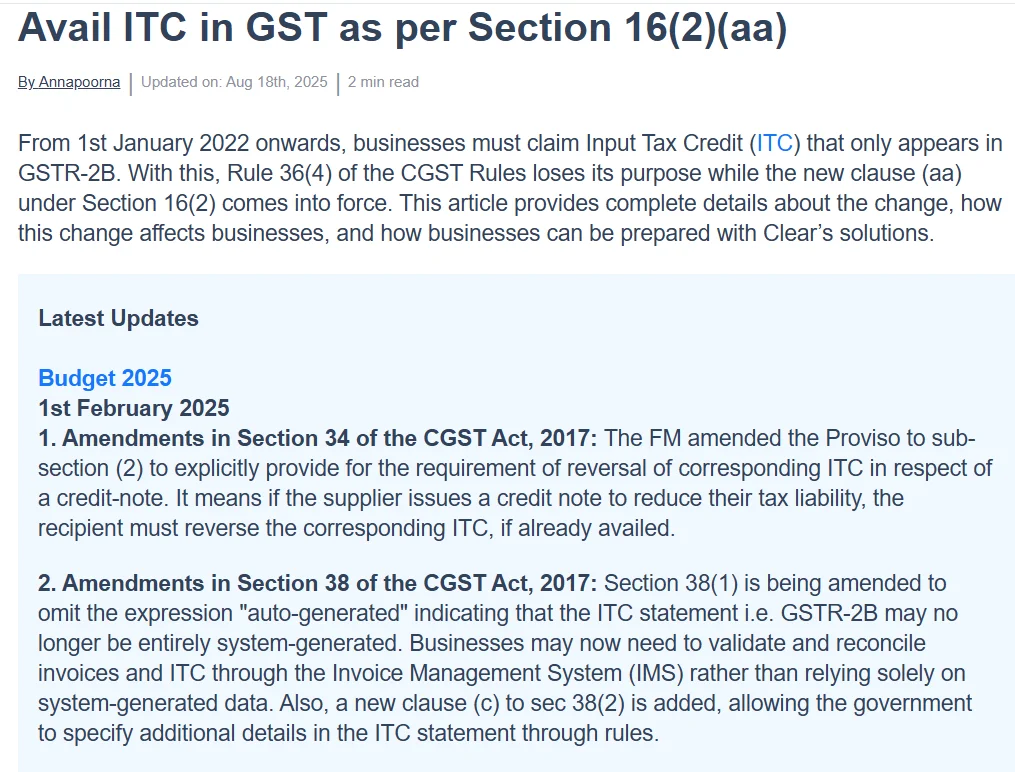
Caption :- This update provides a concise summary of the critical amendments in Section 16(2)(aa) and Section 38, highlighting the shift toward IMS-based reconciliation.
The shift to IMS has changed the rules of the game, making ITC management more complex than ever. If you aren’t careful, you’ll face significant ITC leakage that can erode your working capital. Mastering these new rules is the only way to safeguard your credits against unexpected reversals.
The Connection to our Problem:
The Paradox lies in 16(2)(c). When you click Accept in IMS, you are essentially declaring that you have verified that the tax has been actually paid to the government. But since you cannot verify the upstream payment status of a Tier-3 supplier, your Acceptance is technically an unverified declaration, making your ITC vulnerable to disallowance.
Gazette of India Notification Portal for GST Laws and Statutory Amendments
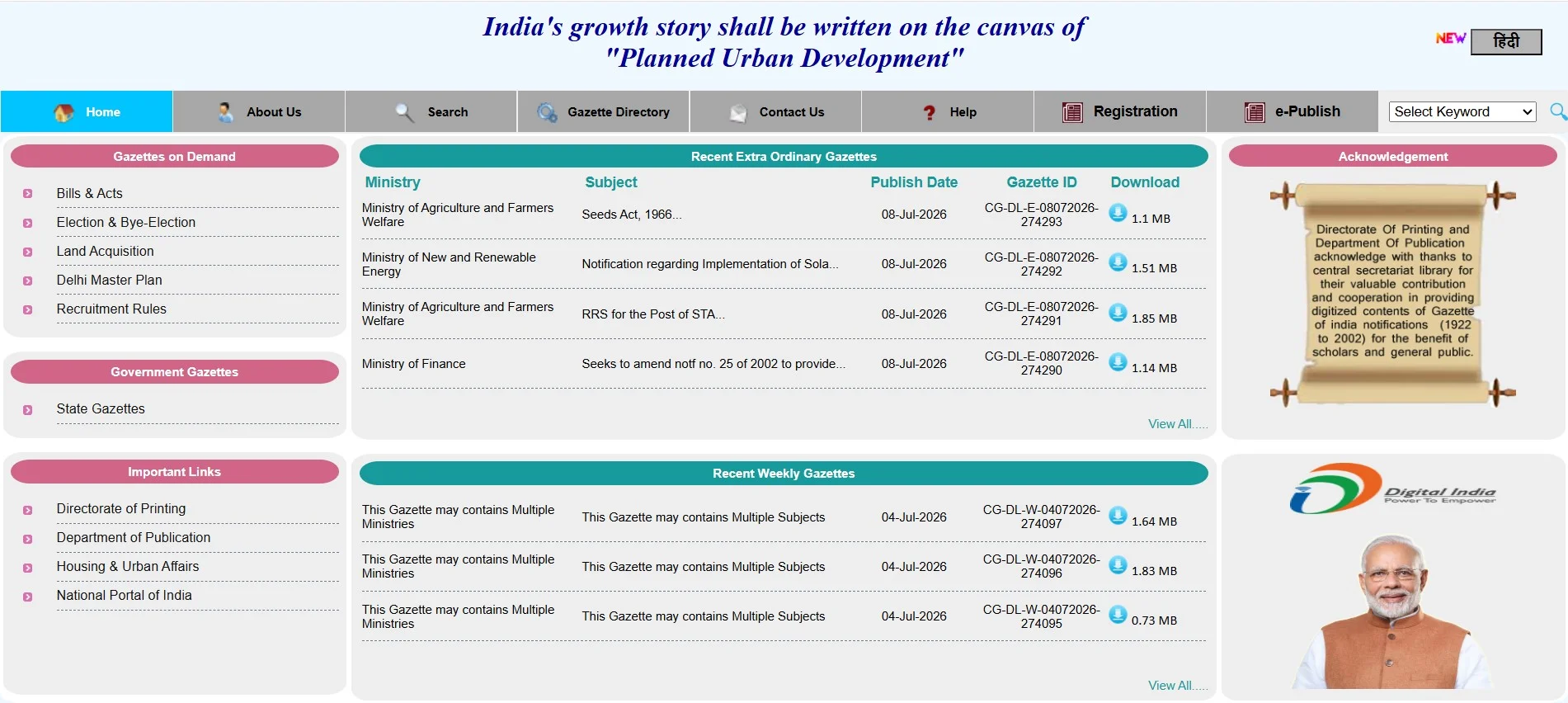
Caption :- This screenshot displays the official Gazette of India notification page, serving as the primary legal source for recent GST amendment updates.
Note :- While Section 16(2)(c) places the onus of payment on the supplier, the introduction of Section 16(2)(aa) makes the reflection of the invoice in your IMS/GSTR-2B a mandatory technical prerequisite for claiming credit. Your IMS actions now serve as the bridge between 16(2)(aa) and 16(2)(c).
Step 3: The Triple Jeopardy Defense
When the department finds an upstream default (e.g., a Tier-3 supplier vanished), they don’t just ask for the ITC back. They trigger the Triple Jeopardy:
- Input Reversal (Section 73/74): You lose the credit.
- Interest (Section 50): You pay 18% per annum on the credit from the date you claimed it.
- Penalty: 10% (Section 73 – non-fraud) or 100% (Section 74 – fraud/willful misstatement) of the ITC amount.
Don’t wait for a notice to realize that penalties often exceed the tax demand itself. Calculate your total financial risk using this GST liability impact guide before the department does it for you.
CGST Act Section 74 Bare Act Text
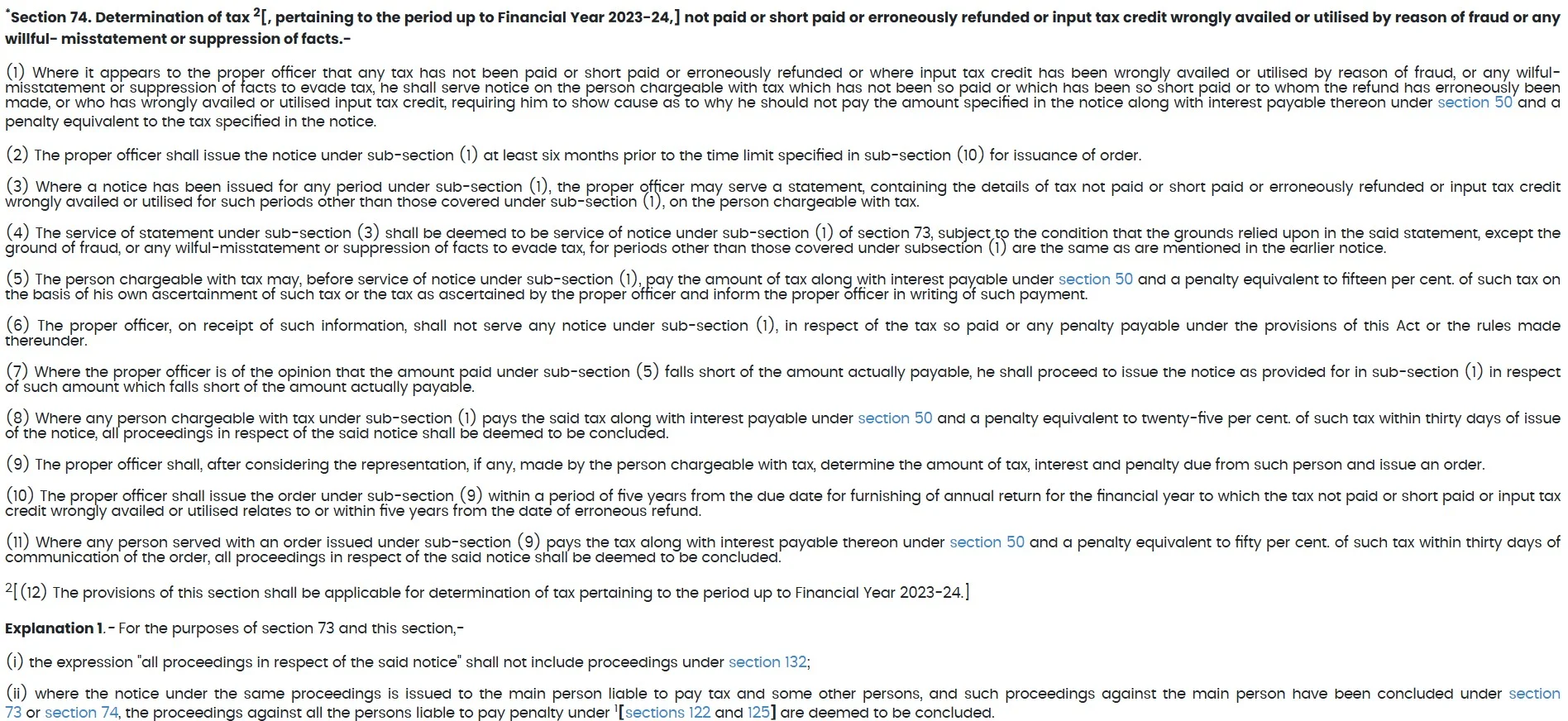
Caption :- The official Bare Act text of Section 74 details the legal provisions and determination of tax in cases involving fraud, willful misstatement, or suppression of facts.
If a discrepancy hits the department’s radar, you’ll likely face a DRC-01C notice. Don’t wait for a scrutiny letter to learn the hard way—proactive reconciliation is your best defense against litigation. Understanding the intersection of Section 16(2)(c) and automated triggers is non-negotiable for 2026.
Defining the Rules:
- Rule 37A: Specifies the mechanism of reversal. If your supplier fails to pay tax (GSTR-3B), you must reverse the ITC or pay it back with interest.
- Section 73: For standard mismatches (Non-fraud). Lower penalty, higher compliance focus.
- Section 74: For alleged Fraud or Suppression of Facts. The department uses this if they believe you knew the supplier was risky.
Section 73 vs 74 GST Penalty Comparison
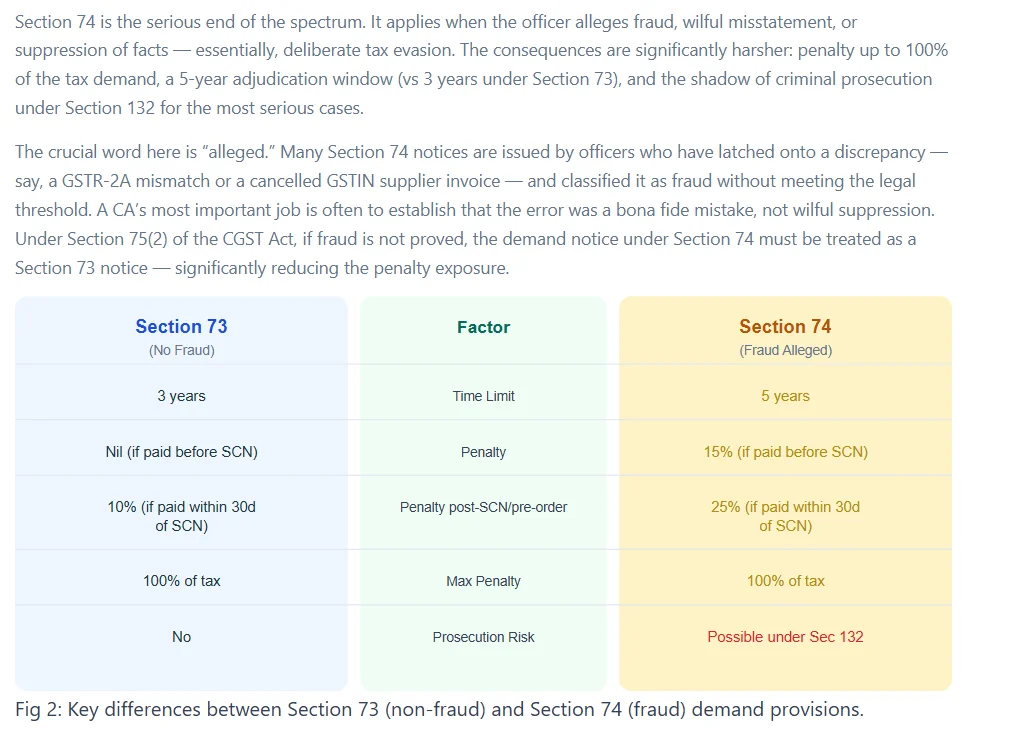
Caption :- This comparative table summarizes the key differences between Section 73 and Section 74, specifically focusing on time limits, penalty structures, and prosecution risks.
End-to-End Verification
Valid Tax Invoice (Sec 31)
+ PO / Work Order
E-way Bill + Weighbridge
+ Gate Entry Logs
Bank Transfer Records
+ RTGS / NEFT / IMPS Proof
Vendor Alpha Score
+ Past Correspondence
Practical Mathematical Framework (The 5 Formulas)
To navigate this, you need to quantify your risk. These formulas transform your intuition into legal data.
Formula 1: The Total Risk Exposure (TRE)
Used to decide: Do we fight this notice or pay it?
Total Recoverable Amount (TRE)
Parameter Details:
- • TRE = Total Recoverable Amount.
- • ITCDisputed = Input Tax Credit amount under dispute.
- • Rint = Applicable Interest Rate (Annual).
- • T = Time period (in months).
- • Psec = Penalty percentage (Section specific).
(R=18% interest, T=months elapsed, P=Penalty %)
Formula 2: The Input Concentration Index (ICI)
Used to measure your dependency on one risky supplier.
ITC Concentration Index (ICI)
Parameter Details:
- • ICI = ITC Concentration Index.
- • ITCVendori = ITC claimed from a specific vendor.
- • Total ITC = Sum of total ITC claimed from all vendors.
- • n = Total number of vendors.
(If ICI > 30, your risk is Highly Vulnerable.)
Formula 3: The Liquidity Shock Ratio (LSR)
Used to ensure you don’t go bankrupt if a notice comes.
Liquidity Solvency Ratio (LSR)
Parameter Details:
- • LSR = Liquidity Solvency Ratio.
- • FreeCash = Available liquid cash.
- • MarketableSecurities = Short-term liquid investments.
- • TRE = Total Recoverable Amount.
- • 0.10 (Pre-deposit) = Mandatory pre-deposit requirement factor.
(If LSR < 1, you cannot afford to appeal the case.)
Formula 4: Risk-Adjusted Cost of Procurement (RACP)
Used to decide if a cheap vendor is actually too expensive due to risk.
Risk-Adjusted Compliance Position (RACP)
Parameter Details:
- • RACP = Risk-Adjusted Compliance Position.
- • Pbase = Base compliance position.
- • ITCexpected = Projected ITC inflow.
- • α (Alpha) = Risk adjustment factor (Confidence level).
(α = Supplier’s compliance score from 0 to 1)
Formula 5: Vendor GST Holdback Calculation
Practical tip: Keep a part of the payment until the risk is clear.
Invoice Holdback Calculation
Parameter Details:
- • Holdback = Amount retained from payment.
- • InvoiceGST = Total GST value of the invoice.
- • αVendor = Vendor compliance/risk score.
Case Study: The Shell Trap
Scenario: A manufacturer buys steel from a Tier-1 vendor. The Tier-1 vendor is compliant. However, the Tier-1 vendor buys from a Tier-3 bill-pooling entity that defaults.
- The Issue: The department tracks the Tier-3 entity. They see your company claimed ITC linked to that same chain. They issue an SCN under Section 74.
- The Solution: You show them your RACP report. You prove that you conducted vendor verification (Proof of existence, bank payment trails). You argue Section 155, shifting the burden of proof back to the department by providing irrefutable bank payment receipts and E-way bills.
Note: These formulas are not statutory rules; rather, they are internal risk management tools (internal control mechanisms) that a prudent businessperson should adopt.
FAQs for Professionals
Q: Can I reject an invoice in IMS if I’m not sure?
Yes. The law does not mandate accepting an invoice if you have reasonable cause to doubt its validity.
Q: Does Section 74 apply if I am an innocent buyer?
The department will try to invoke it. Your defense must be that your actions were based on commercial viability, not willful suppression.
Expert’s Final Advice :- Over the years, I’ve learned that a spreadsheet of invoices isn’t enough. I now maintain a ‘Compliance Dossier’ for every vendor with high ITC exposure. It’s a bit of extra work, but compared to the 100% penalty under Section 74, it’s the cheapest insurance policy you can buy.
Conclusion
The IMS Compliance Paradox requires a shift from being a Data Entry Clerk to a Risk Manager. By using the TRE and RACP formulas, you are no longer just filling returns—you are building a legal wall of defense that justifies your actions under Section 16(2) and prepares you for any Triple Jeopardy scenario.
The IMS Compliance Paradox is here to stay. Will you be a data entry clerk, or will you be the Risk Manager who protects their company’s bottom line ? Tell me in the comments: How are you currently verifying your Tier-2 and Tier-3 vendors?
Disclaimer: This blog is for educational purposes. GST laws are complex; always consult with a tax litigation expert before finalizing your legal defense strategy.

Anurag Panchal
Founder & Chief Editor of ServiceMoney.in & AllRoundUpdate.com.
I specialize in IMS Reconciliation Frameworks and Risk-Splitting Disbursement Models. My mission is to insulate businesses from Sec 74 Show Cause Notices through automated verification and audit-ready data chains.
Explore my Compliance Hub for practical tutorials on mastering GST compliance and risk management.


