

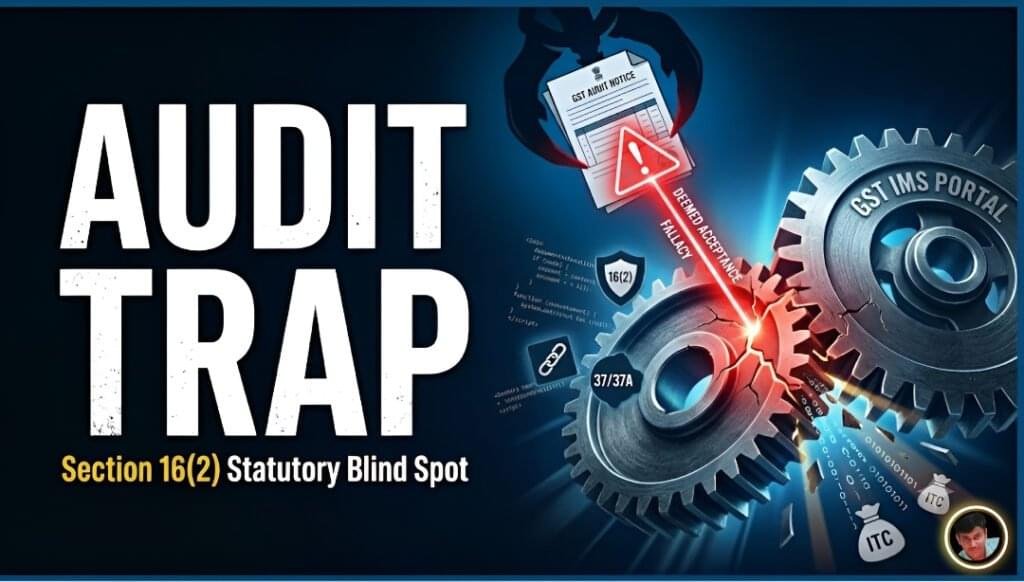
The introduction of the Invoice Management System (IMS) on the GST portal was heralded as a step toward automation and ease of compliance. For accountants, Chief Financial Officers (CFOs), and tax professionals, the Accept, Reject, and Pending buttons seem to offer absolute control over Input Tax Credit (ITC). However, a dangerous statutory blind spot has emerged: The Deemed Acceptance Fallacy.
Note :- This technical analysis is based on the current provisions of the CGST Act, 2017. Professionals are requested to verify specific jurisdictional rulings as GST case law is evolving rapidly.
When a taxpayer takes no action on an invoice in the IMS, the system automatically classifies it as Deemed Accepted, subsequently populating it into GSTR-2B as eligible ITC. The critical, untouched problem is this: The GST portal’s procedural Deemed Acceptance does not override the substantive statutory conditions of Section 16(2) of the CGST Act, 2017.
If you rely solely on system-validated ITC without off-portal statutory backing, you are building a house of cards that will collapse during a Section 61 scrutiny or a Section 65 departmental audit.
Before trusting the portal blindly, check the latest GST notifications to see how the IMS functionality is evolving beyond just ‘automation
In my last three audits for manufacturing clients, I’ve seen this exact scenario: a clean GSTR-2B dashboard, but a panicked finance team during the site visit because they couldn’t produce the GRN logs for ‘Deemed Accepted’ invoices. The portal doesn’t face the auditor—you do. I’ve written this guide not as a theoretical analysis, but as a roadmap to survive the upcoming wave of Section 61 notices.
Part 1: The Deemed Acceptance Fallacy: Why the Portal is NOT your Compliance Shield.
The fallacy is the dangerous assumption that if an invoice appears as Deemed Accepted in IMS and flows into GSTR-2B, the taxpayer holds an absolute, unchallengeable right to claim that ITC.
Before you ignore a ‘Deemed Accepted’ invoice, understand that missing the Section 16(4) deadline is a permanent death knell for your ITC.
The GST portal only verifies digital data matching (GSTR-1 of the supplier vs. GSTR-2B of the recipient). It is entirely blind to the physical and financial realities demanded by the law. Section 16(2) dictates that ITC can only be claimed if four non-negotiable conditions are met:
Section 16(2) ITC Eligibility Provisions
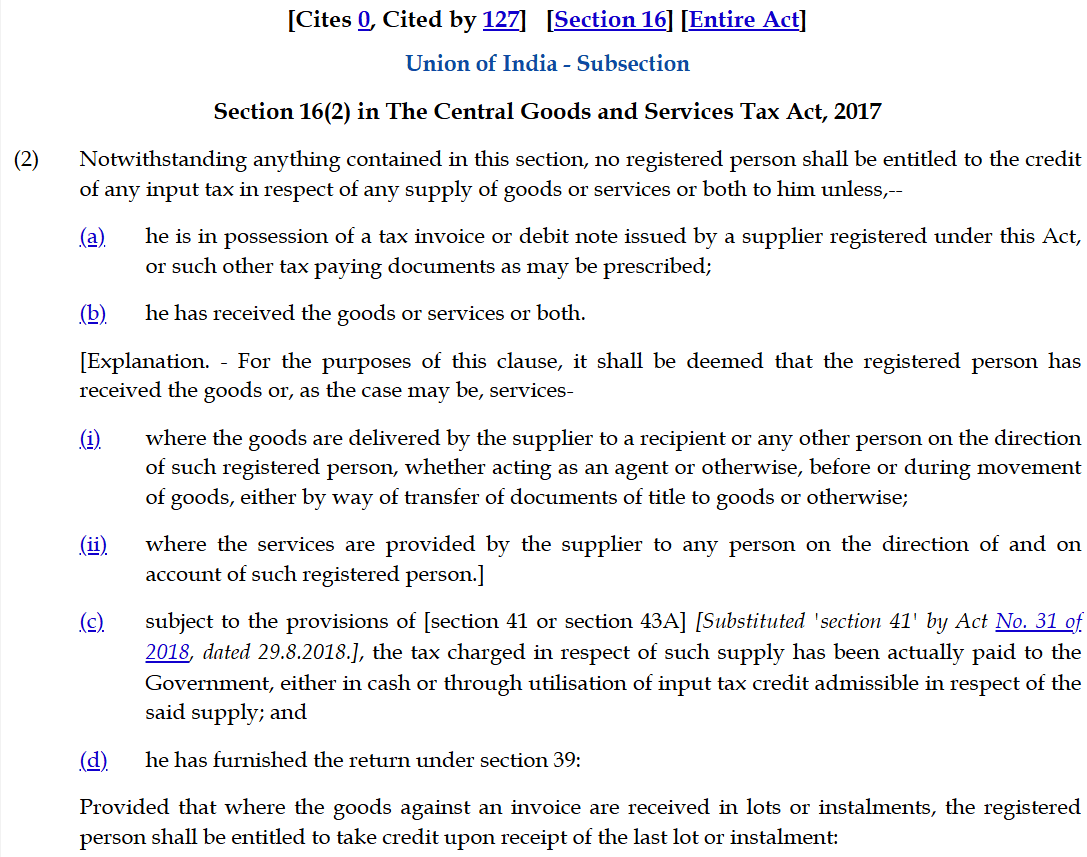
Caption :- The Central Goods and Services Tax Act, 2017. This snippet defines the four non-negotiable conditions under Section 16(2) that must be met to legally claim Input Tax Credit.
- Possession of a tax invoice.
- Actual receipt of goods or services.
- Actual payment of tax to the Government by the supplier.
- Filing of the return.
The portal deems an invoice accepted the moment the supplier uploads it and the recipient takes no action. It completely bypasses the verification of whether the goods were actually received or if the payment terms align with the law.
Part 2: The Four ‘Hidden’ Traps Currently Breeding Litigation.
For CAs, business owners, and lawyers, the litigation of tomorrow is breeding in the following gaps today:
Procedural slip-ups in IMS directly trigger automated DRC-01C notices. Don’t wait for the notice—proactively audit your compliance.
Problem 1: The Goods in Transit Trap [Section 16(2)(b)]
A supplier dispatches goods on the 28th of the month and uploads the invoice. The recipient does not act on the IMS, and the system Deems it Accepted by the 14th of the next month. The accountant, seeing it in GSTR-2B, claims the ITC in GSTR-3B. However, the goods physically arrive at the factory on the 3rd of the following month.
Court Case: Physical Receipt of Goods
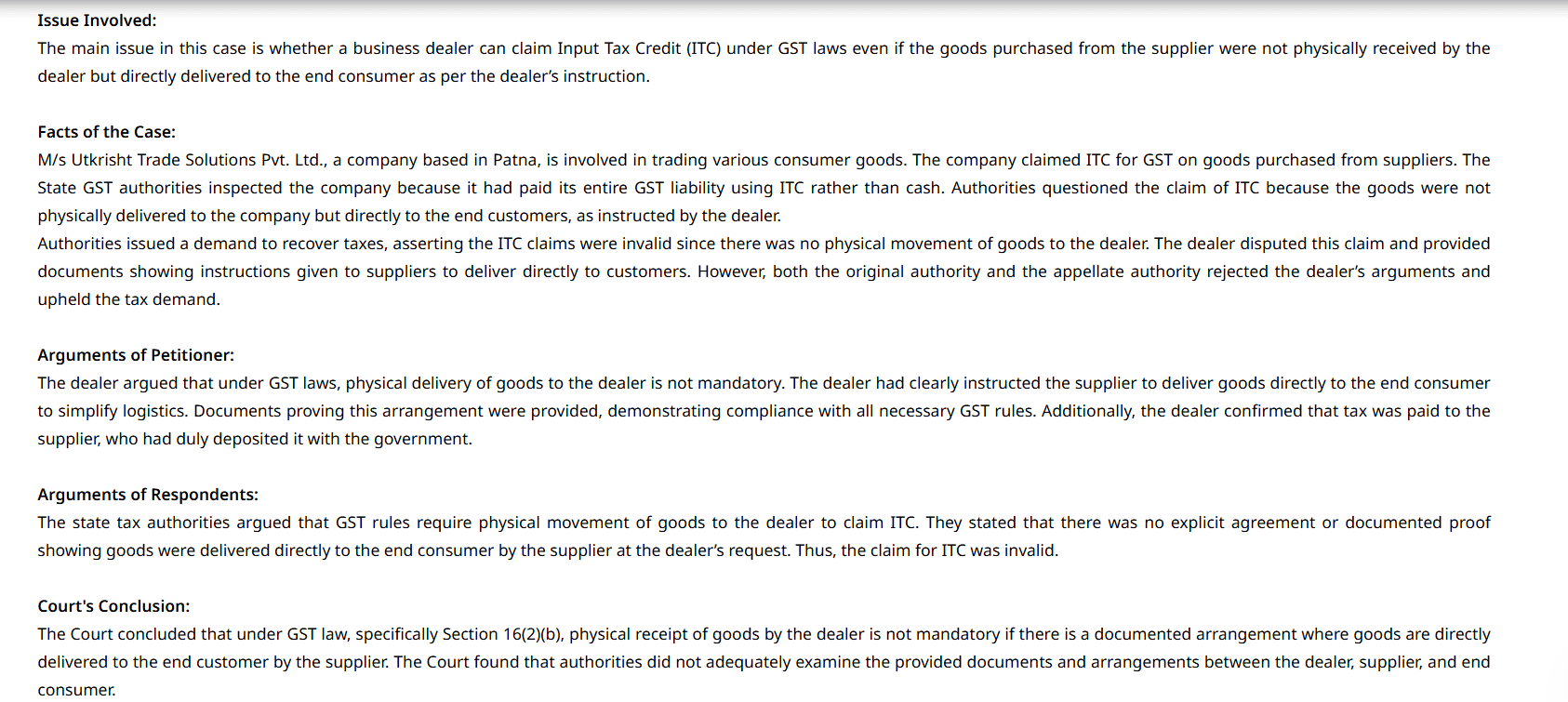
Source: Judicial Precedent Database. This case highlights the court’s view on the physical receipt of goods, clarifying that documented arrangements can satisfy Section 16(2)(b) requirements.
The Legal Trap: Under Section 16(2)(b), ITC cannot be claimed until goods are actually received. During an audit, the Adjudicating Authority will demand the Goods Receipt Note (GRN) or E-way bill closure date. If the GRN date falls in the subsequent month, the ITC claimed in the current month is illegal, attracting heavy interest penalties.
Problem 2: The 180-Day Payment Reversal [Rule 37]
System automation breeds human amnesia. Invoices that are Deemed Accepted bypass manual scrutiny. Accounts Payable teams process the ITC, but if the payment to the supplier is withheld due to quality disputes or cash flow issues beyond 180 days, Rule 37 mandates an ITC reversal along with interest. The IMS does not track your bank statements.
Rule 37: Reversal for Non-payment
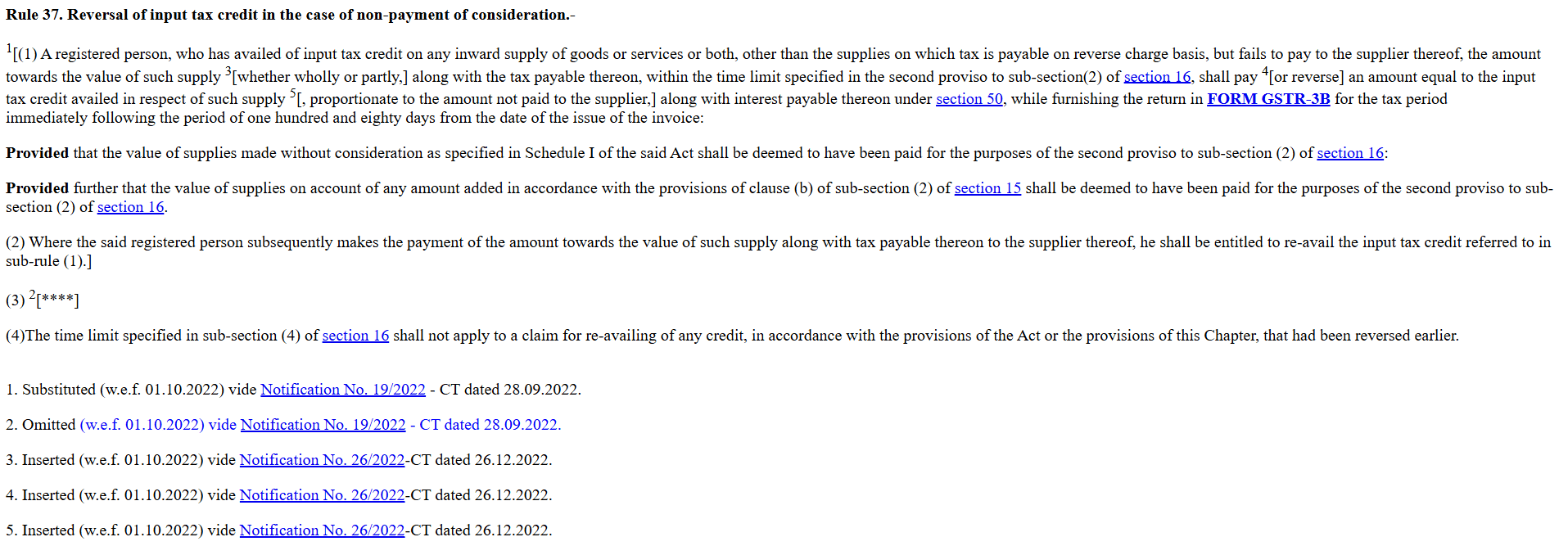
Caption :- CGST Rules, 2017. This clause mandates the proportionate reversal of ITC along with interest under Section 50 if payment for the supply is not made within 180 days.
The 180-day rule is rigid. You can cross-verify the legal text of CGST Rules to understand the exact window for reversal and re-availment.
Problem 3: The Supplier Default & Rule 37A Clash
Under Rule 37A, if a supplier uploads an invoice (Deemed Accepted in your IMS) but fails to file their GSTR-3B and pay the tax by September 30 of the following year, the recipient must reverse the ITC. Relying purely on IMS creates a false sense of security, blinding financial advisors to the massive contingent liabilities building up due to defaulting vendors.
Rule 37A: Supplier Default Provisions
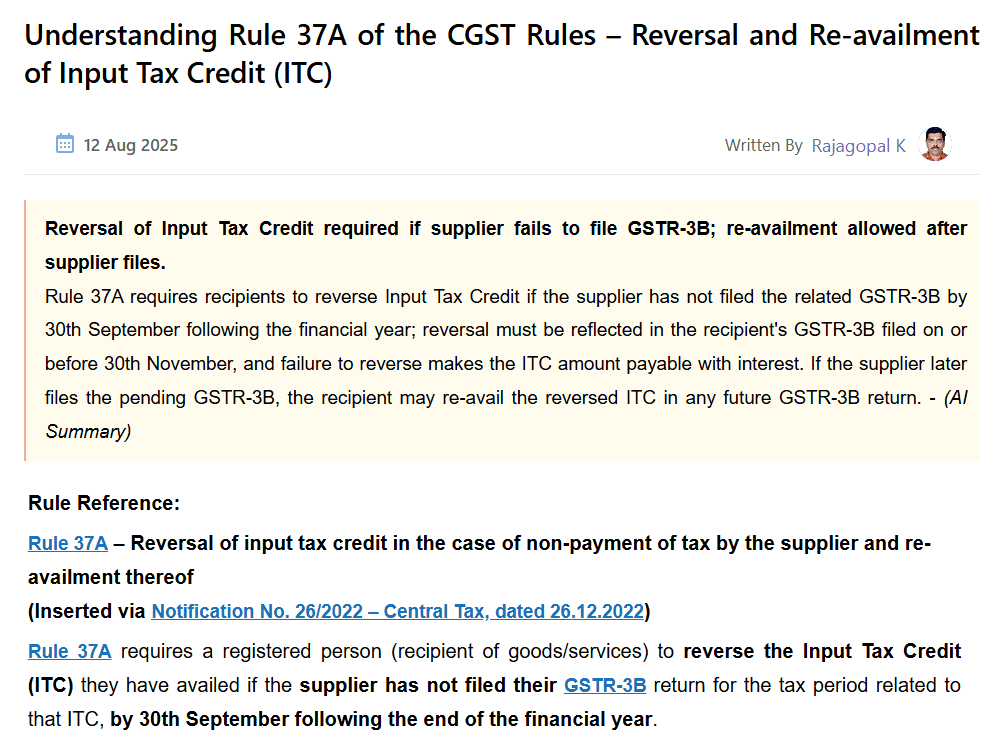
Caption :- GST Portal Notification. Rule 37A provides the statutory mechanism for reversing ITC when a supplier fails to file their GSTR-3B by the 30th of September.
Problem 4: The Rule 86B Cash Blockade
For large businesses subject to Rule 86B (mandatory 1% cash payment of output tax liability), miscalculating valid ITC due to the Deemed Acceptance Fallacy can severely distort liquidity projections. If an auditor disallows a chunk of your deemed ITC, your output tax liability recalculation could force sudden, massive cash outflows, crippling operational liquidity.
Part 3: Quantitative Case Study & Financial Impact Formulas
Let’s translate this statutory gap into numbers using a real-world scenario.
Case Study:
- Company Alpha operates in the manufacturing sector.
- In March 2026, a supplier uploads an invoice for ₹50,00,000 (Base) + 18% GST (₹9,00,000).
- Company Alpha ignores the IMS dashboard; the invoice is Deemed Accepted.
- The ITC of ₹9,00,000 is claimed in the March GSTR-3B.
- Reality: The goods were held up at a checkpoint and arrived on April 5, 2026. Furthermore, Company Alpha withheld 20% of the payment (₹11,80,000) due to a quality dispute, which remained unpaid for over 180 days.
- An audit is conducted in December 2027 (approx. 600 days later).
I remember a specific case where a client lost ITC worth ₹12 Lakhs simply because they auto-accepted an invoice on the 10th, while the material reached the factory gate on the 3rd of the following month. The Adjudicating Officer didn’t care about the ‘green tick’ on the portal; he cared about the gate entry register. That’s when we stopped trusting the default settings and built our ‘Three-Way Match’ protocol.
Want to keep your tax audits error-free?
Tracking compliance formulas manually is difficult. To speed up your auditing process, I have created an ‘Audit-Ready ITC Risk Matrix‘ PDF. It provides a simple calculation format for each rule that you can use directly in your records.
[Click Here to Download Your Free Audit-Ready PDF Tool]
Here is the mathematical framework an Adjudicating Authority will use to penalize the company:
Formula 1: Improper ITC Identification (The Timing Mismatch)
The auditor isolates invoices where the statutory condition was met after the claim period.
Invalid ITC Calculation
Parameter Details:
- • ITCInvalid = Total disallowed Input Tax Credit.
- • InvoiceDeemed = Specific invoices failing compliance validation.
- • DateGRN = Goods Receipt Note date.
- • PeriodGSTR3B = GST return filing period.
In Alpha’s case, the entire ₹9,00,000 was invalid for March.
Formula 2: Interest Computation under Section 50(3)
For wrongly availed and utilized ITC, interest applies at 18% per annum.
Sec 50 Interest Liability
Parameter Details:
- • InterestSec50 = Interest payable on delayed ITC reversal.
- • ITCInvalid = Amount of disallowed ITC.
- • (18/100) = Annual interest rate (18% p.a.).
- • (DaysDelayed/365) = Time factor for calculation.
Section 50/88B: Interest on Tax Delay
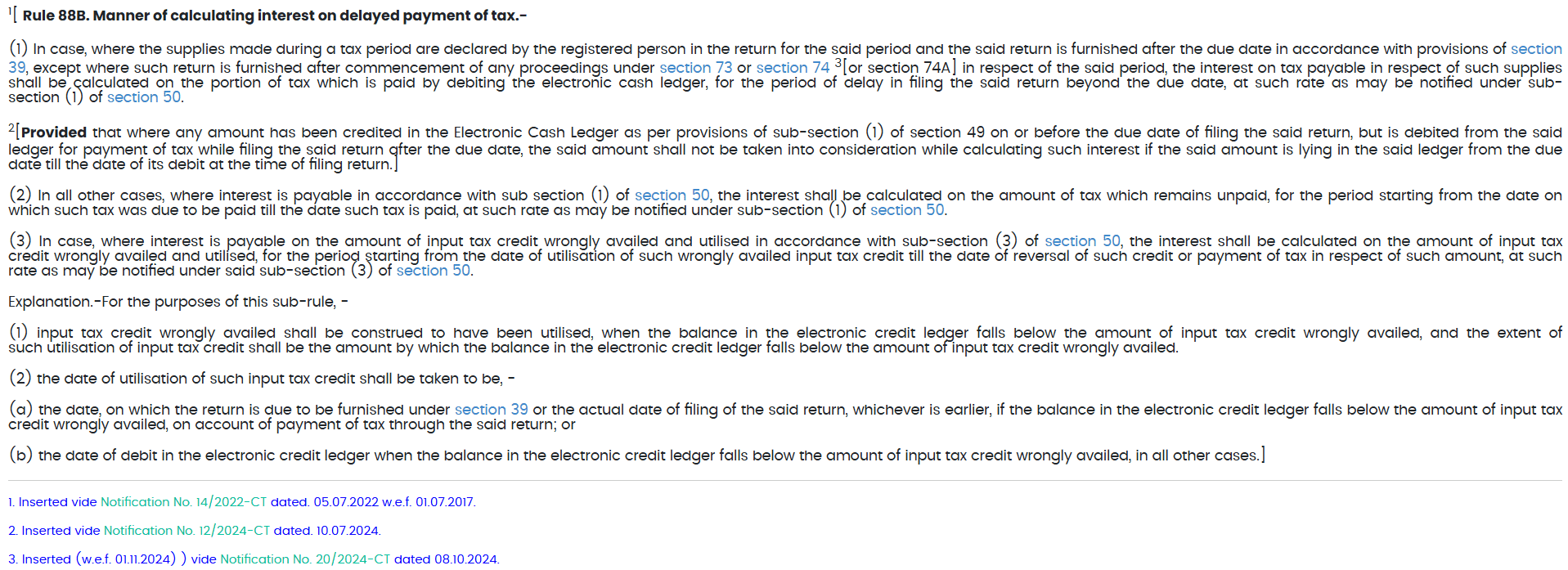
Caption: CBIC/GST Laws. This section defines the manner of calculating interest on delayed tax payments, establishing the 18% p.a. liability on wrongly availed ITC.
Calculation for Alpha (assuming 600 days from wrong claim to audit discovery):
Interest Liability Amount
Calculation Breakdown:
- • Principal Amount: ₹9,00,000.
- • Interest Rate: 18% (0.18) per annum.
- • Time Period: 600 days out of 365 days.
- • Total Liability: ₹2,66,301.
Formula 3: Rule 37 Reversal Liability (The 180-Day Rule)
Because 20% of the invoice value was unpaid beyond 180 days, that proportional ITC must be reversed.
Rule 37 Liability
Parameter Details:
- • LiabilityRule37 = ITC required to be reversed.
- • ITCTotal = Total ITC availed on the invoice.
- • AmountUnpaid = Portion of the value not paid to supplier.
- • TotalInvoice_Value = Total value of the supply.
Calculation for Alpha:
Rule 37 Liability Amount
Calculation Breakdown:
- • Total ITC: ₹9,00,000.
- • Unpaid Amount: ₹11,80,000.
- • Total Invoice Value: ₹59,00,000.
- • Resulting Liability: ₹1,80,000.
Formula 4: The Total Cost of Litigation (TCL)
The true financial damage is not just the lost credit, but the multiplier effect of interest and penalties (under Section 73/74).
Total Compliance Liability (TCL)
Component Breakdown:
- • ITCDisallowed: The base amount of tax credit rejected.
- • InterestSec50: Statutory interest on delayed reversal.
- • PenaltySec73/74: Penalties levied for non-compliance or fraud.
- • Legal_Costs: Associated expenditure for litigation or consultancy.
Formula 5: Rule 86B Liquidity Impact
When invalid ITC is stripped away, the business must fund the gap with hard cash.
Total Cash Outflow Calculation
Parameter Details:
- • Cash_Outflow: Actual tax paid through electronic cash ledger.
- • Output_Tax: Total tax liability on outward supplies.
- • Total_ITC: Total input tax credit available.
- • ITCInvalid: Disallowed portion (reversal).
- • Mandatory_Cash_Rule86B: Statutory cash payment restriction.
Company Alpha thought they gained ₹9,00,000 in working capital. Instead, the Deemed Acceptance trap cost them the principal, over ₹2.6 Lakhs in interest, plus potential 10% to 100% penalties.
+--------------------------------------------------------------------------------------------------+
|                                  COMPLIANCE WORKFLOW ARCHITECTURE                                |
+--------------------------------------------------------------------------------------------------+

[START] IMS Invoice Received (Status: Pending)
          |
          v
STAGE 1: ERP Three-Way Match (PO + Invoice + GRN)
          |
          v
DECISION GATE: Is GRN Date > GSTR-3B Period?
          |
    +-----+-----+
    |           |
[YES]       [NO]
    |           |
    v           v
Move to 'Deferred'  Check: Payment > 180 Days?
ITC Ledger          |
    |           +-----+-----+
    |           |           |
    |        [YES]       [NO]
    |           |           |
    |           v           v
    |    ITC Reversal    Mark 'Accepted'
    |    (Rule 37)          |
    |           |           |
    +-----------+-----------+
                |
                v
FINAL ACTION: GSTR-3B Filing (Scrutiny Proof)

+--------------------------------------------------------------------------------------------------+
| NOTE: Ensure all 'Accepted' logs are archived for 8-year audit defense.                          |
+--------------------------------------------------------------------------------------------------+
Part 4: Legal & Statutory Solutions for the Smart Professional
How do you protect your clients and your business from a system that is legally incomplete? You must build an Air-Gap between portal compliance and statutory compliance.
Fixing compliance gaps requires more than manual sheets. Learn how to stop hidden ITC leakage through advanced ERP reconciliation.
1. Institute a Three-Way Match in your ERP (e.g., Tally Prime / SAP)
Do not allow your accountants to claim ITC based purely on GSTR-2B. Implement a strict three-way matching rule in your accounting software:
- Purchase Order (PO)
- Supplier Invoice
- Goods Receipt Note (GRN)Actionable Step: Only when all three documents are matched within the ERP should the tax ledger be debited. If an invoice is Deemed Accepted on IMS but the GRN is missing, park that ITC in a Deferred ITC Ledger and claim it in the subsequent month’s GSTR-3B.
When I implemented this in my own firm’s process, it initially slowed down our input processing by 15%, but the reduction in audit queries and compliance errors was 100%. Don’t chase speed; chase scrutiny-proof data. If your accounting software doesn’t support a custom ‘Deferred ITC’ ledger, create a manual reconciliation sheet—do not bypass the physical validation.
2. Terminate the Ignore to Accept Culture
Treat the IMS not as an automated bin, but as an active filter.
- Legal Protocol: Mandate that no invoice above a certain materiality threshold (e.g., ₹1,00,000) is allowed to default to Deemed Accepted. It must be manually marked Pending if the goods are in transit or if a quality check is incomplete. This leaves a digital footprint that you are actively complying with Section 16(2).
3. Contractual Indemnity for Rule 37A
Since the portal deems invoices accepted regardless of the supplier’s tax payment status, your defense must be in your vendor contracts.
- Drafting Clause: Lawyers and procurement heads must insert an ITC Indemnity Clause stating: Any loss of ITC, including interest and penalties under Section 50 and Rule 37A of the CGST Act, arising due to the non-filing of GSTR-3B or non-payment of taxes by the Supplier, shall be immediately recovered from the Supplier’s pending or future payments.
4. The 180-Day AP Flagging System
Accountants must set up aging reports in their ERP systems specifically tied to the ITC ledger. If an invoice hits the 150-day unpaid mark, an automated alert must trigger the tax team to either release the payment or proactively reverse the ITC in the current GSTR-3B to avoid the 18% interest bleeding.
Part 5: Frequently Asked Questions (FAQs)
Q1: If the IMS shows an invoice as Deemed Accepted and it reflects in my GSTR-2B, can the GST Officer still deny my ITC?
Yes. GSTR-2B and IMS only satisfy Section 16(2)(aa) — the digital matching requirement. They do not prove you received the goods (Section 16(2)(b)) or that the supplier paid the tax (Section 16(2)(c)). The burden of proof remains entirely on you.
Q2: I received an invoice in May, but the goods arrived on June 2nd. The IMS deemed it accepted in May. When should I claim ITC?
You must claim the ITC in your June GSTR-3B. If you claim it in May based on the IMS status, you are violating Section 16(2)(b) and will be liable for 18% interest for wrong availment. You should manually mark the invoice as Pending in May’s IMS.
Q3: How does Rule 86B interact with disallowed deemed ITC?
If an auditor disallows your deemed ITC, your eligible ITC pool shrinks. If you are a Rule 86B taxpayer, this sudden drop might mean your previous outputs were insufficiently backed by valid ITC, forcing you to pay the difference—plus interest—entirely in cash via the electronic cash ledger.
Q4: Is a Deemed Accepted action legally binding against me?
While the GSTN handles it procedurally, a smart adjudicating officer can argue that your failure to manually reject or pend an invalid invoice implies you certified a false transaction. It is always safer to actively manage the IMS rather than letting it run on autopilot.
Pro-Tip: Don’t Let Compliance Gaps Hurt Your Bottom Line
Even the slightest mistake in taxation directly impacts your cash flow. To avoid Section 73/74 penalties and interest, you can download our ‘Audit-Ready ITC Risk Matrix’ PDF. The formulas given here will help you maintain scrutiny-proof compliance.
[Click Here to Download Your Free Audit-Ready PDF Tool]
Conclusion
The Invoice Management System is a tool, not a shield. The Deemed Acceptance Fallacy is currently the largest blind spot in Indian corporate tax compliance. While the digital interface gives the illusion of finality, the iron-clad rules of the CGST Act—physical receipt, actual payment, and supplier compliance—are what will be tested in the courtroom.
For those aiming for absolute compliance, monitor the High Court tax judgements to stay ahead of how courts are interpreting ‘Deemed Acceptance’ vs ‘Statutory Rights
For Chartered Accountants, lawyers, and business leaders, the strategy moving forward is clear: Do not let the portal dictate your compliance. Build robust internal ERP checkpoints, legally airtight vendor agreements, and a culture that prioritizes the statutory text over a green tick on a website. In the world of taxation, convenience is often a precursor to a penalty.
Disclaimer: The content provided in this article is for informational and educational purposes only and does not constitute formal legal, financial, or tax advice. While every effort has been made to ensure the accuracy of the interpretation of the CGST Act, 2017, and relevant rules (including IMS mechanics, Section 16, Rule 37, Rule 37A, and Rule 86B), tax laws are subject to frequent amendments and varying judicial interpretations. Readers, including professionals, are advised to consult with a qualified tax expert or legal counsel before making any financial decisions or compliance filings based on this material.

Anurag Panchal
Founder & Chief Editor of ServiceMoney.in & AllRoundUpdate.com.
I specialize in Automated GST Reconciliation, IMS Logic Flow, and Sec 50/Rule 37 Compliance.
My mission is to simplify complex tax calculations into precise, audit-proof frameworks that safeguard your ITC and cash flow.
Learn more: @Educationanurag.


