

For Chartered Accountants, Chief Financial Officers (CFOs), and Tax Litigators, the traditional mechanics of indirect tax compliance have shifted. When facing scrutiny, relying on auto-populated GSTR-2B statements is no longer enough; you need a robust GST Section 16(2) defense. The ‘Deemed Acceptance Fallacy’ has created a dangerous false sense of security, as mere auto-population of Input Tax Credit (ITC) does not provide immunity against subsequent disallowances under Section 16(2) of the Central Goods and Services Tax (CGST) Act.
AI Analytics GST Administration
Caption :- Ministry of Finance presentation on AI, Big Data and Machine Learning in tax administration.
However, a far more complex, systemic threat has emerged from the algorithmic architecture deployed by the tax administration. Armed with state-of-the-art big data analytics platforms—specifically ADVAIT (Advanced Analytics in Indirect Taxation) and BIFA (Business Intelligence and Fraud Analytics)—the Directorate General of GST Intelligence (DGGI) and state tax departments are no longer limiting their scrutiny to the immediate transaction. They are increasingly tracing the upstream flow of ITC through multiple layers of the supply chain.
This phenomenon is Supply Chain Contamination (Tier-N Default). It represents a scenario where an enterprise executes a flawless transaction with a fully compliant, verified direct supplier (Tier-1), yet faces retrospective ITC reversals, severe financial penalties, and freezing of bank accounts because a supplier further upstream—at the Tier-2, Tier-3, or Tier-N level—turned out to be a fraudulent shell entity or failed to remit tax to the exchequer.
GST Input Tax Credit Overview
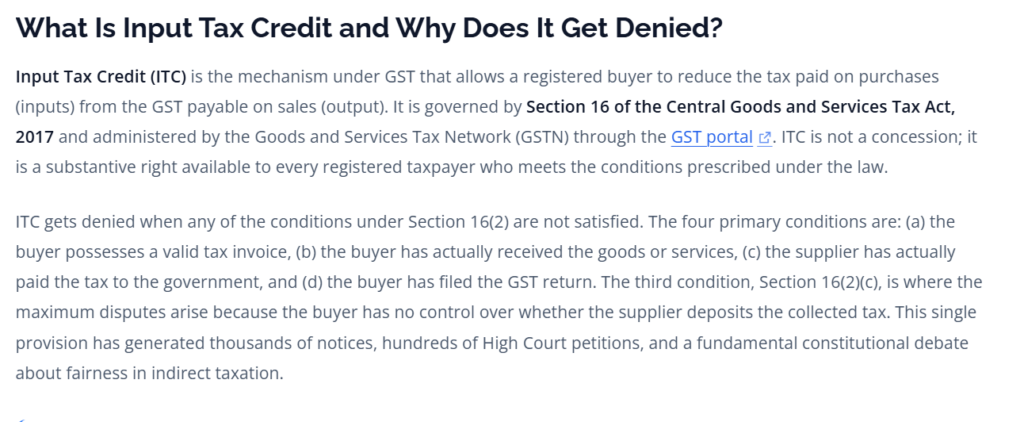
Caption :- Overview explaining statutory conditions for Input Tax Credit under Section 16. Source: Referenced educational article.
This deep-dive operational and legal manual deconstructs the mechanics of Tier-N defaults, provides an advanced mathematical framework for risk quantification, and outlines the precise litigation strategies necessary to defend the corporate balance sheet.
In the current Indian litigation climate, the department’s use of ADVAIT and BIFA is no longer a secret. I’ve seen notices being issued in regions across North and West India where the supply chain looked pristine on paper, but was fractured in the state’s backend data analytics. We are moving toward a ‘data-first’ enforcement era where the department doesn’t visit your factory first—they visit your data first.
AI Analytics GST Administration
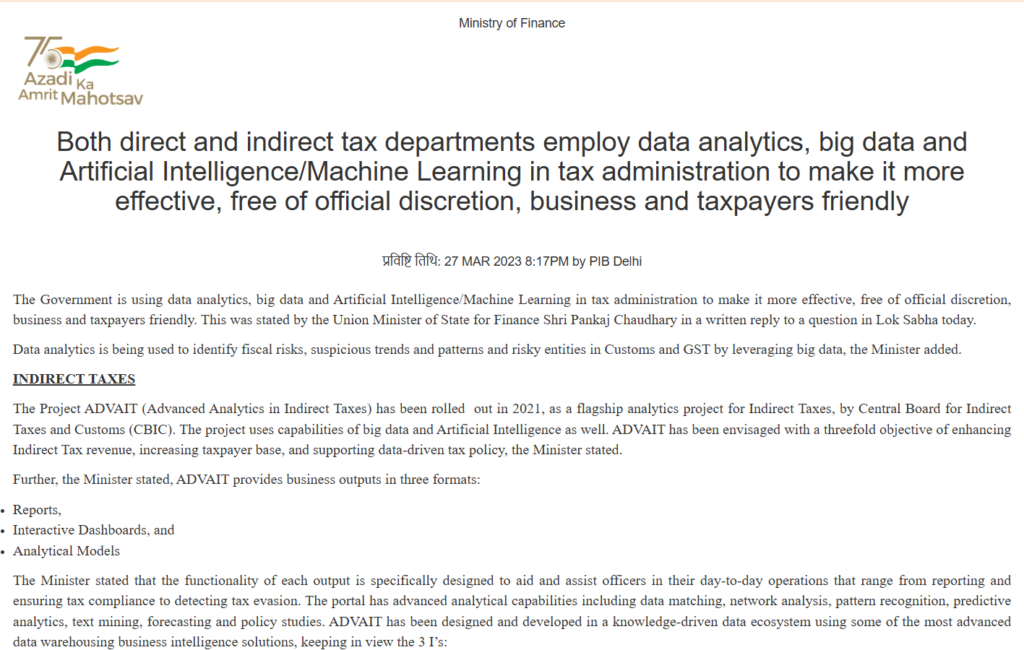
Caption :- Government presentation describing the use of AI, data analytics and machine learning in tax administration. Source: Ministry of Finance.
GST Analytics BIFA Platform
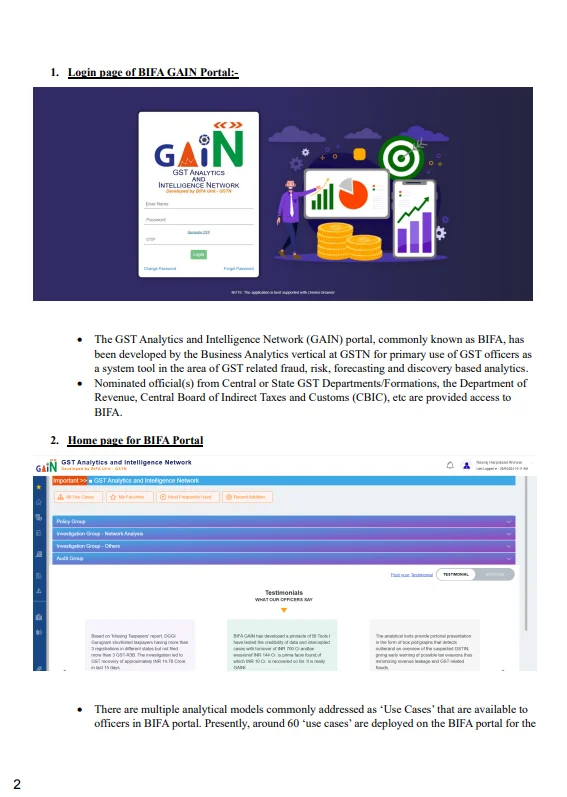
Caption :- Government analytical platform used for tax intelligence and compliance analytics. Source: Directorate General of Analytics & Risk Management.
1. The Anatomy of a Tier-N Supply Chain Contamination
To construct an unassailable legal defense, one must first master the backend data routing that triggers these enforcement notices. The department’s analytics engines employ network-graph analysis to map out the entire ledger lineage of a commodity or credit.
Multi-Tier Supply Chain Default Cascade
+------------------------------------------------------------------------------------------------------------------------+
|                                        UPSTREAM SUPPLY CHAIN CONTAMINATION BLUEPRINT                                   |
+------------------------------------------------------------------------------------------------------------------------+
|                                                                                                                        |
|  [Tier-3: Defaulting Entity]                                                                                           |
|     |                                                                                                                  |
|     v (Fails to file GSTR-3B / Absorbs Cash / Vanishes)                                                                |
|                                                                                                                        |
|  [Tier-2: Intermediary Supplier]                                                                                       |
|     |                                                                                                                  |
|     v (Passes on contaminated ITC to maintain margins)                                                                 |
|                                                                                                                        |
|  [Tier-1: Your Direct Supplier]                                                                                        |
|     |                                                                                                                  |
|     v (Genuine Manufacturer/Trader; Compliant GSTR-1 & 3B)                                                             |
|                                                                                                                        |
|  [The Innocent Corporate Buyer] --------------------► Faced with Sec 74 Show Cause Notice                              |
|                                                                                                                        |
+------------------------------------------------------------------------------------------------------------------------+
Cascade Stage Breakdown:
- • Tier-3 (Origin of Default): The rogue actor breaks the credit lifecycle by missing GSTR-3B filings or vanishing entirely from tax nets.
- • Tier-2 (Involuntary Conduit): Middle-tier suppliers unknowingly absorb and distribute the disrupted Input Tax Credit to guard margins.
- • Tier-1 (Direct Vendor): Your immediate compliant partner registers proper return filings, masking the upstream structural failure.
- • End Point (Corporate Buyer): The systemic burden lands on the final recipient via legal recovery orders and intense scrutiny threats.
I’ve seen clients go from zero-worry to total working capital paralysis in an afternoon because of one system-generated email. The discrepancy notice doesn’t look like a fraud investigation; it looks like a simple ledger mismatch, but the internal audit trail tells a much darker story
Before navigating deep-tier risks, remember: your GSTR-2B isn’t absolute immunity. Many still fall for the Deemed Acceptance Fallacy, trusting auto-population while ignoring hidden ledger gaps.
The Transactional Velocity
- The Upstream Origin (Tier-3): A non-existent or bill-pooling shell company issues an invoice to Tier-2 without physical movement of goods, or fails to discharge its tax liability via GSTR-3B after uploading GSTR-1.
- The Intermediary Conduit (Tier-2): Collects the invoice, pools the contaminated credit with genuine credit, and passes it forward to Tier-1.
- The Legitimate Hub (Tier-1): A highly compliant, active market player buys goods from Tier-2 in good faith, processes or trades them, discharges full tax liability via banking channels, and supplies the finished output to you.
- The Corporate Destination (You): You perform standard internal controls: verify Tier-1’s active GSTIN, match the invoice against GSTR-2B, record actual physical receipt via E-way bills, and pay the entire invoice value (inclusive of GST) through regular banking channels.
Three years later, DGGI raids or audits Tier-3. Finding no physical assets or promoters at the registered premises, the department’s analytical systems may identify downstream transaction chains for further investigation. Because the intermediary nodes (Tier-2 and Tier-1) may lack the immediate liquid liquidity or scale to absorb the massive systemic hit, In certain investigations, the department has issued notices to downstream recipients after identifying alleged upstream fraud. The legality of such recovery depends on the facts of the case and remains the subject of significant litigation.
2. The Structural Friction Across Professional Verticals
This systemic enforcement model bypasses standard auditing assumptions and introduces unique, unprecedented risks across professional ecosystems
In my recent interaction with a top-tier manufacturing CFO, we found that despite their ERP showing 99% GSTR-2B compliance, their exposure to a high-risk commodity trader in the steel sector was hidden in their Tier-2 supply chain. They were technically compliant, yet structurally vulnerable.
- For Statutory Auditors and CAs: Traditional sample-testing of purchase ledgers against GSTR-2B is no longer a safe harbor. Auditors face the challenge of evaluating contingent liabilities and verifying if their clients’ current assets (accumulated ITC) are structurally impaired by hidden upstream defaults.
- For Corporate CFOs and Management: A single multi-crore ITC reversal notice instantly disrupts corporate liquidity. It impairs net working capital, alters retrospective EBITDA calculations, and can destabilize long-term capital allocation strategies.
- For Bankers and Financial Advisors: Supply chain contamination introduces an invisible credit risk. A borrower company with flawless historical financials, a strong current ratio, and stellar credit ratings can instantly face insolvency or technical default if its primary banking channels are attached under Section 83 due to an upstream tax fraud investigation.
- For Bureaucrats and Tax Administrators: The pressure for revenue optimization requires navigating the fine balance between eradicating circular trading networks and inadvertently shutting down operational, tax-compliant industries through aggressive recovery actions.
Enforcement rules are evolving rapidly. Mastering the latest IMS Rules and Section 16 is now mandatory; without this, you’re leaving critical backdoors open for departmental scrutiny.
Consultant’s Note: Don’t just rely on your internal team. In my experience, even the most robust ERP systems (SAP/Tally) fail to flag upstream risks because they are designed to look ‘forward’ at your direct vendor, not ‘backward’ at their suppliers. If you are dealing with high-risk commodities like scrap, base metals, or chemicals, bring in a neutral third-party auditor to run an ‘Upstream Contamination Check’ once every quarter.
3. The Financial Impact: The Risk Assessment Framework
When a business receives an enforcement notice under Section 73 or Section 74 alleging supply chain contamination, calculating the immediate tax amount is a dangerous understatement of the true corporate liability. Financial professionals must deploy exact quantitative models to assess exposure and evaluate potential liquidity shocks.
Disclaimer :- The following models are enterprise risk assessment frameworks developed for financial planning and litigation preparedness. They are not statutory formulas prescribed under the CGST Act.
Formula 1: The Total Risk Exposure (TRE) Model
To evaluate the true cash-outflow impact of an upstream litigation notice over an extended timeline, corporate counsel must calculate the Total Risk Exposure (TRE) using the following formula:
Total Risk Exposure (TRE) Calculation
Parameter Details:
- • TRE = Total Risk Exposure / Total Liability Amount.
- • ITCDisputed = Disputed Input Tax Credit under audit or evaluation.
- • RInt = Annualized Interest Rate applicable to the non-compliance period.
- • TMonths = Time duration elapsed, represented explicitly in months.
- • PSec = Additional statutory Penalty or Security factor rate.
When I present this TRE calculation to a Board of Directors, they stop asking ‘Can we contest this?’ and start asking ‘How quickly can we liquidate our reserves?’ This formula turns a tax dispute into a board-level financial priority.
These TRE metrics aren’t just local data—they are the new gold standard for resilience. See how Global firms are neutralizing supply chain shocks to survive in today’s volatile market.
Real-World Application:
Consider Manufacturing Enterprise Co. which availed an ITC of ₹5,000,000 based on supplies from a verified Tier-1 vendor in FY 2022-23. In FY 2025-26 (after an elapsed period of exactly 36 months), the DGGI issues an SCN alleging fraud at the Tier-3 stage, invoking Section 74.
TRE Numerical Evaluation Step-by-Step
Applied Variable Values:
- • Base Credit Payload (ITCDisputed) = 5,000,000 units.
- • Annual Interest Factor (RInt) = 0.18 (Equates to an 18% statutory annualized rate).
- • Total Months Elapsed (TMonths) = 36 Months (Divided by 12 months to yield a 3-year term).
- • Flat Risk Penalty Multiplier (PSec) = 1.00 (Indicates a 100% additional base premium match).
A basic tax dispute of ₹50 Lakhs compounds into a massive ₹1.27 Crore liability, threatening the net profit margins of the entire operational year.
Formula 2: The ITC Concentration Index (ICI)
Auditors and risk managers must identify vulnerability before the department issues a notice. The ITC Concentration Index (ICI) quantifies an enterprise’s dependence on highly concentrated upstream sourcing networks:
Input Concentration Index (ICI) Formula
Parameter Details:
- • ICI = Input Concentration Index (A localized index evaluating dependency distribution metrics).
- • ITCVendor_i = The specific quantum of Input Tax Credit attributed to an individual vendor i.
- • Total ITC Availed in FY = The absolute aggregate ledger baseline of all valid ITC claimed within that specific Financial Year.
- • n = The total distinct number of transaction-linked supply vendors.
Where ITC_{Vendor_i} is the total inward credit derived from a single supplier group or distinct supply channel.
| ICI Score Range | Risk Classification | Action Required |
| ICI < 10 | Diversified / Low Risk | Standard quarterly GSTR-2B reconciliations. |
| 10 ≤ ICI ≤ 30 | Concentrated / Moderate Risk | Mandatory deep-dive verification of Tier-1 financial health. |
| ICI > 30 | Highly Vulnerable / Extreme Risk | Implement immediate legal indemnity and escrow holdbacks on GST components. |
Formula 3: The Tier-N Liquidity Shock Ratio (LSR)
Bankers assessing credit lines and corporate treasurers evaluating solvency under an active investigation must calculate the Liquidity Solvency Ratio (LSR) to test if the enterprise can sustain an unmitigated tax demand without operational cessation:
Liquidity Solvency Ratio (LSR) Formula
Parameter Details:
- • LSR = Liquidity Solvency Ratio (Measures defensive financial capacity against active audit exposures).
- • Free Cash Flow (FCF) = Immediate operating cash inflows leftover after capital expenditures.
- • Liquid Marketable Securities = High-grade financial assets quickly convertible to physical cash fields within 24–72 hours.
- • Estimated Contingent TRE = Total calculated risk exposure payload flag currently under active legal or compliance challenge.
- • Statutory Pre-Deposit Factor = The state-mandated fraction multiplier required to officially clear processing lines to appeal a demand ledger.
Where the Statutory Pre-Deposit Factor is typically set at 10\% (0.10) for filing an appeal before the First Appellate Authority under Section 107, or 20\% (0.20) for the Appellate Tribunal. If the LSR < 1.0, the company lacks the immediate financial buffer to even dispute the demand in court without severely impacting its working capital or defaulting on operational debt.
4. Operational Risk Mitigation: Pre-Emptive Sourcing Mathematics
To safeguard the enterprise from future supply chain breakdowns, procurement and finance heads must transition from basic portal checks to structured pricing and financial engineering models.
Formula 4: Risk-Adjusted Cost of Procurement (RACP)
When a raw material vendor quotes a price substantially below standard market velocity, the procurement team often overlooks the embedded tax risk. CFOs may consider adopting the Risk-Adjusted Cost of Procurement (RACP) to determine the true structural cost of acquiring goods from unverified or volatile suppliers:
Risk-Adjusted Compliance Provision (RACP)
Parameter Details:
- • RACP = Risk-Adjusted Compliance Provision (Total regulatory capital reserves required).
- • PBase = Base Statutory Provision or baseline standard penalty ledger.
- • ITCExpected = Total Expected Input Tax Credit undergoing systemic reconciliation.
- • α (Alpha) = Realization coefficient or verified vendor compliance probability rate.
- • TRE = Total Risk Exposure (Calculated asset-at-risk ceiling).
- • Pdef = Default factor adjustment or localized failure probability multiplier.
Using this model, a seemingly cheap raw material bid from an unverified source quickly exposes its hidden costs, allowing procurement managers to justify buying from premium, institutional vendors with near-perfect compliance records (alpha to 1).
The first time I suggested a ‘GST Holdback Escrow’ to a client, their vendor was offended. But when I showed them the risk of a potential 100% penalty under Section 74, the vendor agreed to the terms. This isn’t just accounting; it’s business survival.
Consultant’s Note: The ‘Vendor GST Holdback’ might seem like a drastic step that could strain your supplier relationships. However, I’ve found that transparently sharing the ‘Risk-Adjusted Cost’ (RACP) formula with your vendors actually builds trust. It shows them that you are a sophisticated, audit-ready organization, which discourages fraudulent entities from even approaching you in the first place.
Formula 5: The Vendor GST Holdback & Escrow Allocation Mechanism
For sectors dealing in highly vulnerable commodities, corporate accountants may consider implementing an automated financial ring-fencing mechanism within their ERP environments (such as Tally Prime or SAP S/4HANA). The disbursement of the tax component to a vendor must follow a strict risk-retention matrix:
Approved Payment to Vendor Calculation
Parameter Details:
- • Approved Payment to Vendor = Net safe clearance amount authorized for release to the supplier.
- • PBase = Core baseline payment portion (often representing the pure untaxed cost of goods/services).
- • GSTInvoice = Total absolute Input Tax Credit value passing through the specific invoice filing.
- • αVendor (Alpha Vendor) = Reliability index or historic compliance percentage score of the specific merchant.
- • Pdef = Systemic probability factor of default or expected non-reflection rate inside GSTR-2B matrixes.
The residual unallocated GST fraction is automatically routed to a Vendor GST Retention Ledger or an escrow account.
Having sat across the table from officers during adjudication proceedings, I know that ‘Bookish Compliance’ rarely saves you. The officer wants to see your ‘Intent.’ Did you do just the bare minimum portal check, or did you go the extra mile to verify the supplier’s warehouse presence and historical tax filing pattern?
Vendor Risk Assessment & Disbursement Chain
💡 Systemic Safeguard: Splitting operations dynamically holds down balance values inside the Retention Ledger (Stage 3) until cross-verification clears risk parameters.
GST holdbacks are a core governance mandate, not just a tax formality. See how modern finance leaders use Financial Ring-Fencing to stay ahead of today’s automated tax enforcement.
5. The Advanced Legal Defense Blueprint
When a corporate entity is served an SCN under Section 74 demanding the reversal of ITC due to a Tier-N default, the response must be meticulously structured around fundamental legal maxims, constitutional guarantees, and established judicial precedents.
Supplier’s Sin Buyer’s Penalty GST
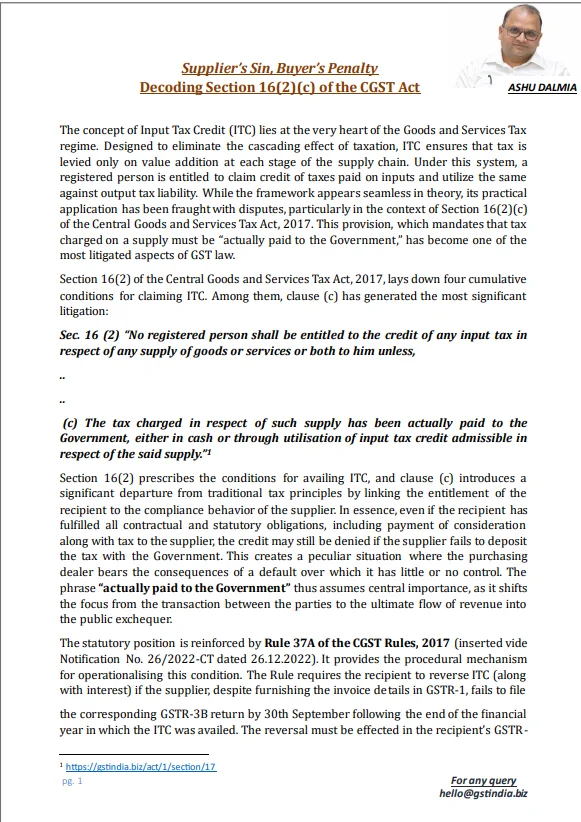
Caption :- Academic legal analysis discussing the practical impact of supplier default under Section 16(2)(c). Source: Original author publication.
A. Invoking the Constitutional Doctrine of Impossibility
The foundational pillar of your litigation defense must be the ancient legal maxim:
Lex Non Cogit Ad Impossibilia — The law cannot compel a person to perform an act which is completely impossible for them to execute.
A purchasing enterprise is a private actor; it possesses no statutory power, judicial authorization, or digital mechanism to step into the offices of its Tier-1 supplier and perform a deep forensic audit of Tier-2 or Tier-3’s accounting books, physical infrastructure, or tax remittance behaviors.
The struggle between automated tax mandates and legal justice is global. For insights on how digital systems reshape financial governance, this World Bank framework is essential.
The GST common portal provides a public utility to check the immediate registration status of a direct counterparty. It offers absolutely no facility to trace the deep genealogy of upstream credits. To penalize an innocent purchaser for an un-verifiable default committed three tiers away may amount to an arbitrary exercise of power capable of being challenged under Articles 14 and 19(1)(g) (Right to practice any trade or business) of the Constitution of India.
When notices arrive, process beats panic. Understanding DRC-01C compliance is your first line of defense to turn a procedural trap into a litigation-proof workflow.
B. Shifting the Burden of Proof under Section 155
Section 155 of the CGST Act states that where any person claims eligibility for Input Tax Credit, the burden of proving such claim lies on that specific individual. To successfully shift this burden back onto the tax department, the corporate taxpayer must front-load their reply with an indisputable trail of physical and financial evidence:
- Statutory Invoices: Pristine copies of tax invoices conforming completely to the mandates of Section 31 and Rule 46 of the CGST Rules.
- Irrefutable Logistical Proof: Clean E-way bills with complete distance-time matching, physical Lorry Receipts (LR) from independent third-party logistics firms, weighbridge receipts, and security gate entry logs showing exact truck numbers matching the invoice details.
- The Financial Trail: Bank statements confirming that the entire invoice value (Base Price + GST) was cleared to the Tier-1 vendor via banking channels within the 180-day window mandated by the proviso to Section 16(2).
- GSTR-2B Reconciliations: Historically stamped prints showing that the credit was fully visible and auto-populated, confirming that the immediate supplier declared the turnover to the state.
Once this comprehensive portfolio is placed on record, the taxpayer has discharged their primary statutory burden. the taxpayer may be regarded as having discharged the initial evidentiary burden. Thereafter, the department must substantiate allegations of fraud or collusion through cogent material.
C. Challenging the Arbitrary Sequence of Recovery
A critical flaw in many enforcement actions is the department’s tendency to target the end-buyer simply because they are an active, operational company with accessible bank accounts and fixed assets, while ignoring the actual defaulting entities upstream.
Maruti Enterprise Judgment
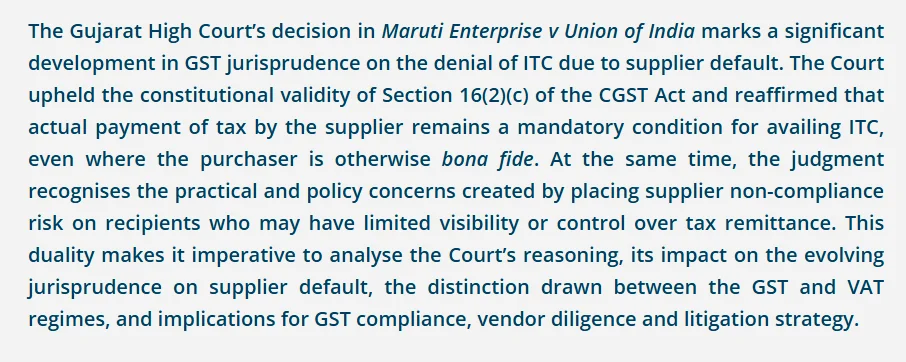
Caption :- Excerpt discussing judicial observations on supplier default and Section 16(2)(c). Source: Referenced legal commentary.
Litigators must argue that recovery proceedings under the framework of Section 73 and Section 74 must strictly follow a logical, sequential path of causation. The tax department cannot directly jump to the bona fide end-buyer without first demonstrating that they have exhausted all statutory recovery mechanisms (such as asset attachments under Section 83 or demand executions under Section 79) against the specific upstream node that actually retained the tax money and committed the core default (Tier-3 or Tier-2). Targeting the buyer first, without initiating proceedings against the actual perpetrator of the fraud, constitutes a fundamental violation of the principles of natural justice.
6. Advanced FAQs for Tax Practitioners and Auditors
Q1: Can the department extend the standard limitation period and issue a notice under Section 74 for a default committed at the Tier-2 or Tier-3 stage?
The department frequently attempts this by alleging that the entire supply chain is part of a grand design to defraud the revenue. However, the extended period of limitation under Section 74 can only be invoked if there is willful misstatement or suppression of facts by the specific taxpayer facing the notice. If you can conclusively demonstrate that you acted in good faith, had no corporate link or shared directors with the defaulting upstream tiers, and maintained flawless physical and financial records, the invocation of Section 74 is legally invalid. The demand must be contested as time-barred.
Q2: How should an enterprise handle a situation where the department blocks its Electronic Credit Ledger under Rule 86A due to an upstream investigation?
Rule 86A allows a tax officer to temporarily block the utilization of ITC if they have reasons to believe that the credit has been fraudulently availed. If the blocking is triggered by a Tier-3 default, you must file a detailed writ or objection before the Commissioner. Argue that reasons to believe cannot be based on third-party actions or generic systemic alerts; they must be backed by independent, material evidence linking your enterprise to the fraud. Furthermore, note the absolute statutory sunset clause: any ledger blocking under Rule 86A automatically ceases to have effect after the expiry of exactly one year from the date of such introduction.
Q3: If a Tier-1 vendor provides an indemnity bond promising to cover any future GST losses, does that completely insulate the buyer?
No. An indemnity bond is a private contractual instrument enforceable under the Indian Contract Act, 1872. It does not bind the GST department or stop them from issuing statutory notices or executing recovery demands against you. While it gives your business a legal right to sue the Tier-1 vendor in civil courts to recover damages after you pay the tax department, it does not prevent the initial financial disruption caused by an active GST enforcement action.
A Case from the Trenches: Last year, a client of mine faced a notice that seemed impossible to fight. The department was pushing for a massive reversal because their Tier-3 supplier had defaulted. We didn’t just dump raw invoices on the officer. Instead, we performed ‘Timeline Mapping’—we showed the department that the Tier-3 defaulter had actually vanished from the system before our client even placed the first order with their direct vendor. That specific evidence proved our lack of mens rea (criminal intent) and broke the department’s chain of accusation. That is the level of forensic evidence you need to prepare today.
The arguments above are aligned with the evolving principles of natural justice and the shifting judicial landscape regarding ITC reversal, as emphasized in recent High Court rulings concerning the bona fide nature of transactions.
Supreme Court keeps Section 16(2)(c) challenge open
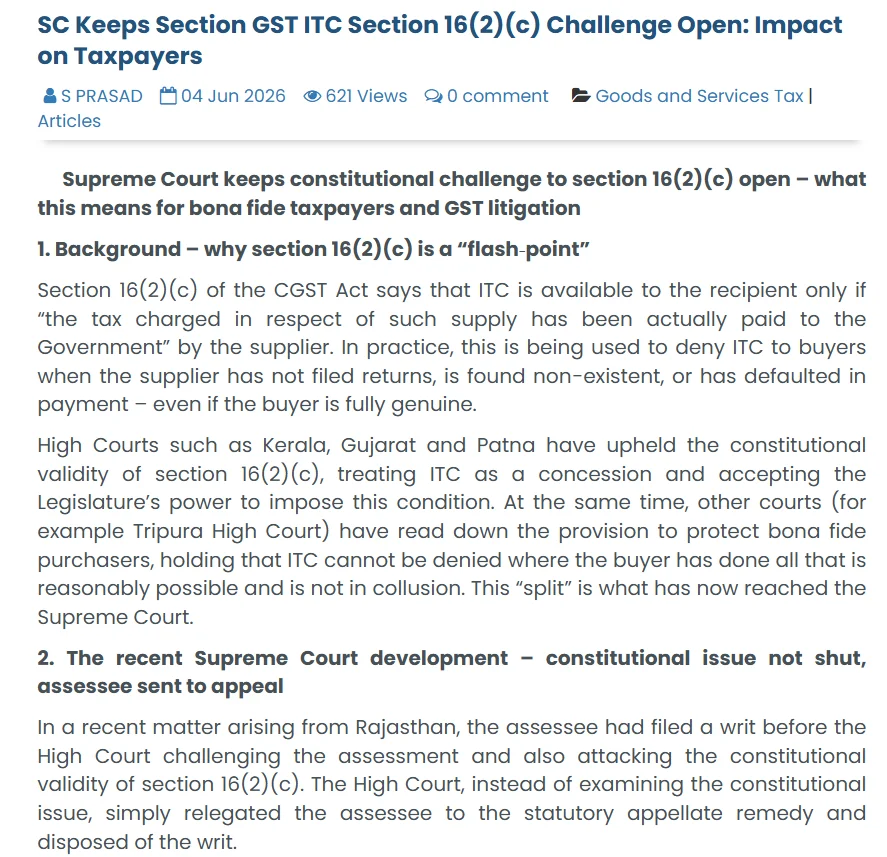
Caption :- Screenshot of recent legal reporting highlighting the continuing constitutional challenge surrounding Section 16(2)(c). Source: Taxscan.
Conclusion
Supply Chain Contamination represents the next critical battleground in indirect tax litigation. As tax administrations rely more heavily on automated algorithms and data networks to safeguard the exchequer, the compliance burden on legitimate enterprises increases exponentially. For Chartered Accountants, CFOs, and Legal Counsel, managing this risk requires a decisive pivot away from basic compliance tracking and toward proactive asset protection. By integrating advanced mathematical risk metrics (like the TRE and ITC Concentration Index) directly into procurement protocols, establishing clear vendor retention rules within accounting systems, and deploying aggressive constitutional defenses during litigation, professionals can effectively secure their organizations against the hidden dangers of upstream defaults.
Statutory Corporate Disclaimer: The analytical models, mathematical formulas, legal strategies, and commentary contained in this document are for advanced educational and informational purposes only. They do not constitute formal legal opinion, tax advice, or a structured professional consultation. GST legislation, digital administrative frameworks, and judicial interpretations are subject to rapid evolution and localized variation across state boundaries. Readers are strictly advised to consult with their appointed legal counsel or a qualified, registered tax practitioner to review the specific factual matrices, contractual structures, and jurisdictional nuances of their unique corporate environments before making any statutory commitments or executing any litigation strategies.
Strategic Takeaway :- Tax compliance is no longer a backend clerical function; it is a front-line financial strategy. If your systems are not mapping your supply chain beyond Tier-1, you are essentially flying blind in a stormy data-led enforcement environment.

Anurag Panchal
Founder & Chief Editor of ServiceMoney.in & AllRoundUpdate.com.
Expert in IMS Reconciliation Frameworks and Risk-Splitting Disbursement Models.
Focused on protecting businesses from Sec 74 Show Cause Notices through automated compliance verification and audit-ready data chains.
Deep-dive insights: @Educationanurag.


