

The implementation of Rule 88C of the Central Goods and Services Tax (CGST) Rules, 2017—introduced vide Notification No. 26/2022–Central Tax—has fundamentally altered the compliance landscape by operationalizing a rigid automated discrepancy-signaling matrix between outward supplies declared in Form GSTR-1 and the outward tax liability discharged in Form GSTR-3B. While designed to curtail revenue leakage without direct human intervention, the automated architecture of Rule 88C & Section 79 has simultaneously manufactured an acute procedural friction point for multi-jurisdictional enterprises.
When the automated system detects a variance exceeding prescribed threshold limits or percentage parameters between GSTR-1 and GSTR-3B, it automatically triggers Form GST DRC-01B (Part A), serving an electronic intimation to the registered person. Under the strict architecture of the rule, the taxpayer is subjected to a compressed limitation window of 7 days to either:
- Deposit the differential tax liability along with applicable interest under Section 50 via Form DRC-03, or
- Furnish a detailed explanation elucidating the reasons for such divergence in Form GST DRC-01B (Part B).
GST Portal Return Compliance Navigation
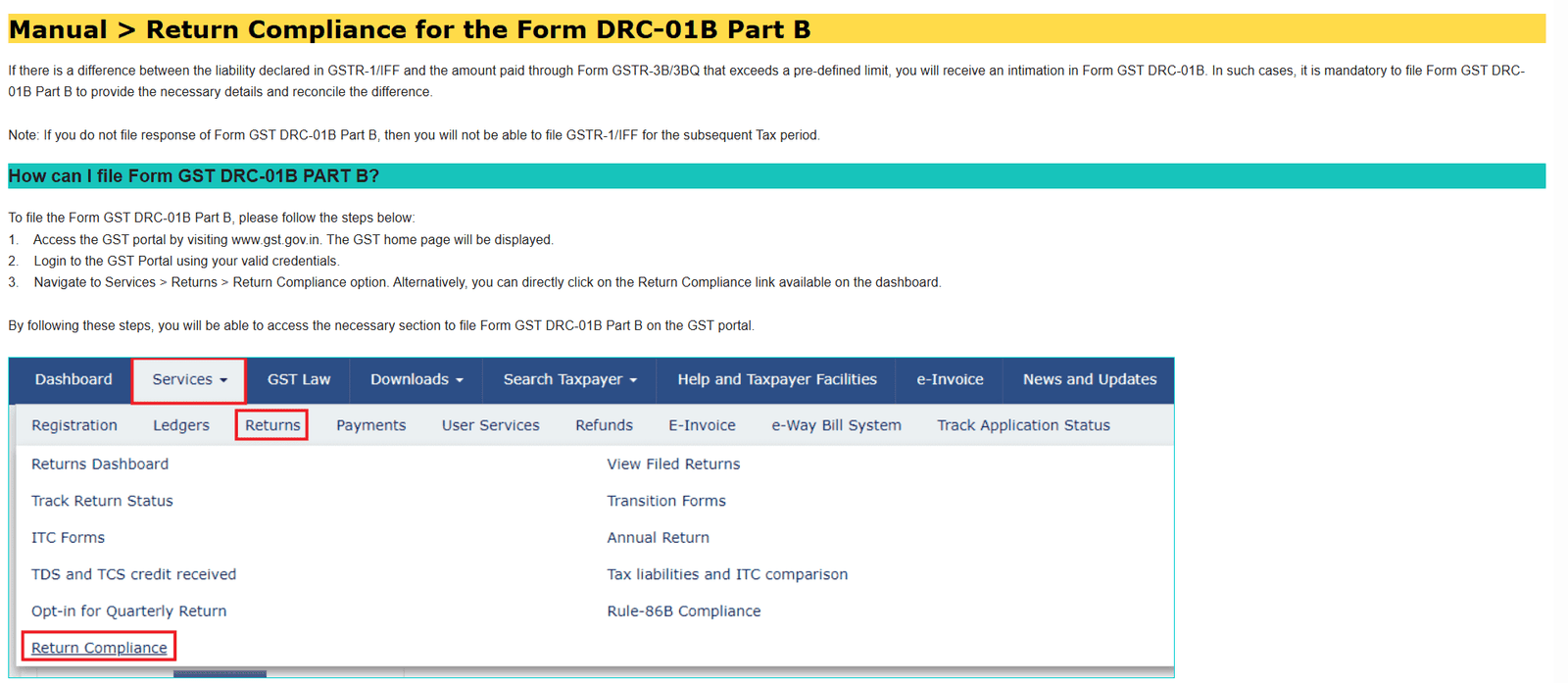
Caption :- Step-by-step navigation path on the GST portal to access Return Compliance for filing Form DRC-01B Part B. Source: [GST Official User Guide Portal]
Before automated notices escalate into coercive recovery, finance teams must understand how statutory safeguards operate. Discover how to tackle direct demands through our detailed guide on GST Sec 75(12) Defense.
The Legislative Contradiction: Section 75(12) vs. Section 79
The central statutory friction arises when field formations attempt to weaponize the Explanation to Section 75(12) of the CGST Act, 2017. Section 75(12) empowers tax authorities to initiate direct recovery proceedings under Section 79 for self-assessed tax liability as reflected in GSTR-1, bypassing the elaborate show-cause notice (SCN) architecture under Section 73 or Section 74.
Revenue authorities frequently commit severe quasi-judicial overreach by conflating unreconciled reporting variances (such as temporary timing differences in multi-state stock transfers, inter-unit adjustments, and e-way bill valuation variances) with an unconditional, admitted self-assessed tax liability.
Automated discrepancies often begin upstream with preliminary scrutiny flags. If your ERP is repeatedly flagged, you can master systematic resolutions using our playbook on ASMT-10 Notices.
Critical Legal Distinction: A mismatch populated by automated risk-parameters on the portal is merely a statistical variance. It does not possess the legal character of an “admitted tax liability” under Section 75(12) unless the taxpayer explicitly concedes the liability or the statutory verification process under Rule 88C is fully exhausted.
Why Automated Recovery Violates Natural Justice and Statutory Intent
The deployment of automated Section 79 garnishee notices (direct bank attachments, debtor blocking, and third-party asset freezes) prior to the completion of the Rule 88C lifecycle constitutes a direct infringement of Audi Alteram Partem and runs ultra vires the CGST Act.
1. The Fiction of “Self-Assessed Tax” in Multi-State Inter-Unit Dynamics
Under the statutory framework, self-assessment is inextricably linked to the statutory returns filed under Section 39 (GSTR-3B), where the taxpayer computes and discharges their net tax liability after adjusting input tax credit. GSTR-1 is fundamentally a statement of outward supplies, serving a reporting and matching function. Treating a reporting mismatch between these two returns as an automatic admission of tax ignores the complex reality of modern supply chains, where:
- Multi-state branch transfers between distinct persons (under Schedule I read with Section 25) are valuation-sensitive and frequently subject to subsequent inter-unit credit notes or debit adjustments.
- E-way bill valuations often incorporate freight, insurance, or post-supply discounts that may not align instantaneously with invoice-level GSTR-1 reporting schemas due to ERP synchronization lags.
2. Procedural Bypass and Absence of Adjudicatory Scrutiny
By directly freezing bank accounts via Section 79 without waiting for the expiration of the 7-day window under Rule 88C—or entirely ignoring the explanations furnished in Part B of DRC-01B—the Proper Officer subverts the multi-tiered safeguard mechanism built into the statute. Section 79 is a summary recovery tool designed exclusively for undisputed, ascertained, and crystallized demands (such as confirmed adjudication orders, self-assessed returns where GSTR-3B itself shows unpaid tax, or undisputed demand notices). Applying it to dynamic GSTR-1 vs. GSTR-3B reconciliation variances amounts to executing recovery without statutory backing, rendering the attachment orders void ab initio.
| Nature of Discrepancy / Trigger | Department’s Automated Approach (Section 79 Overreach) | Legal Reality & Statutory / Judicial Shield |
|---|---|---|
| Multi-State Branch Transfers | Treating valuation differences (Rule 28) or inter-unit stock movements as suppressed outward supplies. | Recognized as distinct-person internal transfers; subject to subsequent adjustments and valuation audits, not instant tax evasion. |
| E-Way Bill Valuation Lags | Mechanically matching invoice values with e-way bill generation values without accounting for freight/discounts. | Temporary reporting lags or valuation components; protected by CBIC Instruction No. 01/2022-GST against premature coercive action. |
| Inter-Unit Adjustments | Issuing automated garnishee notices to banks (DRC-09) bypassing Rule 88C/DRC-01B window. | Declared illegal by Madras HC in Caterpillar India, ruling that DRC-01B procedure is a mandatory jurisdictional prerequisite. |
The Shield: CBIC Instruction 01/2022-GST
To curb the rampant abuse of coercive recovery mechanisms by field formations, the Central Board of Indirect Taxes and Customs (CBIC) issued Instruction No. 01/2022-GST dated January 07, 2022. This circular serves as an authoritative protective shield for taxpayers facing aggressive automated enforcement.
Key Mandates of Instruction 01/2022-GST:
- Prohibition of Premature Recovery: The circular explicitly commands field officers that direct recovery or automated bank attachments under Section 79 cannot be adopted as the first step for alleged discrepancies where returns do not match.
- Mandatory Communication and Opportunity: The Proper Officer is legally bound to issue a formal communication, afford a reasonable opportunity of being asked and heard, and allow the taxpayer adequate time to substantiate their reconciliation before initiating any coercive recovery.
- Verification of Revenue-Neutral Variances: Field officers are specifically directed to verify whether discrepancies arise from genuine clerical oversights, typographical mistakes, multi-state stock transfer pricing adjustments, or inter-unit accounting reallocation before treating them as tax evasion or short-payment.
Compliance with this instruction is mandatory for all tax authorities. Any deviation constitutes a procedural illegality that provides immediate grounds for invoking the writ jurisdiction of the High Courts under Article 226 of the Constitution of India.
High Court Precedents: Judicial Safeguards Against Arbitrary Coercion
Judicial scrutiny across various High Courts has consistently struck down mechanical, automated recovery actions that bypass statutory safeguards. Tax litigators can rely on the following landmark ratios to dismantle illegal bank attachments:
1. M/s Caterpillar India Pvt. Ltd. v. Assistant Commissioner (Madras High Court – W.P. No. 28092 of 2023)
- Ratio Decidendi: The Madras High Court held that strict adherence to the procedural milestones prescribed under Rule 88C and the thorough examination of the taxpayer’s reconciliation explanation are mandatory jurisdictional prerequisites before invoking the draconian machinery of Section 79. The court unequivocally quashed direct recovery notices issued by authorities who bypassed the structured DRC-01B mechanism, establishing that automated alerts cannot substitute statutory adjudication.
2. Devashish Barua v. State of Assam & Ors. (Gauhati High Court)
- Ratio Decidendi: The Gauhati High Court reinforced that tax mismatches stemming from inadvertent data-entry errors, clerical slips, or software reporting discrepancies cannot be mechanically characterized as “admitted self-assessed tax liability.” The court emphasized that a taxpayer must be granted an effective window to reconcile records before any coercive measures are deployed against their commercial assets.
3. Mahadeo Construction Co. v. Union of India (Jharkhand High Court)
- Ratio Decidendi: A landmark authority establishing that summary recovery proceedings under Section 79 are wholly illegal unless the tax liability has been officially quantified through a proper adjudicatory mechanism or has been explicitly and unconditionally admitted by the taxpayer in their statutory returns.
Strategic Action Plan and Proactive Defense Framework
Practicing tax professionals, CFOs, and corporate counsels must adopt a two-pronged strategy—combining rigorous procedural compliance with immediate judicial remedies—to counter automated overreach.
+----------------------------------------------------------------------------------+
                     PROACTIVE LITIGATION & DEFENSE PIPELINE
+----------------------------------------------------------------------------------+
[Step 1: Immediate DRC-01B Part B Submission]
* File detailed cross-state reconciliation statement within 7 days.
* Attach ERP audit logs, e-way bill registers, and inter-unit ledgers.

            │
            ▼
[Step 2: Interception & Representation Letter]
* Serve formal notice to jurisdictional Commissioner & Bank Branch.
* Cite CBIC Instruction 01/2022-GST and Caterpillar India precedent.

            │
            ▼
[Step 3: High Court Writ Petition (Article 226)]
* Invoke writ jurisdiction if bank attachment is executed prematurely.
* Pray for certiorari to quash Section 79 notice & mandamus for lift.
+----------------------------------------------------------------------------------+
- Immediate DRC-01B Part B Submission: Upon receipt of Form GST DRC-01B (Part A), the taxpayer must not default on the 7-day timeline. A comprehensive Cross-State Reconciliation Statement must be uploaded in Part B, explicitly mapping multi-state stock transfers, e-way bill valuation differences, and inter-unit billing adjustments.
- Interception Letter for Bank Freezes: If an automated Section 79 garnishee notice is slapped onto the taxpayer’s banker despite pending reconciliations, an immediate representation must be served on the jurisdictional Assistant/Deputy Commissioner and the bank branch manager. This letter must formally place on record the violation of CBIC Instruction No. 01/2022-GST and the binding ratios of Caterpillar India and Mahadeo Construction.
- Constitutional Challenge via Writ: If revenue authorities refuse to lift illegal bank attachments, invoke Article 226 of the Constitution of India before the jurisdictional High Court. The petition should challenge the action as being ultra vires Section 75(12), violative of principles of natural justice, and suffering from a complete lack of jurisdictional prerequisite.
Section 3: The Shield — CBIC Instruction No. 01/2022-GST as a Binding Procedural Check
The invocation of coercive recovery measures via Section 79 of the CGST Act, 2017, in response to automated GSTR-1 versus GSTR-3B discrepancies, has been systematically circumscribed by the Central Board of Indirect Taxes and Customs (CBIC) vide Instruction No. 01/2022-GST dated January 07, 2022. For practicing litigators and corporate tax counsels, this instruction serves as a foundational enforcement safeguard against arbitrary, high-handed field administration.
Staying ahead of portal deadlines requires regular monitoring of your dashboard alerts. You can cross-verify compliance statuses and statutory updates directly by visiting the GST Official Portal.
1. Regulatory Status and Binding Nature on Field Formations
Issued under the statutory administrative powers governing tax administration, CBIC instructions and circulars are binding on all subordinate field formations under Section 168 of the CGST Act. Field officers do not possess the discretion to bypass or dilute these instructions under the guise of automated revenue protection. When automated portals flag variances—particularly those emerging from multi-state branch transfers, e-way bill valuation discrepancies, or inter-unit accounting adjustments—the Proper Officer is strictly bound by the following statutory protocols:
- Prohibition of Direct Garnishee Action: The instruction explicitly mandates that direct recovery or automated bank attachments under Section 79 cannot be adopted as the initial recourse upon the identification of a mismatch between outward supplies declared in GSTR-1 and tax discharged in GSTR-3B.
- Mandatory Communication and Opportunity of Being Heard: Before any recovery mechanism is set into motion, the Proper Officer must issue a formal communication, afford a reasonable opportunity of being asked and heard, and grant the taxpayer adequate time to substantiate their reconciliation explanations.
- Verification of Revenue-Neutral and Timing Variances: The instruction directs field officers to independently verify whether variances are attributable to genuine clerical mistakes, typographical errors, multi-state stock transfer pricing adjustments, or subsequent-month reporting corrections before characterizing them as tax evasion or short payment.
2. Neutralizing Automated Overreach in Multi-State Inter-Unit Dynamics
In the context of multi-state operations, inter-branch transfers often attract valuation complexities under Rule 28 of the CGST Rules, 2017, or timing lags between e-way bill generation and invoice reporting. CBIC Instruction No. 01/2022-GST acts as a statutory shield by recognizing that these are accounting and timing differentials rather than suppressed liabilities. Consequently, any preemptive freeze of a taxpayer’s current accounts or cash credit facilities under Section 79, without first allowing the taxpayer to reconcile these entries through the prescribed administrative channels, is rendered legally unsustainable and ultra vires the established administrative guidelines.
Section 4: High Court Precedents and the Rule of Law
When field formations flout statutory instructions and proceed with arbitrary coercive recoveries, the judiciary has consistently stepped in to uphold the rule of law. Tax litigators can rely on the following landmark High Court rulings to challenge and set aside illegal recovery actions:
1. M/s Caterpillar India Pvt. Ltd. v. Assistant Commissioner (Madras High Court — W.P. No. 28092 of 2023)
- Ratio Decidendi: The Madras High Court firmly established that complying with the procedural mandates of Rule 88C/Form GST DRC-01B and thoroughly examining the taxpayer’s reconciliation explanation constitutes a mandatory jurisdictional prerequisite before invoking the summary recovery provisions of Section 79. The court ruled that automated alerts generated by electronic portals cannot substitute the mandatory requirement of natural justice. Consequently, direct recovery notices issued by bypassing the DRC-01B mechanism were declared illegal and quashed.
2. Devashish Barua v. State of Assam & Ors. (Gauhati High Court)
- Ratio Decidendi: The Gauhati High Court addressed the arbitrary classification of clerical errors as “admitted tax liability.” The court held that discrepancies arising from inadvertent data entry slips, clerical oversights, or software synchronization lags cannot be mechanically treated as an unconditional admission of self-assessed tax under Section 75(12). The ruling reinforces that a taxpayer must be afforded a fair and effective window to reconcile records before any coercive measures are deployed against their commercial assets.
3. Mahadeo Construction Co. v. Union of India (Jharkhand High Court)
- Ratio Decidendi: This landmark judgment established the precise boundaries of Section 79 recovery powers. The court held that summary recovery proceedings under Section 79 are entirely illegal unless the tax liability has been officially quantified through a proper adjudicatory process under Sections 73/74 or has been explicitly and unconditionally admitted by the taxpayer in their statutory returns. The ratio prevents tax authorities from treating mere reconciliation variances as crystallized demands subject to immediate attachment.
Modern tax governance requires insulating your workflow from algorithmic scrutiny. Learn how to safeguard your ledgers against automated flags with our expert analysis on AI-Generated ASMT-10.
Section 5: Litigation Strategy — Proactive Defense Protocol and Practical Blueprint Against Rule 88C & Section 79 Arbitrary Bank Freezes
When corporate taxpayers are confronted with automated discrepancy alerts between Form GSTR-1 and Form GSTR-3B involving complex multi-state branch transfers, e-way bill valuation variances, and inter-unit adjustments, a passive compliance approach invites aggressive recovery measures. To neutralize the threat of arbitrary bank freezes under Section 79, tax practitioners, CFOs, and litigators must execute a rigorous, multi-tiered proactive defense protocol.
Grounding your defense in established judicial logic protects your enterprise from arbitrary executive actions. Legal practitioners frequently review landmark interpretations on the Supreme Court of India Official Website
1. Architecting Form GST DRC-01B (Part B) Submissions
Upon the electronic receipt of Form GST DRC-01B (Part A), the taxpayer has a strict 7-day limitation window to file Part B. A perfunctory or generalized reply will be summarily rejected by automated risk engines, triggering coercive Section 79 action. The Part B submission must be treated as a quasi-judicial pleading and structured with mathematical and legal precision:
- Comprehensive Cross-State Reconciliation Statement: Establish an itemized, ledger-to-ledger audit trail mapping every outward supply declared in GSTR-1 against the corresponding tax discharge in GSTR-3B.
- Deconstructing Multi-State Branch Transfers: Explicitly segregate stock transfers between distinct persons (under Schedule I read with Section 25). Reconcile valuation differences arising from Rule 28 of the CGST Rules, 2017, by attaching certified cost-sheet certificates or contemporaneous open-market valuation evidence.
- E-Way Bill vs. Invoice Valuation Mapping: Provide a reconciliation matrix reconciling e-way bill generation values with taxable turnover, explicitly isolating components such as freight, insurance, transit insurance, and post-supply credit notes that account for temporary reporting mismatches.
- Timing and Subsequent-Month Adjustments: Demonstrate how invoices reported in GSTR-1 of a preceding tax period were duly accounted for in GSTR-3B of a subsequent period (or vice versa), proving the revenue-neutrality of the temporal lag.
+------------------------------------------------------------------------------------------------+
                      7-DAY COMPLIANCE WINDOW & DEFENSE ARCHITECTURE
+------------------------------------------------------------------------------------------------+

       [DAY 1 - 2: ERP AUDIT & IDENTIFICATION]
         │
         ├──> Pull system-generated logs for flagged GSTR-1 vs. GSTR-3B variance.
         └──> Isolate branch transfers, e-way bill valuation, or credit note gaps.
         │
         ▼
       [DAY 3 - 4: CROSS-STATE LEDGER RECONCILIATION]
         │
         ├──> Reconcile inter-unit ledgers, registers, and cost sheets.
         └──> Establish itemized mathematical proof of revenue-neutrality.
         │
         ▼
       [DAY 5 - 6: DRAFTING PART B EXPLANATION]
         │
         ├──> File Form GST DRC-01B (Part B) on the official portal.
         └──> Attach matrix & invoke CBIC Instruction No. 01/2022-GST.
         │
         ▼
       [DAY 7: PRE-EMPTIVE INTERCEPTION SHIELD]
         │
         └──> Serve Pro-forma Representation Letter to jurisdictional Officer
              to block executive overreach & preempt Section 79 bank attachments.

+------------------------------------------------------------------------------------------------+
2. The Pre-emptive Interception Letter (Placing CBIC Instruction 01/2022-GST on Record)
If the Proper Officer issues intimidating communications or shows propensity to initiate coercive recovery without affording an effective hearing, the taxpayer must immediately serve a formal Interception and Protest Representation to the jurisdictional Assistant/Deputy Commissioner before any garnishee order is dispatched to banks.
Navigating automated enforcement requires a thorough understanding of central administrative circulars. Tax authorities govern these protocols based on official circulars published on the CBIC Official Website
- Jurisdictional Challenge: The representation must explicitly invoke CBIC Instruction No. 01/2022-GST (Dated: January 07, 2022), asserting that direct recovery or automated bank attachments under Section 79 cannot be adopted as the first resort for unverified matching variances.
- Binding Ratios Citation: Formally place on record the binding legal ratios of M/s Caterpillar India Pvt. Ltd. v. Assistant Commissioner and Mahadeo Construction Co. v. Union of India, putting the department on notice that any precipitate recovery action bypassing Rule 88C and DRC-01B is ultra vires the statute and will attract immediate exemplary costs via writ proceedings.
3. Post-Attachment Legal Recourse: The Litigation Protocol
Should field formations commit procedural illegality by freezing current accounts or cash credit facilities via Section 79 garnishee notices without completing the statutory adjudication or ignoring the DRC-01B Part B submission, the defense must instantly pivot to active litigation:
+----------------------------------------------------------------------------------+
                        POST-ATTACHMENT LITIGATION PROTOCOL
+----------------------------------------------------------------------------------+
[Step A: Immediate Representation & Form DRC-09 Objections]
* Serve urgent notice to Proper Officer & Banker citing illegal freeze.
* Demand immediate withdrawal of garnishee under Section 79.

            │
            ▼
[Step B: High Court Writ Petition (Article 226)]
* File Writ Petition challenging action as ultra vires Section 75(12).
* Plead violation of Audi Alteram Partem and CBIC Instruction 01/2022.

            │
            ▼
[Step C: Interim Stay & Mandamus Relief]
* Secure interim stay on recovery & writ of mandamus for unfreezing accounts.
* Establish commercial prejudice and absolute revenue-neutrality.
+----------------------------------------------------------------------------------+
- Immediate Objections to the Proper Officer and Banker: Issue a formal legal notice to both the initiating tax authority and the branch manager of the victimized bank. Highlight that Section 79 cannot be invoked for unadjudicated statistical mismatches, demanding the immediate withdrawal of the garnishee notice.
- High Court Writ Petition under Article 226: If authorities fail to lift the attachment within 24 to 48 hours, move the jurisdictional High Court invoking extraordinary writ jurisdiction. The petition must seek a Writ of Certiorari to quash the Section 79 notice as being ultra vires Section 75(12), and a Writ of Mandamus directing the immediate unfreezing of bank accounts, underpinned by proof of commercial hardship and absolute revenue-neutrality.
Conclusion: The Definitive Legal Standard
Definitive Legal Standard: Automated electronic data-matching parameters—whether under Rule 88C or Section 75(12)—cannot substitute statutory due process, nor can they elevate unreconciled reporting variances, multi-state branch transfer adjustments, or e-way bill valuation discrepancies into an unconditional, self-assessed tax liability. Any attempt by tax authorities to deploy Section 79 recovery or automated bank attachments without first exhausting the mandatory procedural safeguards of DRC-01B and adhering to CBIC Instruction No. 01/2022-GST is a nullity in law, suffering from fatal jurisdictional overreach and rendering itself liable to be struck down under Article 226 of the Constitution of India.
Frequently Asked Questions (FAQs): Advanced Litigation & Compliance Insights
Q1. Can the Proper Officer initiate Section 79 recovery if the 7-day window under Rule 88C is still active or if Part B of DRC-01B has been filed ?
No. Complying with the procedural architecture of Rule 88C and Form GST DRC-01B—including the mandatory 7-day window for depositing the differential tax or submitting explanations in Part B—constitutes a mandatory jurisdictional prerequisite before invoking the summary recovery machinery of Section 79. As established by the Madras High Court in M/s Caterpillar India Pvt. Ltd. v. Assistant Commissioner (W.P. No. 28092 of 2023), automated portal alerts or pre-emptive recovery notices issued by bypassing the structured DRC-01B adjudication and reconciliation phase are illegal, arbitrary, and ultra vires the statute.
Q2. How does CBIC Instruction No. 01/2022-GST protect a company against mismatches arising purely from revenue-neutral multi-state branch transfers or stock valuation lags?
Issued under statutory administrative powers, CBIC Instruction No. 01/2022-GST (Dated: January 07, 2022) is binding on all subordinate field formations. It explicitly commands that direct recovery or automated bank attachments under Section 79 cannot be adopted as the first recourse upon identifying a GSTR-1 vs. GSTR-3B variance. The instruction mandates that field officers afford a formal communication, reasonable time, and an opportunity of being heard to verify whether discrepancies stem from multi-state stock transfer pricing adjustments, valuation rules, or temporal reporting lags. Any coercive freeze violating these instructions is procedurally infirm and legally unsustainable.
Q3. Can a typographical or clerical mismatch between GSTR-1 and 3B be legally treated as “admitted self-assessed tax liability” under Section 75(12)?
Absolutely not. The Explanation to Section 75(12) permits direct recovery of self-assessed tax, but an unverified reporting variance caused by clerical slips, data-entry errors, or software synchronization lags does not possess the legal character of an unconditional admission. Relying on the ratios of Devashish Barua v. State of Assam & Ors. (Gauhati High Court) and Mahadeo Construction Co. v. Union of India (Jharkhand High Court), summary recovery proceedings under Section 79 are wholly illegal unless the tax liability has been officially quantified through proper adjudication under Sections 73/74 or explicitly and unconditionally admitted by the taxpayer in their statutory returns.
Q4. What is the immediate legal remedy if the bank branch manager freezes accounts under Form GST DRC-09 without any prior DRC-01B notification?
When revenue authorities bypass statutory due process and execute direct garnishee actions without serving Form GST DRC-01B or evaluating reconciliations, the taxpayer must immediately serve a formal protest representation to both the Proper Officer and the bank branch manager, citing CBIC Instruction No. 01/2022-GST and binding High Court precedents. If the attachment is not withdrawn immediately, the taxpayer must invoke the extraordinary writ jurisdiction of the jurisdictional High Court under Article 226 of the Constitution of India seeking a Writ of Certiorari to quash the illegal Section 79 notice and a Writ of Mandamus for the immediate unfreezing of commercial bank accounts.
Q5. Does the presence of an E-Way Bill valuation variance justify a summary recovery under Section 79?
No. An E-Way Bill valuation mismatch—incorporating components like freight, transit insurance, or post-supply discounts—represents a statistical or timing variance rather than an established tax evasion or short-payment. Section 79 is a summary recovery tool reserved exclusively for ascertained, crystallized, and undisputed demands. Treating an E-Way Bill vs. GSTR-1 statistical divergence as a self-assessed tax liability without statutory adjudication constitutes a fatal jurisdictional overreach and a direct violation of the principles of natural justice (Audi Alteram Partem).
Professional Legal Disclaimer
This technical analytical article, including all associated legal commentary, structured frameworks, and strategic blueprints, is prepared solely for educational, research, and professional resource-sharing purposes among practicing Chartered Accountants, Tax Advocates, Corporate Lawyers, CFOs, and Bureaucrats.
- No Binding Legal Opinion: The contents herein do not constitute a formal legal, tax, or accounting opinion, nor do they establish a binding client-professional relationship between the author/publisher and any reader.
- Custom Verification Mandate: Tax laws, statutory notifications, and judicial precedents are subject to dynamic statutory amendments and jurisdictional interpretations. Practitioners and corporate tax managers are strictly advised to independently map, verify, and audit their specific multi-state branch transfer ledgers, e-way bill registers, and ERP reconciliation logs before filing formal submissions under Form GST DRC-01B or initiating constitutional writ proceedings under Article 226 before any High Court. The authors and publishers disclaim any liability for direct or consequential losses arising from reliance on these technical frameworks without specialized professional counsel.

Anurag Panchal
Founder & Chief Legal Strategist at ServiceMoney.in & AllRoundUpdate.com.
I specialize in Automated Recovery Defense. My mission is to safeguard businesses against arbitrary bank freezes and coercive recovery actions triggered under Rule 88C and Section 79.
Defense Philosophy: We dismantle automated discrepancy notices by prioritizing High Court Precedents over non-statutory system alerts. We equip tax practitioners with legal matrices to stop commercial paralysis.
Explore our Litigation & Compliance Hub to deploy these tactical defense strategies today.


