

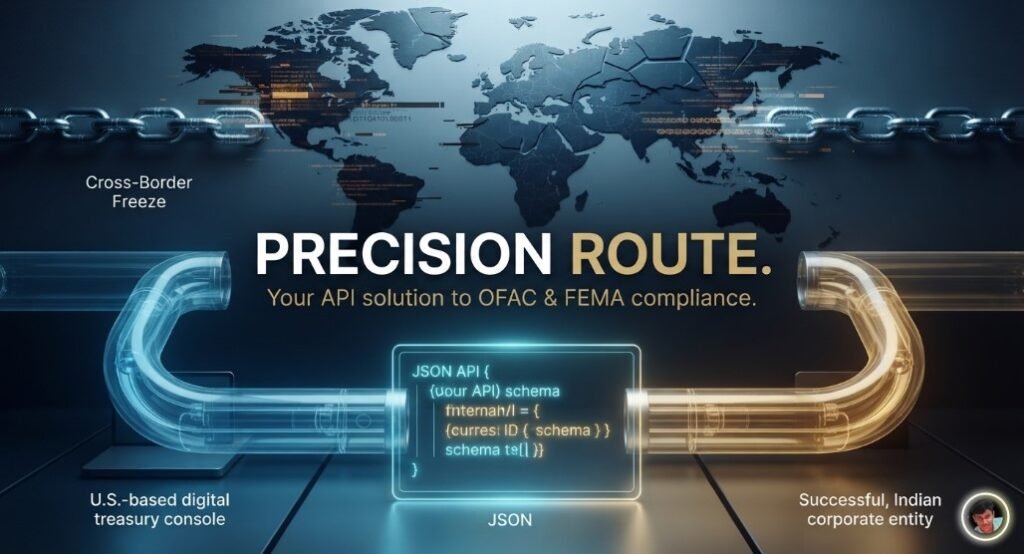
Executive Summary
Global founders, Chief Financial Officers (CFOs), and fintech platform builders navigating the post-2026 international banking landscape face an unprecedented convergence of regulatory hostility and infrastructural friction. Traditional correspondent banking models are buckling under the weight of stringent enforcement by the Financial Crimes Enforcement Network (FinCEN), the Office of Foreign Assets Control (OFAC), and global regulatory counterparts. Under current OFAC & FEMA Rules, cross-border operations For non-resident corporate structures—particularly those leveraging U.S. neobanks, Electronic Money Institutions (EMIs), and legacy SWIFT rails—cross-border operations have become a high-stakes gauntlet of sudden asset freezes, account terminations, and opaque compliance investigations triggered by algorithmic “False Positives.”
The Definitive Resolution: This technical guide deconstructs the structural mechanics behind automated account freezes and exposes the architectural vulnerabilities of legacy transaction screening. Crucially, it delivers the exact programmatic blueprint to bypass the SWIFT correspondent banking layer entirely—leveraging a dual domestic-loop settlement routing engine paired with immutable, code-level compliance payload injection (such as cryptographic invoice hashes and FEMA-compliant purpose codes directly embedded within the API stream). This infrastructure future-proofs your global treasury routing, providing absolute regulatory pre-verification and clearing high-volume B2B payouts seamlessly before automated risk engines can flag them.
1. The Silent Freeze Epidemic: The Cross-Border Data Mismatch
Structural Friction and Account Terminations
The wave of corporate account terminations targeting non-resident founders across major U.S. neobanks and partner bank program managers (such as Mercury, Brex, and Wise for Business) stems from a fundamental structural mismatch. U.S. financial institutions operate under strict interpretations of the Bank Secrecy Act (BSA) and USA PATRIOT Act. They must maintain ultimate visibility and risk ownership over Ultimate Beneficial Owners (UBOs).
Operating a non-resident entity without continuous compliance telemetry forces neobanks to trigger automated defensive actions. These risk platforms are bound by strict oversight bodies that require unconditional visibility into global cash flows. To analyze the exact operational thresholds that trigger these reviews, consult the updated Federal Bank Secrecy Act mandates directly before scaling your outbound transactions.
However, non-resident corporate structures—frequently incorporated in Delaware, Wyoming, or Singapore by founders residing in high-growth, non-FATF-aligned or complex regulatory jurisdictions (such as India, the UAE, or emerging markets)—create a high-risk telemetry gap for legacy risk engines.
Data Misalignment: EMIs, Domestic Verification, and Global UBOs
EMIs and neobanks often rely on automated, lightweight onboarding verification chains calibrated for domestic or near-shore entities (e.g., automated credit bureau checks, domestic utility bills, and standard SSN/EIN validation). When these onboarding frameworks encounter a foreign UBO, the verification stack suffers from a severe data deficit:
- Identity Fragmentation: Foreign identity documents, overseas corporate registries, and non-standard proof of address do not feed cleanly into domestic U.S. verification heuristics.
- Dynamic Risk Scoring: Neobanks, acting as front-end user interfaces backed by traditional FDIC-insured sponsor banks, pass regulatory liability upward. When sponsor banks audit these books under regulatory pressure, they frequently mandate sweeping de-risking initiatives.
- Behavioral Discrepancy: An entity incorporated in Delaware that generates 100% of its operational revenue from overseas software development services, while its UBO transacts from a mobile IP address in Dubai or Bangalore, triggers automated anomaly detection. The electronic profile indicates a shell or pass-through entity lacking tangible domestic nexus, regardless of actual corporate legitimacy.
Moving heavy capital through misconfigured gateways introduces structural vulnerability. To prevent algorithmic triggers, global CFOs must thoroughly audit their processing nodes. For an execution-level analysis of how traditional channels compound these risks compared to zero-leak networks, analyze our structural breakdown on FinCEN-registered payout rails before restructuring your payment stack.
2. The Anatomy of a ‘False Positive’: How Legacy AI Flags Large B2B Payments
Mechanics of SWIFT-Based Intermediary Screening
When a B2B corporate wire exceeding $50,000 traverses the legacy SWIFT network, it rarely moves directly from the originating bank to the beneficiary bank. Instead, it cascades through a chain of intermediary and correspondent banking nodes (e.g., JPMorgan Chase, Citibank, BNY Mellon). Each node in this chain acts as an independent compliance gatekeeper.
Intermediary banks run rules-based transaction monitoring engines alongside early-stage AI screening tools that parse the unstructured text fields of SWIFT MT103 or ISO 20022 payment messages (specifically fields mapping remittance information).
Correspondent banks process financial data through tightly wound pipelines where unstructured text strings inevitably default to structural review loops. Migrating away from antiquated remittance headers requires absolute alignment with modern global data formatting. Review the structural baseline of ISO 20022 data standards to understand how programmatic message schemas alter banking risk parameters.
Fuzzy Matching Errors and Context Isolation
Two critical structural vulnerabilities drive the vast majority of false-positive asset freezes:
- Algorithmic Fuzzy Matching: Sanctions screening engines utilize algorithmic string-matching (such as Jaro-Winkler or Levenshtein distance algorithms) to flag names in payment instructions against the Office of Foreign Assets Control (OFAC) Specially Designated Nationals (SDN) list and global watchlist databases. A common corporate name or a client abbreviation can easily trigger a phonetic or typographic match with a sanctioned entity, instantly halting the wire.
Algorithmic scanning filters do not possess human nuance; they merely search for string similarities across high-risk global databases. A slight cryptographic or naming overlap can cause your operational capital to be flagged as a false match. To audit your vendors and ensure your beneficiary names do not collide with restricted groups, check the Official OFAC SDN registry systematically.
- Context Isolation: The primary architectural flaw of the legacy correspondent banking layer is context isolation. The intermediary bank sees only the raw transaction metadata and payment instruction string; it cannot natively access underlying commercial invoices, executed master service agreements (MSAs), or proof of delivery. Lacking programmatic context, risk officers and automated filters err on the side of caution. Under the threat of civil and criminal penalties for sanctions violations, systems default to a precautionary asset freeze while manual compliance investigations commence.
Relying solely on legacy USD channels leaving the United States leaves your treasury exposed to intermediary data filtering. Advanced international structures are shifting a portion of their liquidity into alternative regulatory frameworks. Discover how sovereign entities utilize the MiCA Euro EMT architecture to eliminate SWIFT transmission dependencies altogether.
3. The Architectural Solution: The 2028 Payment Stack
To bypass the fragility of the public SWIFT network and eliminate false-positive freezes, modern fintech architects are deploying a two-layered payment stack that replaces correspondent banking layers with programmable domestic clearing loops and immutable metadata injection.
+---------------------------------------------------------------------------------+
|                        THE 2028 PROGRAMMATIC PAYMENT STACK                      |
+---------------------------------------------------------------------------------+

[ Layer 1: Domestic Rail Capturing ]
  Global Corporate Payer
       │
       ▼
  [ Wise Business Engine API ] (Segmentation & Conversion)
       │
       ├──> US Loop: Converted Wire ──> Local ACH / FedNow ──> U.S. Beneficiary
       ├──> EU Loop: Converted Wire ──> SEPA Instant       ──> Eurozone Beneficiary
       └──> IN Loop: Converted Wire ──> IMPS / RTGS        ──> Indian Beneficiary

[ Layer 2: Programmatic Compliance Shield ]
  Payload Ingestion (JSON/API)
       │
       ├──> Immutable Metadata Injection (RBI Purpose Codes, Contract IDs, Hashes)
       ├──> Pre-Verification Against Algorithmic Regulatory Flags
       ▼
  Clean Telemetry Transmitted to Sponsor Bank & Local Clearing Nodes
Layer 1: Domestic Rail Capturing
The foundational component of the 2028 payment stack is the elimination of cross-border SWIFT wires for routine B2B settlements. By integrating localized clearing engines—specifically utilizing infrastructure like the Wise Business Engine API—cross-border transfers are segmented into dual domestic routing loops before execution.
- The Workflow: Instead of dispatching a cross-border wire via SWIFT, the platform converts the foreign currency locally within a multi-currency ledger network.
- Bypassing SWIFT: The funds are then injected directly into domestic clearing loops:
- Local ACH or FedNow networks within the United States.
- SEPA Instant in the Eurozone.
- Local networks such as IMPS, NEFT, or RTGS in India.
- Result: Because the funds originate from a domestic bank account held by an authorized money transmitter or partner bank within the destination country, intermediary bank screening filters do not trigger cross-border alarms.
🇺🇸 US-to-India Cross-Border Payout Tool 🇮🇳
Compare real-time exchange rates and hidden transfer fees
Safeguarding the outbound U.S. rail is only half the battle; ensuring inbound liquidity clears local domestic nodes without interference is critical. While API parameters mitigate transit issues, founders must know how to legally challenge localized enforcement directives. If you are handling operations under Indian jurisdictions, review our legal defense guide on overturning Ultra vires corporate account freezes to secure your onshore capital.
Layer 2: The Programmatic Compliance Shield
To satisfy stringent AML and regulatory reporting requirements without relying on manual intervention, the platform must programmatically inject structured compliance metadata directly into the API transaction payload block.
By embedding immutable data tokens—such as standardized regulatory purpose codes, cryptographic invoice hashes, and unique contract identifiers—at the point of origination, the payment carries verifiable context that legacy systems cannot ignore.
This structured payload allows automated risk engines and recipient banks to parse purpose codes and verify cryptographic invoice hashes instantly, neutralizing false positives before funds are settled.
4. Conclusion: The Real Cost of Delayed Migration
Delaying the transition away from legacy SWIFT rails until 2028 introduces an existential threat to global corporate treasury operations. Relying on legacy correspondent banking for cross-border B2B transactions creates a single point of failure characterized by unpredictable intermediary deductions, compounding compliance delays, and indefinite corporate asset lockups.
As regulatory agencies tighten enforcement on non-resident corporate accounts, founders and CFOs who fail to implement programmable, domestic-loop routing architectures will find their capital trapped in administrative purgatory. Migrating to an API-driven, metadata-enriched payment stack is no longer an optional optimization—it is an absolute prerequisite for sovereign global operations.
5. Frequently Asked Questions (FAQs)
Why do banks refuse to explain why my corporate account was frozen or terminated ?
Under federal Anti-Money Laundering (AML) laws and the Bank Secrecy Act (BSA), financial institutions are strictly prohibited from "tipping off" customers when an account is flagged for suspicious activity, subjected to a law enforcement inquiry, or undergoing a suspicious activity report (SAR) filing. Disclosing the precise trigger for a freeze can compromise ongoing federal investigations or tip off illicit actors, leaving institutional compliance teams legally bound to maintain absolute silence.
What is the exact legal status of MSB licenses under FinCEN for local clearing networks utilizing API wrappers ?
Entities operating payment layers that bridge domestic clearing systems via API wrappers typically fall under the regulatory definition of Money Services Businesses (MSBs), specifically as Money Transmitters, under FinCEN regulations (31 CFR Chapter X). Operating in this capacity requires comprehensive state-level money transmitter licenses (MTLs), registration with FinCEN, and the implementation of an institutional-grade BSA/AML compliance program, including designated compliance officers, independent audits, and regular reporting.
Why are FEMA-compliant purpose codes mandatory for inbound corporate banking into India ?
Under India’s Foreign Exchange Management Act (FEMA) administered by the Reserve Bank of India (RBI), all inbound cross-border commercial remittances must be explicitly categorized using standardized purpose codes (e.g., P0802 for software services). Authorized Dealer Category-1 (AD-1) banks in India are legally mandated to verify the underlying commercial nature of every inbound wire. Lacking a valid, FEMA-compliant purpose code, incoming funds cannot be matched to electronic Foreign Inward Remittance Certificates (e-FIRC), freezing corporate liquidity and violating capital control statutes.
6. Disclaimer
Disclaimer: This document is published strictly for educational, structural, and architectural design purposes only and does not constitute formal legal, regulatory, tax, or financial advice. The mechanisms, JSON payload schemas, and compliance strategies outlined herein require independent validation by qualified legal counsel and certified compliance professionals licensed within the relevant operational jurisdictions.

Anurag Panchal
Founder & Chief Legal Strategist at ServiceMoney.in & AllRoundUpdate.com.
I specialize in Cross-Border B2B Routing & Algorithmic Compliance Defense. My mission is to protect global corporate liquidity against arbitrary account freezes under BSA, FinCEN, OFAC, and FEMA regulations.
Architectural Philosophy: We bypass legacy SWIFT intermediary friction by deploying dual domestic routing loops via Wise Business Engine APIs and immutable metadata payload injections.
Explore our FinTech Compliance Hub for technical blueprints and API workflows today.

