

The Core Difference: Is SAP vs ERP or a Product ?
When it comes to data processing ERP vs SAP business management, two terms often get tossed around as if they mean the same thing, but they actually refer to quite different ideas: Enterprise Resource Planning (ERP) and Systems, Applications & Products in Data Processing (SAP).
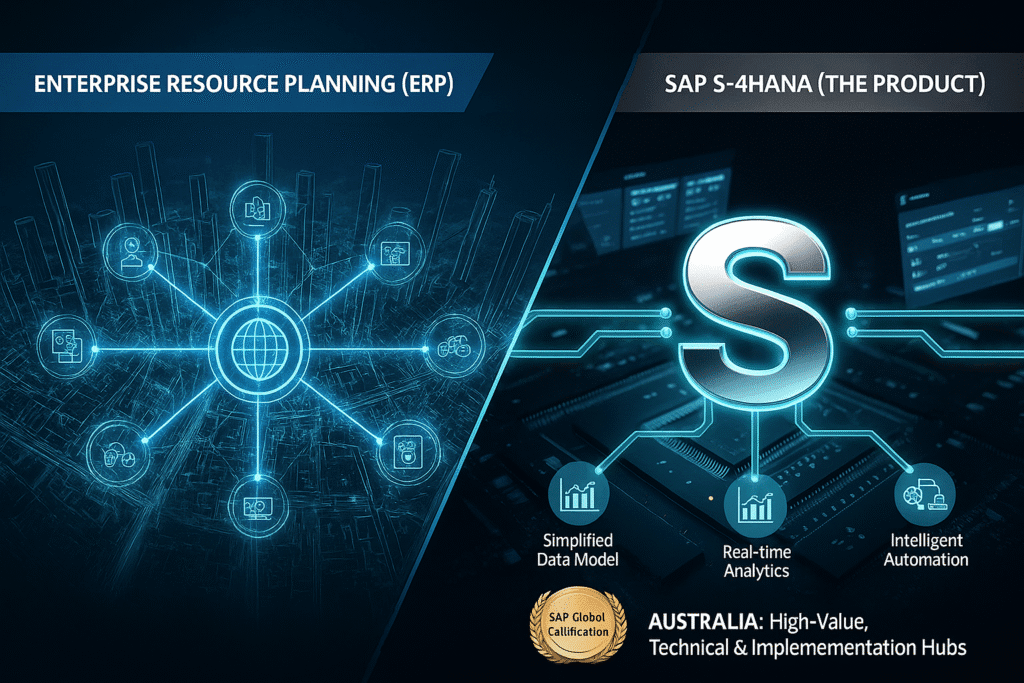
The key difference is pretty straightforward: ERP is a type of software, while SAP is one of the leading companies that provides that software.
To put it simply: think of ERP as the car, and SAP as the brand—like Mercedes-Benz or Toyota—that makes a specific, high-end model.
ERP vs SAP
What is Enterprise Resource Planning (ERP) ?
Enterprise Resource Planning (ERP) is a management approach brought to life through an integrated software suite.

Its main goal is to bring together and streamline all the essential processes of a business—like finance, human resources, manufacturing, supply chain, procurement, sales, and service—into one cohesive system.
Key Features of a Modern ERP System:
- Integration: All modules (Finance, HR, Logistics, etc.) are interconnected and share a single database, which helps eliminate data silos.
- Centralized Database: This provides a “single source of truth” for the entire organization.
- Real-time Processing: Data is updated instantly across all modules, enabling real-time reporting and decision-making.
- Modular Design: This allows a company to implement only the components it needs (for example, just the Finance and Supply Chain modules).
- Automation: It automates routine tasks to boost efficiency and cut down on manual errors.
- Why Lenskart’s IPO Focuses on Growth Over Big Numbers
- How Nita Ambani Handles Family Joy on Busy NSE Stage of Piramal finance
- Lenskart Solutions IPO Final Decision GMP/ Is Lenskart IPO Worth Your Money in 2025
- How the CBDT Deadline Extension Eases Tax Filing Stress for Audits latest News
In the context of a Data Processing course, ERP serves as the foundational concept and architectural framework for how large organizations manage the flow of information. To truly master ERP, one must grasp the theory behind business integration.
💻 What is SAP (Systems, Applications & Products in Data Processing) ?
SAP is a German software giant that kicked off its journey in 1972. Today, it stands as the top provider of enterprise application software, with its flagship offerings being robust ERP system
So, what does SAP actually mean? It’s short for Systems, Applications, and Products in Data Processing.
While SAP has a wide range of products, when folks talk about “SAP” in the ERP world, they’re usually referring to its core business suite software, which has seen some significant upgrades over the years:
- SAP R/3 (The Classic) :- This was the go-to solution for decades, featuring a traditional three-tier architecture. It typically operated on third-party databases like Oracle or SQL Server and used the older SAP Graphical User Interface (GUI).
- SAP ECC (ERP Central Component) :- This is the successor to R/3, offering a mature and reliable ERP suite. However, SAP plans to end mainstream support for ECC in 2027, with some extended options available, nudging customers to make the switch.
- SAP S/4HANA (The Future) :- Launched in 2015, this is SAP’s latest and most sophisticated ERP suite. S/4HANA is a real game-changer, designed to run exclusively on the SAP HANA in-memory database.
The SAP S/4HANA Revolution: A Paradigm Shift
SAP S/4HANA isn’t just a simple upgrade; it marks a significant leap forward that sets the standard for the future of ERP and data processing.
| Feature | SAP ECC (Older ERP) | SAP S/4HANA (Modern ERP) |
| Underlying Database | Works with multiple traditional databases (Oracle, IBM DB2, etc.) | Exclusively runs on SAP HANA (an in-memory database) |
| Data Processing Speed | Slower, often requires batch processing for reporting. | Ultra-fast, Real-time Processing (due to in-memory computing). |
| Data Model | Complex, with redundant aggregate tables and indexes. | Simplified Data Model (The “Simple Finance” and “Simple Logistics” concepts reduce data redundancy). |
| User Interface (UI) | Older, transaction-based SAP GUI. | Modern, role-based SAP Fiori UI/UX. |
| Embedded Intelligence | Limited AI/ML integration, often required separate tools. | Built-in AI, Machine Learning, and Predictive Analytics. |
If you’re a data processing professional, mastering SAP S/4HANA and its HANA database is an incredibly valuable and future-proof skill to have. This knowledge shifts your role from just entering transactional data to engaging in real-time data analysis and supporting strategic decisions.
🌍 Education Landscape Comparison: Australia vs. India
Choosing where to study a Data Processing course, particularly one that focuses on enterprise systems like ERP or SAP, can greatly influence your learning style, industry exposure, and career prospects.
🇦🇺 Australia: Practicality, Research, and Industry Integration IN ERP vs SAP
In Australia, universities and vocational education institutions (TAFE) typically embrace a hands-on, practical approach that encourages critical thinking.
- Curriculum Focus :- Data Science and IT courses in Australia often blend modern business practices with foundational skills in data analytics, cloud computing, and cybersecurity. You’ll usually find specific SAP modules offered as specialized postgraduate subjects or in vocational diplomas.
- Teaching Methodology :- The emphasis is on case studies, group projects, hands-on lab work, and engaging with industry professionals. The aim is to cultivate problem-solving and consultancy skills that can be directly applied in the workplace.
- Work Experience :- Student visas often permit part-time work, and many programs include mandatory or elective industry placements (internships). This connection with the local corporate scene offers invaluable experience with real ERP implementation or migration projects, often involving S/4HANA.
- Technology Integration :- The learning environment is typically equipped with the latest technology, utilizing cutting-edge software tools and cloud platforms.
India: Theoretical Depth, Scale, and Certification Focus
When it comes to education in Data Processing and Computer Science, India stands out for its strong theoretical foundation, rigorous academic framework, and the vast scale of its training program
- Curriculum Focus: Core engineering and IT courses provide a solid grounding in databases, algorithms, and business logic—key components for technical SAP roles like ABAP development. Much of the specialized SAP training is offered by independent institutes and major IT service companies, which host dedicated bootcamps for certification.
- Teaching Methodology: The traditional approach leans heavily on lectures, competitive exams, and a thorough understanding of fundamental concepts. While practical skills are important, many aspiring SAP professionals often pursue external, certified training after graduation or benefit from employer-sponsored upskilling.
- Work Experience: Internships are quite common, but with so many graduates entering the field, many start their SAP careers as freshers at large Indian IT firms (like TCS, Infosys, Wipro, etc.) that focus on global SAP implementation and maintenance. This provides them with quick exposure to large-scale projects.
- Scale and Specialization: India produces the highest number of SAP professionals in the world, creating a competitive market but also a vast talent pool that specializes in niche or legacy SAP modules
🥇 The Certificate Showdown: Value and Demand
The big question for anyone looking to advance their career is: Which certification holds more value in which market?
Currently, the most sought-after certifications are from SAP, as they demonstrate expertise in a specific, industry-leading product, making them more appealing to employers than generic ERP qualifications.
- Most Valuable SAP Certifications Today (Global Context)
The most valuable SAP certifications are those associated with the latest technologies.
| Certification Area | Role Focus | Global Demand Rationale |
| SAP S/4HANA (Specific Modules: FI/CO, MM, SD) | Functional Consultant, Business Analyst | The core of the current global ERP migration wave. FICO (Finance and Controlling) is perpetually in high demand. |
| SAP SuccessFactors | HR Consultant, Talent Management | Focuses on cloud-based Human Capital Management (HCM). High demand due to the shift in HR systems. |
| SAP Business Technology Platform (BTP) | Technical Developer, Integration Architect | Essential for extending, integrating, and developing custom applications on the SAP platform. This is the future technical skill. |
| SAP Analytics Cloud (SAC) | Data Analyst, Business Intelligence Specialist | Demand for professionals who can use SAP’s dedicated cloud BI solution to create real-time reports and dashboards. |
- Demand in Australia 🇦🇺
In Australia, the need for certified SAP professionals is fueled by two main factors: Digital Transformation and a Competitive Salary Market.
- High Value, Lower Volume :- While Australia’s overall IT market is smaller compared to India, the demand for senior, certified SAP Consultants—especially S/4HANA Functional Leads and Project Managers—is incredibly high, which translates into premium salaries.
- Focus Areas :- There’s a significant demand for consultants who are skilled in SAP S/4HANA Finance (FICO) and Supply Chain (MM/SD), driven by major enterprise-level migrations in sectors like mining, banking, and government.
- Certification Value :- Holding a recognized SAP Global Certification (like the SAP Certified Application Associate – SAP S/4HANA for Financial Accounting) really sets you apart, showcasing your expertise and justifying those high contract rates. Interestingly, local work experience and strong communication skills are often just as important, if not more so, than the certification itself.
Salary Snapshot (AUD per year):
- SAP Functional Consultant: AUD $120,000 – $165,000+
- SAP Project Manager (S/4HANA): AUD $140,000 – $200,000+
Source: Seek & Industry Data 2025
- Demand in India 🇮🇳
In India, the demand for SAP-certified professionals is largely driven by the country’s role as the global hub for SAP implementation and maintenance projects.
- Massive Volume, High Competition: India churns out the highest number of SAP professionals in the world. The job market is extensive and fiercely competitive, with a steady need for both fresh graduates and seasoned consultants.
- Focus Areas: There’s a strong demand for technical specialists, such as SAP ABAP Developers (who handle custom coding and maintenance), as well as consultants in high-demand modules like SAP MM (Materials Management) and SAP SD (Sales and Distribution).
- Certification Value: An SAP certification is essential for standing out in a sea of graduates. It’s often the first hurdle to clear for landing a position in major IT service companies. Certifications in niche areas can really give you an edge.
Salary Snapshot (INR per year):
- Entry-Level SAP Consultant/Fresher: INR ₹4,00,000 – ₹7,00,000
- Experienced SAP Consultant (5+ years): INR ₹12,00,000 – ₹25,00,000+
Note :- Salaries can vary significantly depending on the company (service vs. product) and the city.
Conclusion on Certification Value of ERP vs SAP
The SAP Global Certification stands out as the most sought-after credential in both countries.
For Australia :- This certification opens doors to high-paying, specialized roles and serves as solid proof of technical skills, complementing consultancy and business process expertise.
For India :- It’s a vital stepping stone into the structured IT services industry and plays a key role in career advancement.
📈 Future Trends in ERP vs SAP for Data Processing Professionals
The ERP landscape is changing quickly, fueled by the merging of technology and data processing. Those entering this field should keep an eye on these four major trends:
- The Cloud Imperative
The future of ERP lies in the Cloud. We’re seeing a shift from bulky, on-premise systems to flexible, scalable, and cost-effective cloud ERP solutions. Professionals should focus on:
- SAP S/4HANA Cloud: Gaining insights into both Public and Private Cloud deployment models.
- Hybrid Integration: Developing skills to connect cloud ERP systems with older, on-premise legacy systems.
- Agentic AI and Automation
Artificial Intelligence (AI), Machine Learning (ML), and Robotic Process Automation (RPA) are becoming integral to core ERP functions.
- Skill Shift: The focus is moving from manual transaction processing to overseeing, training, and optimizing AI agents (like SAP’s Joule Agent) that handle tasks such as financial reconciliation and procurement.
- Data Science within ERP: ERP systems are evolving into sophisticated data platforms, requiring professionals to utilize embedded analytics and predictive capabilities.
- SAP Online Courses with Certificates in India ?
- Top Australian ERP Course for Indian Students ?
- SAP Scholarship 2025: Everything in 2025
- Modularity Over Monolith
Companies are transitioning from a single, massive, custom-built ERP system (monolith) to a more modular approach, allowing for greater flexibility and adaptability.
- SAP Business Technology Platform (BTP): This is SAP’s go-to platform for driving innovation. Having skills in BTP is essential for creating custom extensions, integrating applications that aren’t part of SAP, and building a truly flexible “composable ERP” environment.
- ESG and Sustainability Reporting
Environmental, Social, and Governance (ESG) reporting has become a vital function.
- Green ERP : The future of ERP systems is all about managing and monitoring an organization’s carbon footprint, waste, and social impact. There will be a strong demand for professionals who can implement SAP Sustainability Solution
Frequently Asked Questions (F&Q)
Q1: Is a generic ERP certification useful compared to an SAP certification ?
A generic ERP certification can definitely help you grasp the basic theories behind business processes and how they integrate. That said, an SAP certification—especially in S/4HANA—holds much more weight in the job market. It demonstrates your expertise in a product that influences over 80% of the world’s transaction revenue.
Q2: Is SAP ABAP (Programming) still a relevant skill for the future ?
Absolutely, but its significance is evolving. While the core of SAP S/4HANA remains standard, more custom extensions and integration logic will be developed using cloud-native technologies on the SAP Business Technology Platform (BTP). ABAP is still essential for maintaining existing ECC systems (at least until 2027) and for complex migration projects from legacy systems to S/4HANA. The most future-proof technical profile will be someone who is skilled in both ABAP and BTP.
Q3: Which country is better for a fresher to start an ERP vs SAP career, Australia or India ?
India might be the better choice if you’re looking for high-volume, fast-paced project exposure in a specialized technical or functional role within a major IT services company. The competition is fierce, but there are plenty of entry-level opportunities.
On the other hand, Australia could be more appealing if you’re after higher starting salaries and a career that leans towards consultancy, business process re-engineering, and high-level strategy in client-facing roles. These positions often require a solid mix of technical and soft skills.
Q4: Should I focus on the “functional” side (Finance, Supply Chain) or the “technical” side (ABAP, BTP) ?
Functional :- If you choose to focus on a module like FICO or MM/SD, you’ll need to have a deep understanding of business processes and be able to configure the software to meet those needs.
Technical :- If coding, system architecture, and building custom solutions or interfaces excite you, then BTP/Integration or ABAP is the way to go.
Q5: How important is the SAP HANA database for non-technical roles ?
It’s incredibly important! Even those in functional consultant positions should have a grasp of the simplified data model and the real-time processing that HANA offers. This understanding is key for designing effective solutions, speeding up reporting, and making the most of the embedded analytics features in S/4HANA.
| Aspect | ERP (The Concept) | SAP (The Product/Certification) | Career Strategy |
| Definition | A category of software that integrates all business processes into one system. | A vendor and their specific, market-leading ERP software suite (S/4HANA). | Understand ERP theory; specialize in an SAP product. |
| Core Skill | Business Process Analysis, Integration Logic, Strategic Alignment. | Module-specific Configuration, System Implementation, Data Migration (S/4HANA). | Combine business acumen with technical product mastery. |
| Highest Value Cert. | N/A (Value is in the application of the knowledge). | SAP S/4HANA Certification (e.g., FICO, MM, SD, or BTP). | Invest in official SAP Global Certification. |
| Australia Market | High pay, focus on consultancy, S/4HANA migration, and strategic leadership. | Certificate is a differentiator for premium roles. Experience and soft skills are highly weighted. | Aim for senior, specialized roles with a clear focus on end-to-end process ownership. |
| India Market | Vast volume, focus on implementation, maintenance, and technical development (global delivery hub). | Certificate is a prerequisite for entry into top IT service firms. High demand for technical roles (ABAP, BTP). | Build a strong technical foundation and gain exposure to massive-scale projects early. |
Conclusion: Charting Your Future in Enterprise Data
Understanding the distinction between Enterprise Resource Planning (ERP) and Systems, Applications & Products in Data Processing (SAP) is crucial: ERP serves as the broad business strategy, while SAP is the key tool that brings that strategy to life. If you’re looking to carve out a career in the data processing arena, honing in on SAP—especially the SAP S/4HANA suite—will set you on a path toward a rewarding and sought-after profession.
Whether you kick off your journey in the academically rigorous environment of India or dive into the hands-on, high-paying consultancy scene in Australia, your greatest asset will be an official SAP Global Certification, complemented by in-depth knowledge in a specific area like Finance or Supply Chain.
Would you like me to look into specific SAP S/4HANA training programs available in major cities like Sydney (Australia) or Bengaluru (India) to help you find a great starting point?


