

Last verified: 27 November 2026, against the Income-tax Act 2025 (as amended by the Finance Act 2026), the Income-tax Rules 2026 and the Income Tax Department’s own form guidance.
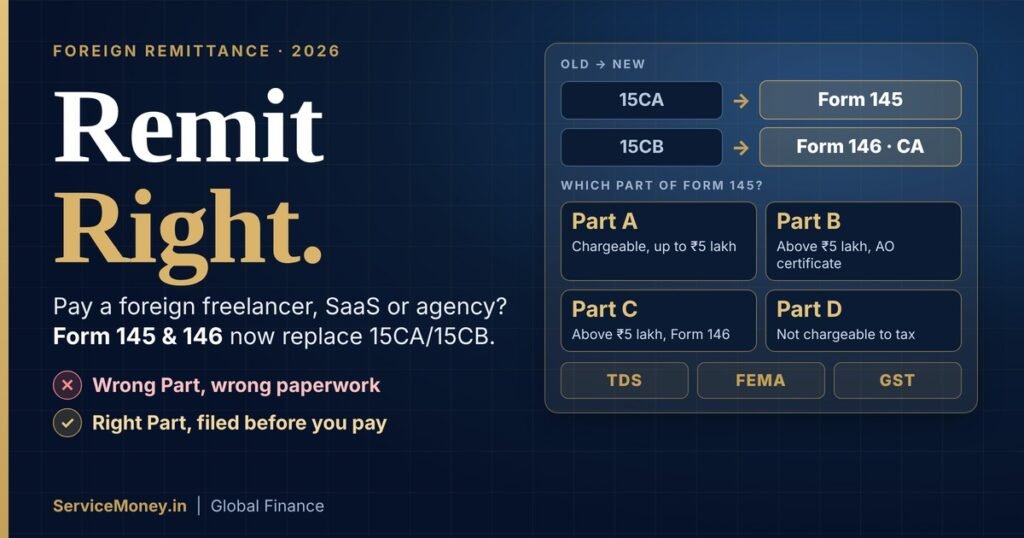
If you pay a foreign freelancer, a SaaS vendor or an agency abroad from India, your bank will usually ask for a tax form before the money leaves. For remittances on or after 1 April 2026, Form 145 and 146 replace Form 15CA and 15CB: Form 145 (earlier Form 15CA) is the information form you file, and Form 146 (earlier Form 15CB) is the Chartered Accountant’s certificate where one is needed. This guide shows which Part of Form 145 applies, when a CA certificate is really needed, and what the bank, FEMA and GST add on top.
• Form 145 is filed by the payer before every foreign remittance covered by Rule 220. Form 146 is the CA’s certificate, needed only for Part C.
• Part A: chargeable, up to ₹5,00,000 in the tax year. Part B: chargeable, above ₹5,00,000, with an Assessing Officer certificate. Part C: chargeable, above ₹5,00,000, with Form 146. Part D: not chargeable.
• Part A does not mean no TDS. Deduction is decided by whether the sum is chargeable and the rate in force or treaty.
• Not filing, or wrong information, can attract a ₹1,00,000 penalty under section 462.
• FEMA limits and GST reverse charge are separate checks.
Is there a new Form 15CA? What changed on 1 April 2026
Yes. The Income-tax Act 2025 and the Income-tax Rules 2026 came into force on 1 April 2026. Form 15CA became Form 145 and Form 15CB became Form 146. The CBDT’s own FAQs say that for remittances on or after 1 April 2026 the Act 2025 provisions apply and Forms 145 and 146 must be used, and that the thresholds are similar to the old rules.
Old vs new, a quick map (remittances on or after 1 April 2026)
← Swipe left / right to see all columns →
| What it does | Old (Income-tax Act 1961 / Rules 1962) | New (Income-tax Act 2025 / Rules 2026) |
|---|---|---|
| Information the payer files before remitting | Form 15CA | Form 145 |
| Chartered Accountant’s certificate | Form 15CB | Form 146 |
| Payer’s application to the Assessing Officer for lower / nil deduction | Form 15E | Form 129 |
| Payee’s treaty declaration (with TRC) | Form 10F | Form 41 (section 159(8), Rule 75) |
| Legal source of the filing duty | Section 195(6) | Section 397(3)(d) |
| Rule that requires the information | Rule 37BB | Rule 220 |
| TDS on payments to non-residents | Section 195 | Section 393(2) (Table, Sl. No. 17), with sections 395 and 397 |
| Penalty for not filing / wrong information (payer) | Section 271-I | Section 462 |
| Penalty for wrong CA certificate | Section 271J | Section 463 |
Source: Income Tax Department form guidance for Forms 145, 146, 129 and 41 and CBDT FAQs on interplay and transition (Q4.23). Each guidance document shows its old form, section and rule.
Two transition points from the same CBDT FAQs (Q4.24 and Q4.27):
- Form 15CA/15CB filed for remittances made before the new Act started stay valid, provided the remittance was made by the proposed date in the form. If the money did not go out in time, file fresh forms.
- For a payment made after 1 April 2026 against an older liability, the FAQs say the form follows the law on the date of remittance (Act 2025), while taxability of the underlying income follows the Act of the year it accrued. Ask your CA before you pay old invoices.
Who must file Form 145, and who does not need to
Rule 220 puts the duty on the person responsible for paying a non-resident (not being a company) or a foreign company. You file it before you remit. There is no separate due date, but the form must reach your bank (the authorised dealer) before the payment is made. It is event-based, so you file one for every remittance that falls under Rule 220.
Rule 220(3) lists the cases where nothing needs to be filed, and this is where people go wrong. The exemption applies only to a sum that is not chargeable to tax, and only if one of these is true:
- An individual is remitting and the remittance does not need prior RBI approval under FEMA (this is the Liberalised Remittance Scheme route);
- The remitter is a Unit of an International Financial Services Centre; or
- The RBI purpose code is one of the 33 codes listed in the rule (for example import settlement S0102, business travel S0301, education travel S0305, donations S1302).
Which Part of Form 145 do you need?
The Part depends on two things: whether the sum is chargeable to tax in India, and the amount. Use the tree first, then check the table.
Which Part of Form 145 applies to this payment?
Deduct TDS at the rate in force and report it in the form.
Part C is then not needed.
Source: Rule 220(1) to (3), Income-tax Rules 2026.
Form 145 at a glance, Part A to Part D
← Swipe left / right to see all columns →
| Part | Use it when | Needs | What the form asks you to add |
|---|---|---|---|
| A | Sum is chargeable to tax and the amount (or aggregate) in the tax year does not exceed ₹5,00,000 | No certificate | Remitter, remittee and remittance details, bank / authorised dealer details, TDS amount, rate and date, declaration |
| B | Chargeable, above ₹5,00,000, and you hold an Assessing Officer certificate or order under section 395(1) / 395(2) | AO certificate or order | Everything in Part A, plus certificate number, date, section, amount and TDS rate |
| C | Chargeable, above ₹5,00,000, and you hold Form 146 from an accountant (section 515(3)(b)) | Form 146 acknowledgement number | Panels pre-fill from Form 146: accountant details, taxability under the Act and the treaty, TDS |
| D | Sum is not chargeable to tax (and Rule 220(3) does not exempt you) | No certificate | Remitter, remittee and remittance details, declaration |
Source: Rule 220, Form 145 (official form and guidance), Income Tax Department.
Two details that save time:
- Part B replaces Part C. If you file Part B on the strength of an Assessing Officer certificate or order, Part C is not required. Under section 395(2), the payer can apply in Form 129 (earlier Form 15E) for the Assessing Officer to determine the chargeable portion of the sum. Section 395(1) is the payee’s own application for lower or nil deduction.
- The CA must be an “accountant” under section 515(3)(b): a chartered accountant with a valid certificate of practice. If the payer is a company, the CA must be eligible to be its auditor under section 141(3) of the Companies Act, 2013. In other cases the exclusions include the assessee himself, the partners of a firm or members of an AOP or HUF, their relatives, and officers or employees. So you cannot use yourself, a partner, a relative or an employee to certify your own payment.
The ₹5 lakh test: how the aggregate works
Rule 220(1) looks at “the amount of payment or the aggregate of such payments” made in the tax year. Form 145 asks for the aggregate of all remittances in the year including the current one, before deducting tax (Note 7 of the form).
Example: how the ₹5,00,000 aggregate builds up in a tax year
← Swipe left / right to see all columns →
| Remittance | Amount (before TDS) | Aggregate in the tax year, including this one | Part to use (sum is chargeable) |
|---|---|---|---|
| First | ₹2,00,000 | ₹2,00,000 | Part A |
| Second | ₹2,50,000 | ₹4,50,000 | Part A |
| Third | ₹1,00,000 | ₹5,50,000 (crosses ₹5,00,000) | Part B (with AO certificate or order) or Part C (with Form 146) |
| Fourth | ₹50,000 | ₹6,00,000 | Part B or Part C again |
Source: Rule 220(1); Form 145, Part A (row 18 and Note 7).
Illustration only. We assume every sum is chargeable to tax and paid to the same payee. Rule 220(1) speaks of “the aggregate of such payments” made during the tax year, and Form 145 asks for the aggregate of remittances made during the tax year before TDS. Neither spells out how payments to different payees are counted, so ask your CA and your bank how they count them.
Remember what Part A is. It is the Part for a chargeable sum up to ₹5 lakh. It is not a no-TDS category, and the form itself asks for the TDS amount, rate and date.
Step by step: how the filing works
You can file online on the e-Filing portal or prepare bulk entries with the offline utility and upload one zipped XML. The department guidance lays out the flow below.
Filing workflow
← Swipe left / right to follow each track →
Track 1: Part A, Part B or Part D (you file on your own)
Log in to the e-Filing portal. Go to e-File > Income Tax Forms > File Income Tax Forms.
Open the tab “Forms as per Income Tax Act 2025” and select Form 145. Choose Online and the tax year.
Pick the Part, complete every panel and save. Preview unlocks when all panels show Completed.
Preview, then e-Verify. DSC is mandatory for TAN users; others can use DSC or EVC.
Note the acknowledgement number and transaction ID. Give a copy to your bank (authorised dealer) before the money moves.
Track 2: Part C (a CA certifies first)
Add your CA on the portal (My Account > Add CA, form name Form 146).
The CA files Form 146 with DSC, adds the UDIN and shares the acknowledgement number.
You select Part C and enter that acknowledgement number. Panels pre-fill. Review and save each.
Preview, e-Verify and submit. The Form 146 then shows as Consumed (one Form 146 serves one Form 145).
Give your bank the Form 145 copy before remitting.
Source: Form 145 and Form 146 guidance and Form 145 FAQs, Income Tax Department; portal user guide for Form 145.
Points to plan around:
- You cannot edit a submitted Form 145. You can withdraw it within 7 days of submission and file again. Withdrawing a Part C also marks the linked Form 146 as withdrawn.
- UDIN is mandatory on Form 146 under the ICAI notification, so the authenticity of the CA’s certificate can be checked in real time through ICAI. The department’s guidance says ICAI generates the UDIN after the form is filed, and the portal lets the CA submit the form and update the UDIN later.
- Your bank files its own statement. Under Rule 220(6) the authorised dealer reports remittances to the department in Form 147 within 15 days of each quarter end, so the details in your Form 145 should match what the bank processes.
- Report the tax you deduct. After you deduct and deposit TDS on a payment to a non-resident, it is reported in the quarterly statement in Form 144 (section 397(3)(b)), which covers payments other than salary made to non-residents. The due dates are 31 July, 31 October, 31 January and 31 May for the four quarters.
The official form and FAQs are on the Income Tax Department site: Form 145 guidance and Form 145 FAQs.
TDS on payment to a foreign freelancer: the questions that decide everything
Form 145 does not decide your tax. It records a decision you have already made, so make that decision in order.
1. Is the sum chargeable to tax in India? Section 393(2) (Table, Sl. No. 17) requires deduction on “any other sum chargeable under the provisions of this Act” paid to a non-resident (not being a company) or a foreign company. Chargeability comes from section 9 (income deemed to accrue or arise in India), which covers, among others, income through a business connection in India (including a significant economic presence), royalty (section 9(6)) and fees for technical services (section 9(7)).
Fees for technical services mean consideration for managerial, technical or consultancy services. Where your payee works for you from abroad, whether the work counts as such a service, and whether the payee has a business connection or permanent establishment in India, is the real question. Our guide on Permanent establishment risk explains the PE side, and our guide on Dual tax residency helps if the payee may be resident in two countries.
Section 9(7)(a) makes fees for technical services paid by a resident deemed to accrue in India, but not where the services are utilised for a business or profession the resident carries on outside India, or for earning income from a source outside India. Whether your payment falls in this exception depends on the facts, and it is one of the first things your CA will examine.
Note 3(b) to section 393(2) (Sl. No. 17) says the duty to deduct applies even if the non-resident has no residence, place of business, business connection or any other presence in India. Lack of presence does not remove the duty. Only the “chargeable” test does.
2. Does a tax treaty change the answer? As an example, the India-US treaty (the 1989 convention with its protocol, exchange of notes and Article 12 understanding, as published on the Income Tax Department’s treaty page, which lists no later amending protocol) says business profits of a US enterprise are taxable in India only through a permanent establishment (Article 7). For a US-resident individual professional (not a company), Article 15 lets India tax the income only if the person has a fixed base regularly available in India or stays in India for 90 days or more in the tax year.
Article 12 caps royalties and “fees for included services” at 15%, or 10% for equipment-related royalties and ancillary services. “Fees for included services” has its own treaty definition, so not every service fee falls in it. Article 12(5)(e) also excludes amounts paid to an individual or firm of individuals (other than a company) for professional services as defined in Article 15. Every country pair has its own text. If you are the one being paid by a US client, the US-side withholding question is separate; see our 30% IRS withholding guide.
3. What rate, and what if the payee has no PAN? The rate is the “rate in force”, lowered by the treaty where it applies. Deduction is due at the earlier of credit to the payee’s account or payment, and a credit to a suspense account counts as credit (section 393(11)). The tax you deduct must be deposited within 7 days from the end of the month of deduction, or by 30 April if you deducted in March (Rule 218(2)).
If the payee gives no PAN, section 397(2) requires deduction at the highest of the rate in the Act, the rate in force, or 20% (5% in two specific cases). Rule 217 switches this off for interest, royalty, fees for technical services, dividend and capital-asset payments if the payee gives the listed details, and Rule 217(3) also covers a payee who is not required to apply for PAN under section 262.
4. Did you promise a net amount? If your contract says the payee must receive a fixed net sum and you bear the tax, section 393(10) increases the income to the amount which, after tax, equals that net sum.
Net-of-tax contracts and gross-up (section 393(10))
← Swipe left / right to see all columns →
| Case A: payee bears the tax | Case B: payer bears the tax (net contract) | |
|---|---|---|
| Agreed amount | ₹1,00,000 (gross) | ₹1,00,000 (net, payee must receive this) |
| Assumed TDS rate (illustration only) | 10% | 10% |
| Amount on which TDS is computed | ₹1,00,000 | ₹1,00,000 ÷ (1 − 0.10) = ₹1,11,111 (rounded) |
| TDS | ₹10,000 | ₹11,111 |
| Payee receives | ₹90,000 | ₹1,00,000 |
| Your cost | ₹1,00,000 | ₹1,11,111 |
Source: Income-tax Act 2025, section 393(10); Form 146 guidance.
The 10% rate is only to show the arithmetic. The actual rate depends on the nature of the payment and any treaty. Form 146 has a field asking whether tax has been grossed up under section 393(10).
Documents to collect before you pay
← Swipe left / right to see all columns →
| Document | Needed when | Why it matters |
|---|---|---|
| Invoice and agreement / contract | Every remittance | Shows what is being paid for, so you can pick the correct nature of remittance and test chargeability |
| Payee’s PAN, or Tax Identification Number (TIN) of the country of residence | Every remittance | Form 145 asks for it. With no PAN, section 397(2) can push TDS to a higher rate unless Rule 217 conditions are met |
| Tax Residency Certificate (TRC) and Form 41 | Payee claims treaty (DTAA) benefit | Listed as required documents in the Form 145 and Form 146 guidance |
| No-PE certificate or self-declaration from the payee | Business income is being paid (for Form 146) | Listed in the Form 146 guidance as a document for business income |
| Assessing Officer certificate or order (section 395) | Part B | Lets you file Part B and skip Part C |
| Form 146 acknowledgement number | Part C | Pre-fills Part C. One Form 146 can be used for one Form 145 only |
Source: Form 145 and Form 146 guidance, Form 145 FAQs (Q7), Rule 217, section 397(2).
This was a batch of appeals decided together. In the leading case, the appellants distributed imported software and paid the foreign suppliers without deducting tax. The tax officer treated the payments as royalty and demanded TDS. The tribunal held they were not royalty and not taxable in India.
In the High Court the department argued for the first time that unless the payer had applied to the tax officer under the old section 195(2) and obtained permission not to deduct, the payer could not argue that the payment was not taxable. The High Court accepted that. The Supreme Court set it aside. It held that the TDS provision applies only to sums chargeable to tax in India, that a payment abroad does not by itself create taxable income, and that the application under section 195(2) is a safeguard for a payer who is unsure about the taxable portion. It sent the question of whether the software payments were royalty back to the High Court.
Why it matters here: this is why the chargeability question comes before the form. The case was decided under the 1961 Act. The new section 393(2) (Sl. No. 17) uses the same words, “any other sum chargeable under the provisions of this Act”, but check with your CA whether later changes in the law affect how far the reasoning applies.
The bank and FEMA: what Form 145 does not cover
Form 145 is a tax form. Your bank also checks that the payment is permitted under FEMA. Under the Current Account Transactions Rules, some purposes are prohibited (Schedule I), some need Government approval (Schedule II), and some need RBI approval above limits (Schedule III).
For business payments, Schedule III says persons other than individuals need prior RBI approval for consultancy services procured from outside India above USD 1,000,000 per project (USD 10,000,000 for infrastructure projects). For individuals the limit is USD 250,000 per financial year under the Liberalised Remittance Scheme, as stated in the RBI’s Master Direction on Other Remittance Facilities (updated as on 1 October 2026).
The consultancy limits above are from the RBI’s Published text of the Current Account Transactions Rules, which is marked as updated up to 30 June 2023. RBI directions change, so check the RBI website for anything newer before you rely on a limit.
Separately, when an individual remits under the Liberalised Remittance Scheme, the authorised dealer collects tax at source under section 394(1) (Table, Sl. No. 7) if the remittance, or the aggregate of remittances, exceeds ₹10 lakh: 20% for purposes other than education or medical treatment, and 2% for education or medical treatment (the 2% rate was substituted by the Finance Act 2026 from 1 April 2026).
That collection is different from TDS and from Form 145. If your bank has ever put a hold on a payment, our guide on FEMA, B2B payments and bank holds covers what to expect.
GST: reverse charge on imported services
GST is a separate layer from Form 145. Under the IGST Act, the Government can notify services on which the recipient pays tax on reverse charge (section 5(3)). Notification 10/2017-Integrated Tax (Rate), Sl. No. 1, covers “any service supplied by any person who is located in a non-taxable territory to any person other than non-taxable online recipient”, with the recipient being a person in the taxable territory.
In plain terms, a business in India that buys a service from abroad may have to pay IGST itself on reverse charge. Imported services are treated as inter-State supplies (section 7(4) of the IGST Act), and under the CGST Act an import of services for a consideration counts as a supply even if it is not in the course of business (section 7(1)(b)). Import of services from a related person or from your own establishment abroad, in the course of business, is a supply even without consideration (Schedule I, item 4). India Code lists the IGST Act notifications.
On the other side of the same transaction, our guide on receiving payments from a US client (GST, FEMA and Section 58) covers what happens when you are the exporter.
One payment, several separate checks
← Swipe left / right to see all columns →
| Layer | The question | Where it comes from | What you do |
|---|---|---|---|
| Income tax: TDS | Is the sum chargeable to tax in India? At what rate? | Section 393(2) (Table, Sl. No. 17), section 397 | Deduct at the rate in force, at credit or payment, whichever is earlier |
| Income tax: information | Which Part of Form 145 (and is Form 146 needed)? | Rule 220, section 397(3)(d) | File before remitting. Give the bank a copy |
| FEMA / bank | Is the purpose permitted and within limits? | FEMA Current Account Transactions Rules 2000, Schedules I to III | Bank (authorised dealer) checks. Some payments need RBI or Government approval |
| GST | Is IGST payable by you under reverse charge? | IGST Act section 5(3); Notification 10/2017-Integrated Tax (Rate), Sl. No. 1 | Pay IGST on reverse charge where it applies, and follow the credit rules |
| Equalisation levy | Online ads: any levy? | Finance Act 2025 | Withdrawn from 1 April 2025 for online advertisement consideration |
Source: documents named in each row. Form 145 does not settle GST or FEMA, and filing it does not replace them.
One more item that is now off the list: the Finance Act 2025 withdrew the equalisation levy on online advertisement services received by a non-resident on or after 1 April 2025. If you pay Google or Meta for ads, there is no levy to consider for that period, but the TDS and GST questions above still apply to the payment.
What happens if you get it wrong
- Payer: not filing Form 145, or filing inaccurate information, can attract a penalty of ₹1,00,000 under section 462.
- CA: incorrect information in a Form 146 can attract a penalty of ₹10,000 per certificate under section 463.
- Tax default (section 398): if you do not deduct, or deduct and do not deposit, you are treated as an assessee in default, in addition to other consequences. Simple interest runs at 1% for every month or part of a month from the date the tax was deductible until it is deducted, and at 1.5% for every month or part of a month from deduction until it is paid. Section 398(2) gives limited relief where the payee has filed a return, included the income and paid the tax, supported by an accountant’s certificate.
- Expense disallowance (section 35(b)(ii)): a sum payable to a non-resident, or payable outside India, as interest, royalty, fees for technical services or any other chargeable sum is not deductible in computing your business or professional income if the tax was not deducted, or was deducted but not paid, by the due date for filing your return under section 263(1).
- The whole sum is disallowed (for a resident payee the figure is 30%). If you deduct and pay the tax later, the sum is allowed in the year of payment.
- Scrutiny: Form 145 feeds the department’s ITBA system, which uses it for risk profiling and cross-checks against the bank’s Form 147.
Common mistakes to avoid
- Filing after the money has gone. The form must be filed before the remittance.
- Treating “under ₹5 lakh” as “no TDS”. Part A is for chargeable sums.
- Assuming a CA certificate is needed for every foreign payment. It is needed only for Part C.
- Starting Part C before the CA has filed Form 146. The acknowledgement number is what pre-fills the form.
- Entering an RBI purpose code that does not match what your bank uses. Form 145 asks for it in every Part.
- Picking the wrong nature of remittance. The form gives a fixed list (for example Professional Services, Fees for Technical Services, Purchase of Software, Advertisement Fee), and your bank sees it.
- Missing the TRC and Form 41 when claiming treaty relief, or the TIN when the payee has no PAN.
- Ignoring a net-of-tax clause in the contract.
- Assuming Form 145 takes care of GST. It does not.
Form 145 and 146: frequently asked questions
Q1: Is Form 145 the same as Form 15CA?
It replaces it. Form 145 corresponds to Form 15CA, and Form 146 to Form 15CB, for remittances on or after 1 April 2026.
Q2: Can I file Form 145 after making the payment?
No. It must be submitted before the remittance. A copy must also go to your bank before the payment is processed.
Q3: Do I need a CA for a payment to a foreign freelancer?
Only if the payment is chargeable to tax, the total in the tax year exceeds ₹5,00,000 and you have no Assessing Officer certificate. That is the Part C case. Below that, you file Part A, B or D yourself.
Q4: Who can e-verify the form?
DSC or EVC. DSC is mandatory if the filer is a TAN user. Form 146 can be e-verified only with the CA’s DSC.
Q5: Can I correct a Form 145 after submitting it?
No. You can withdraw it within 7 days and file a fresh one.
Q6: Is the foreign payee’s PAN mandatory?
No. If the payee has no PAN, give the Tax Identification Number from the country of residence. Whether higher-rate TDS applies without a PAN depends on section 397(2) and Rule 217.
Q7: What if the payment is not taxable in India?
File Part D, unless Rule 220(3) exempts the payment.
Q8: Does Form 145 cover GST on imported services?
No. GST reverse charge is a separate check, covered above.
This article is general information for readers who deal with cross-border payments. It is not tax, legal, accounting or FEMA advice, and reading it does not create a professional relationship with servicemoney.in. Tax law, rules, forms and RBI directions change, and the right answer depends on the facts of your payment, your contract and the payee’s country. Figures and examples are illustrations only. Before you make a foreign remittance, confirm the position with a qualified Chartered Accountant or tax adviser and with your bank.
We have taken care to base this article on official sources as on 27 November 2026, but we cannot accept liability for losses arising from reliance on it. Sources reviewed: Income-tax Act 2025 (as amended by the Finance Act 2026), Income-tax Rules 2026 (including Rules 217, 218 and 220), the Act’s sections 35, 394 and 398, Income Tax Department guidance for Forms 145, 146, 129 and 41 and the Form 145 FAQs, CBDT FAQs on interplay and transition, the Finance Act 2025 key highlights, FEMA Current Account Transactions Rules 2000, IGST and CGST Acts, Notification 10/2017-Integrated Tax (Rate), the India-US tax treaty, Form 144 FAQs, the GST Council’s consolidated copy of Notification 10/2017, the RBI Master Direction on Other Remittance Facilities and the RBI’s published Current Account Transactions Rules, and the Supreme Court judgment in GE India Technology Centre v CIT.

Anurag Panchal
Founder & Editor at ServiceMoney.in & AllRoundUpdate.com.
I am an independent blogger and freelancer, and I research each topic from the official documents before I write about it. I am not a chartered accountant, lawyer or tax professional, and I have no affiliation with the Income Tax Department, CBDT, RBI, CBIC or any government body.
For this guide I read the Income-tax Act, 2025 (as amended by the Finance Act, 2026), the Income-tax Rules, 2026 (including Rules 217, 218 and 220), Forms 145, 146, 129 and 41 with the department’s guidance and FAQs, the CBDT FAQs on the transition from the 1961 Act, the FEMA Current Account Transactions Rules and RBI’s Master Direction on remittances, the IGST and CGST Acts with Notification 10/2017-Integrated Tax (Rate), the India-US tax treaty, and the Supreme Court judgment in GE India Technology Centre.
This article explains how a payment from India to a foreign freelancer, SaaS vendor or agency is handled: which Part of Form 145 applies, when a CA certificate in Form 146 is needed, how TDS, FEMA limits and GST reverse charge fit in, and what a missed deduction can cost. It is for education only and is not tax or legal advice. Please consult a qualified Chartered Accountant or advocate before you file a form or make a payment.
Found an error? Please let me know. I correct mistakes when they are pointed out, and the “Last verified” date at the top shows when the law was last checked. More explainers on my YouTube channel.

