

Automatic GSTR-2B vs. Purchase Register reconciliation is no longer just a choice—it’s a survival skill for every Indian accountant and business owner.
In the era of AI-driven “Hard-Blocking,” even a ₹1 mismatch can trigger a GST notice or freeze your filings. Whether it’s the monthly deadline or the crucial Financial Year-end, you need a shield that works faster than the portal’s bots.
Mastering TallyPrime 2026 is your only way to claim 100% accurate ITC, avoid heavy interest penalties, and keep your business cash flow 100% safe.
TallyPrime 2026 AI-Driven GSTR-2B Reconciliation Interface.

Say goodbye to manual errors! TallyPrime 2026 AI Match ensures 99.9% accuracy between GSTR-2B and your Purchase Register.
In 2026, the GST portal’s new AI-driven “Hard-Blocking” system is in full force. If your data doesn’t match the portal’s records, your filing gets blocked instantly. But don’t worry—TallyPrime 7.0 (2026 Edition) has introduced an AI Matching Engine that solves this in minutes.
Automatic GSTR-2B vs. Purchase Register
1. Why 2026 Compliance is Different: The Era of System-Driven Audits
The modern GST landscape has moved from human review to system-based enforcement. At servicemoney.in, we’ve noticed that the portal no longer waits for year-end audits to find mistakes. Instead, the moment you upload a return, AI-driven bots cross-verify it instantly. If you aren’t using an automated tool, you’re not just risking a notice; you’re risking a direct cash-flow hit.
Filing your taxes correctly requires following the latest legal updates. To stay safe, always verify your data with the Official GST Notifications by CBIC. This ensures your reconciliation strategy is 100% compliant with the current government rules issued for the current financial year.
Before you even open Tally, you must understand the financial risk of a single mismatch:
⚠️ The Cost of Error (Interest Warning)
If you claim excess ITC today and the department flags it next month, you don’t just pay it back—you pay it with heavy interest under Section 50 of the CGST Act.
2. Setting the Boundary: The ITC Utilization Limit
TallyPrime 2026 introduces the “Safe Zone” dashboard. The GST portal now uses a hidden “Permissible Variance.” If your manual claim crosses this, your GSTR-3B will be blocked.
TallyPrime 2026 Real-time GST Safe Zone Dashboard with ITC Utilization Limit.
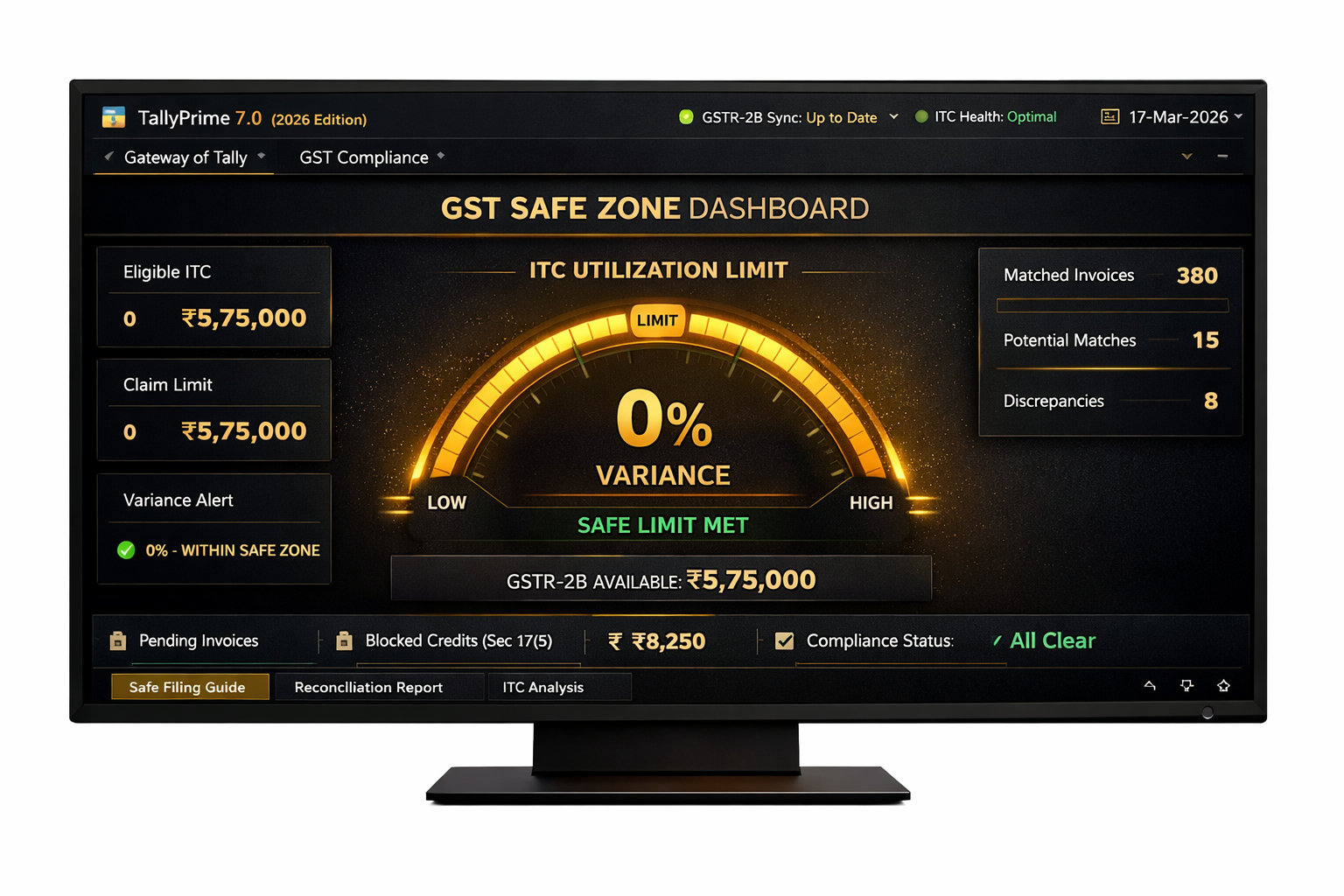
Monitor your audit risk with the GST Safe Zone Dashboard. This AI gauge ensures zero variance and keeps your penalties at 0%.
Tally calculates your safe filing limit using this logical boundary:
Accurate GST filing starts with clean financial records. If your bank statements are messy, your tax calculations will never be 100% precise. To streamline your pre-audit process, you can use these AI Bank Reconciliation Hacks for TallyPrime 2026 to sync your statements instantly before you begin the GSTR-2B matching process.
📊 The “Safe Filing” Formula
Pro Tip: During peak filing seasons, the permissible variance is often near 0%.Always keep your claim within the GSTR-2B reflected amount to avoid ‘Hard-Blocking’.
3. Deep Dive: How the AI Matching Engine Thinks
The “Fuzzy Logic” in TallyPrime 7.0 is the biggest tech jump since GST began. Let’s look at the four layers of validation Tally performs:
Understanding how automated matching works is key to error-free accounting. For technical details on system configurations, you can refer to the Tally Solutions Help Documentation. It provides a deep dive into how modern AI algorithms interpret your digital invoices during the reconciliation process.
TallyPrime 7.0 AI-Driven Pattern Recognition and Fuzzy Matching Interface.
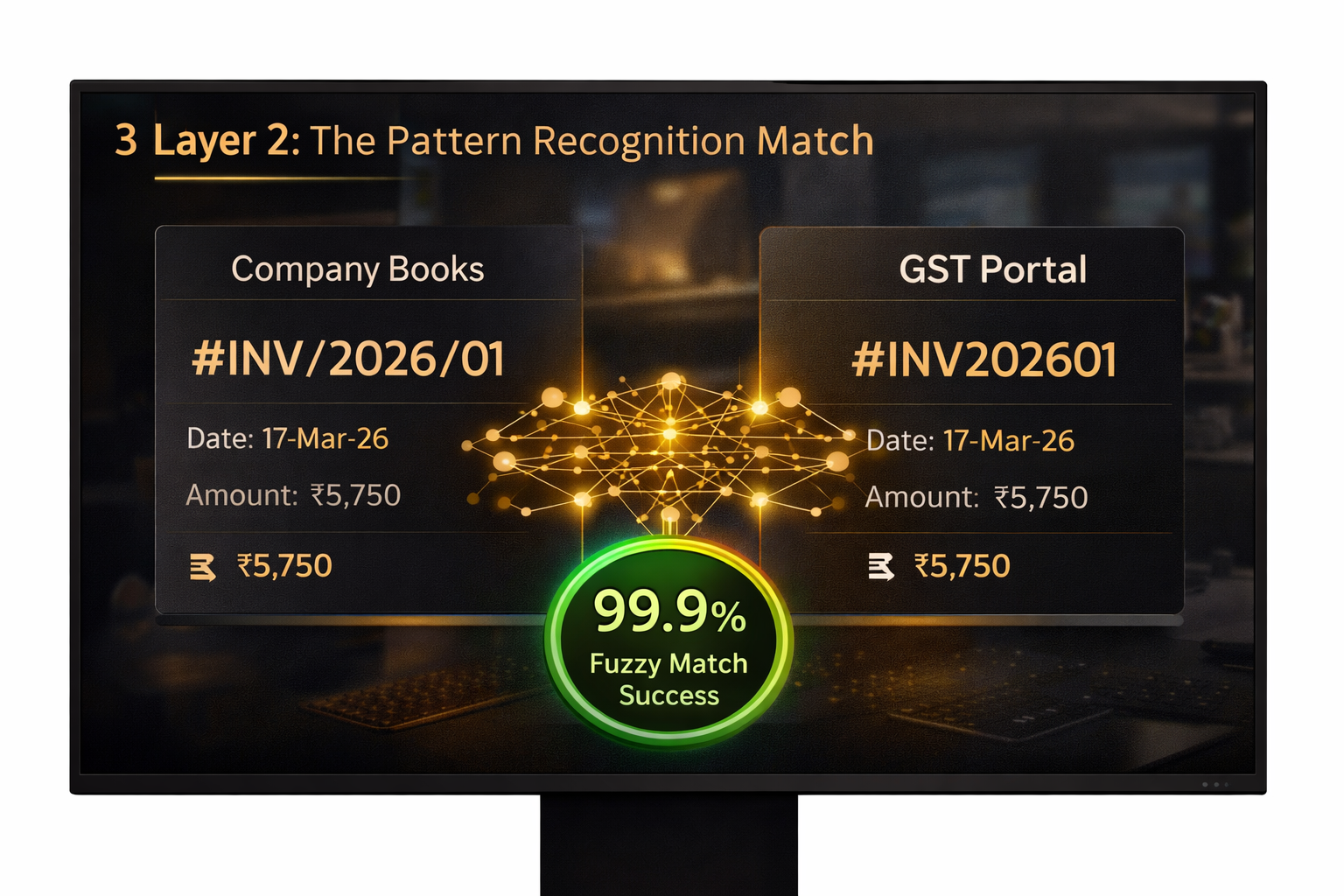
This AI Matching Engine automatically links invoices with formatting differences, achieving a 99.9% success rate in reconciling portal data with your books.
Layer 1: The Exact Match (Deterministic)
The system checks the GSTIN, Invoice Number, Date, and Total Tax Amount. If all 4 match perfectly, it’s marked “Green”.
Our Experience: This is a pure time-saver. We found that it clears about 90% of the bulk work instantly, letting us focus only on the tricky entries that actually need a human eye.
Layer 2: The Pattern Recognition Match (Fuzzy Logic)
In older versions, Bill #INV/101 and #INV101 were mismatches. The AI Hack: Tally 2026 uses string-similarity algorithms to recognize symbols like slashes, dashes, or leading zeros as common human entry errors. It suggests these as “Probability Matches.
Our Experience: This layer effectively “thinks” like an accountant. It stopped our team from wasting hours manually fixing minor typing differences that have no impact on tax values.
Layer 3: The Tax-Value Match
Sometimes invoice numbers differ completely, but the Taxable Value and Tax Amount match perfectly for a specific GSTIN on the same date. Tally flags these as “Potential Counterparty Errors,” allowing you to link them with one click.
Our Experience: We noticed this is perfect for catching supplier mistakes. Even if they use a different invoice series, the tax “DNA” matches, ensuring you never lose a single rupee of claimable ITC.
Layer 4: The Multi-Month Lookup
If a supplier files an invoice in March that you recorded in February, Tally’s AI automatically scans the previous 6 months of unreconciled data to find the link.
Our Experience: This solves the “Timing Difference” nightmare. It automatically finds bills we had almost forgotten about from previous months, making the March closing surprisingly smooth.
4. Dealing with Discrepancies: Actionable Insights
Tally categorizes discrepancies so you can prioritize your time:
- Available only on Portal: This is “Hidden Profit.” These are purchases your team forgot to record. Entering these reduces your net tax liability.
- Available only in Books: This is your “Follow-up List.” These suppliers have taken your money but haven’t paid the government.
- Mismatched Amount: Usually due to “Rounding Off” differences. Tally 2026 allows you to set a Tolerance Limit (e.g., ₹2.00) to auto-reconcile minor differences.
| Scenario | Status Check | Action Required |
|---|---|---|
| Data matches in Books & Portal | PERFECT MATCH | No Action Needed. Claim ITC Safely. |
| Found in Portal but Missing in Books | MISSING ENTRY | Urgent: Record purchase entry to reduce tax. |
| Recorded in Books but Not on Portal | SUPPLIER DEFAULT | Follow up with supplier to file GSTR-1. |
| Invoice Amount or GSTIN Mismatch | DATA ERROR | Use Tally AI to reconcile instantly. |
When Tally’s AI identifies a “Missing Entry” or “Data Error,” you need to act fast to rectify the ledgers. Navigating through multiple accounts manually can be time-consuming during the month-end rush. Mastering these 8 Essential Tally Prime Ledger Shortcuts will help you jump between entries and fix discrepancies in seconds without leaving the reconciliation screen.
5. Audit Readiness: The RAS Score
TallyPrime 2026 Audit Readiness RAS Score Interface on Tablet.
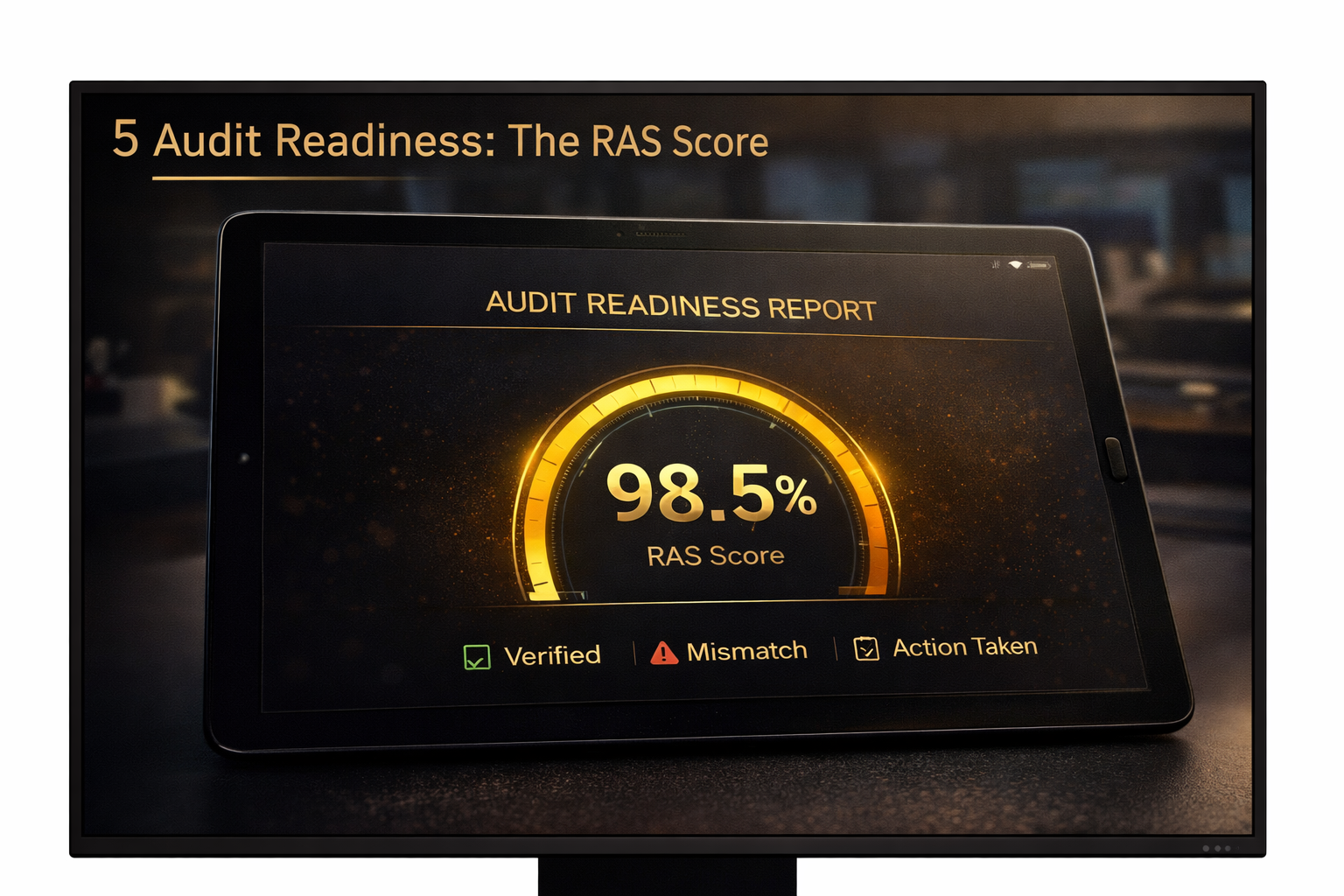
Your compliance status at a glance. A 98.5% RAS Score ensures that your data is audit-proof and matches perfectly with the portal’s new blocking system.
For Chartered Accountants and Tax Professionals, the Reconciliation Accuracy Score (RAS) is the new benchmark for quality.
✅ The RAS Formula
Maintaining a high RAS score is no longer optional for serious tax professionals. A score below 98% often triggers a ‘High Variance’ flag on the GST portal. We recommend setting aside a few hours every weekend to run this report in Tally. By keeping your RAS score consistently high, you ensure that your books are always ready for a sudden department audit.
6. Sector-Specific Impact of AI Matching
Different businesses face different reconciliation challenges. Tally 2026 handles them all:
- E-commerce Sellers: Matches thousands of small-value invoices against GSTR-2B in seconds.
- Manufacturers: Handles complex RCM (Reverse Charge Mechanism) reconciliation for raw material imports.
- Service Providers: Manages “Place of Supply” mismatches that often lead to IGST vs. CGST/SGST errors.
Sometimes, the mismatch occurs because a Credit Note or Sales Return was not recorded correctly on either side. Understanding how to handle these returns is crucial for maintaining a high RAS score. You should check out the Best Ways to Master Tally Prime Sales Return to ensure that your returns are perfectly documented before you send a nudge to your suppliers.
7. The Final Calculation for GSTR-3B
Once the AI has finished its work and you have verified the “Potential Matches,” you are ready for the final numbers.
TallyPrime 2026 Final GSTR-3B ITC Summary and Ready to File Button.
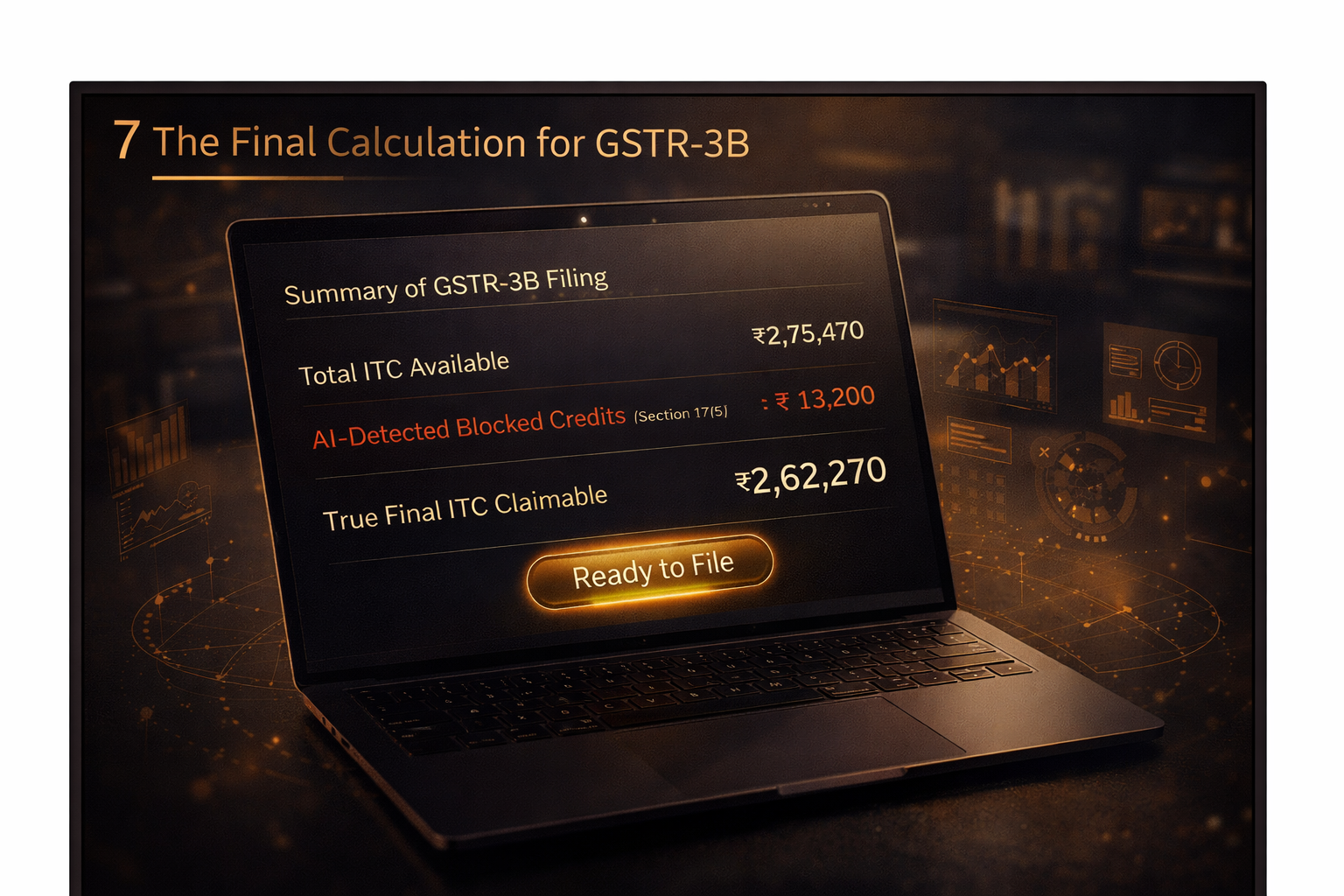
The final output. This screen calculates the True Final ITC Claimable after filtering blocked credits, making your filing 100% safe.
Before final submission, make sure your ITC claims are within the legal limits. You can double-check the latest eligibility criteria on the GST Council Meeting Recommendations portal. This simple step helps you avoid legal notices and keeps your final GSTR-3B filing completely audit-proof.
🧮 The Final ITC Formula
Note: Tally 2026 now uses AI to detect ‘Section 17(5) Blocked Credits’ (like food/insurance) and automatically deducts them from your claimable total.
8. Frequently Asked Questions (F&Q)
Q1: How does Tally handle Bill of Entry (Imports) ?
Tally 2026 syncs with the ICEGATE portal data reflected in GSTR-2B, matching your custom duty payments automatically.
Q2: Can I reconcile data for multiple branches (GSTINs) at once ?
Yes, the “Multi-GSTIN” feature in TallyPrime 7.0 allows you to view a consolidated reconciliation report for the entire organization.
Q3: What is the benefit of the ‘Direct API’ sync over JSON ?
Security and Speed. The direct API uses 256-bit encryption and eliminates the risk of file tampering during the download/upload process
Expert Author
About the Author : Anurag
Anurag is a seasoned Digital Content Creator and Website Administrator at servicemoney.in. With deep expertise in TallyPrime, GST compliance, and Indian financial regulations, he specializes in helping businesses bridge the gap between complex tax laws and modern accounting technology. His mission is to empower Indian or US accountants with the right tools for a 100% audit-ready business.
9. Conclusion: Don’t Let the Deadline Control You
When the deadline is near, you cannot afford to be anything less than perfect. By using the AI-powered tools in TallyPrime, you aren’t just doing “data entry”—you are performing High-Value Tax Management.
Clean reconciliation means a better cash flow, a better reputation with the GST department, and most importantly, peace of mind during the hectic March closing.
Stop struggling with Excel sheets. Sync your TallyPrime 7.0 today and let AI handle the stress!
Disclaimer
This blog is for educational and informational purposes based on the 2026 tax landscape. GST laws are subject to frequent changes by the government. Always consult a certified Chartered Accountant (CA) or tax professional at servicemoney.in for specific advice.

