

Position as on 23 November 2026. The statutory provisions, notified dates and portal steps discussed below are drawn from the primary sources listed at the end of this article. Time-bound items are marked as dated.
An adjudication order under Section 73, Section 74 or Section 74A converts a notice dispute into a recoverable demand, and the GST appeal pre-deposit then decides whether that order can be challenged at all. From that point, three questions decide the outcome: within what time can the order be challenged, what must be deposited for the appeal to be entertained, and does the deposit protect the balance demand from recovery. This article answers each in sequence, from the first appeal under Section 107 to the Goods and Services Tax Appellate Tribunal (GSTAT) under Section 112, with a numerical illustration of the cumulative deposit.
Key Takeaways
- First appeal (Section 107): three months from communication of the order; one further month may be allowed on sufficient cause.
- GSTAT appeal (Section 112): three months from communication, or the date notified by the Government, whichever is later; the Tribunal may admit a delayed appeal within a further three months.
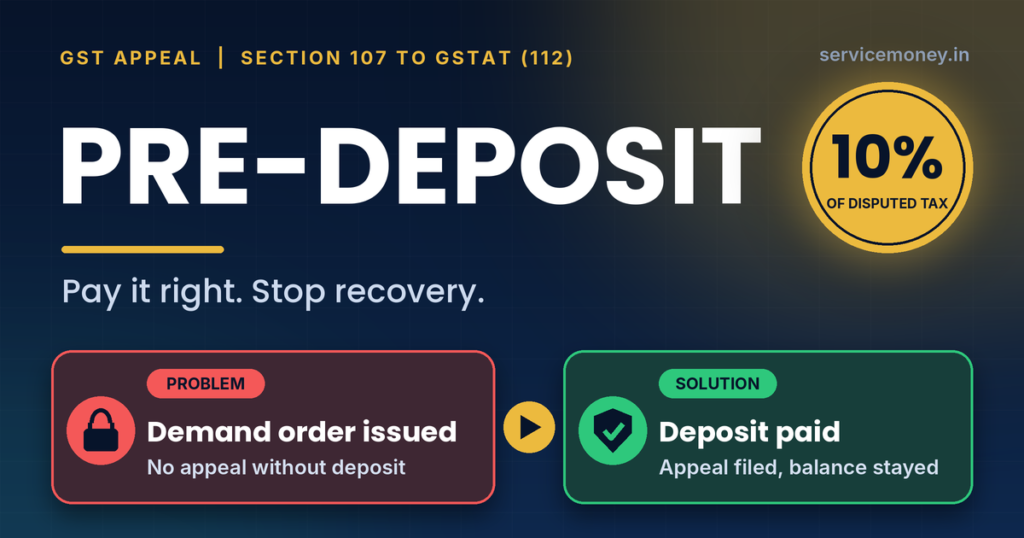
- Pre-deposit: the admitted amount in full, plus 10% of the disputed tax. The 10% deposit is subject to a separate maximum under each Act: ₹20 crore under the CGST Act, ₹20 crore under the SGST Act and ₹40 crore under the IGST Act (Section 20, IGST Act). The GSTAT deposit is payable in addition to the first-stage payment.
- Stay: once the prescribed amount is paid, recovery of the balance amount is deemed stayed (Sections 107(7) and 112(9)).
- Refund: a successful appellant is entitled to interest under Section 115 from the date of each payment.
1. Immediate Checks After Receiving the Order
Before computing anything, establish the nature of the order, the date of its communication and the component-wise demand. Where the demand originated from a system-generated intimation, for instance a Rule 88C intimation in Form DRC-01B, trace how the amount in the order was derived, since the split between admitted and disputed amounts depends on it.
Swipe left or right to view the full table
| Checkpoint | Why it matters |
|---|---|
| Nature of the order | An order of an adjudicating authority (Sections 73, 74, 74A) goes to the Appellate Authority under Section 107. An order of the Appellate or Revisional Authority goes to GSTAT under Section 112. |
| Date of communication | Limitation runs from communication of the order, not from the date printed on it. Verify the date of service on the common portal. |
| Component-wise demand | Separate tax, interest, fine, fee and penalty. The 10% deposit is computed on disputed tax (penalty-only orders are treated separately). |
| Admitted vs disputed | The admitted portion must be paid in full before filing. The disputed portion is the base for the 10% deposit. The classification is made by the appellant at the time of filing (Circular 259/05/2026-GST). |
| Ledger balances | The cash and credit ledgers are not interchangeable for every component. See the section on mode of payment. |
2. The Appeal Hierarchy
An order of an adjudicating authority is appealable to the Appellate Authority under Section 107. The order of the Appellate Authority, or of the Revisional Authority under Section 108, is appealable to the Appellate Tribunal under Section 112(1). The statutory text of these provisions is available in the CGST Act, 2017 as amended.
Swipe left or right to view the full flowchart
Section 109 provides for the Principal Bench at New Delhi and State Benches. Appeals where the tax or input tax credit involved, or the fine, fee or penalty, does not exceed ₹50 lakh and which do not involve a question of law may, with the approval of the President, be heard by a single Member (Section 109(8)). Cases involving place of supply are heard only by the Principal Bench. The Tribunal’s notices, benches and portal are maintained at gstat.gov.in. Under Section 112(2), the Tribunal may, in its discretion, refuse to admit an appeal where the tax, input tax credit, difference or penalty does not exceed ₹50,000.
3. Limitation and Condonation
Limitation runs from the date on which the order is communicated to the appellant. The condonation powers are discretionary and require sufficient cause.
For the first appeal, Section 107(1) allows three months, and Section 107(4) permits a further one month. For GSTAT, Section 112(1) allows the later of three months from communication or the date notified by the Government, and Section 112(6) permits a further three months. An application by the Commissioner under Section 112(3) must be made within six months from the date on which the order was passed, and a memorandum of cross-objections under Section 112(5) within forty-five days of receipt of notice of the appeal.
Swipe left or right to view the full table
| Forum / Proceeding | Limitation | Condonation | Provision |
|---|---|---|---|
| First appeal (APL-01) | 3 months from communication of the order | 1 further month, on sufficient cause | S. 107(1), 107(4) |
| GSTAT appeal (APL-05) | 3 months from communication, or the date notified by the Government, whichever is later | 3 further months, on sufficient cause | S. 112(1), 112(6) |
| Application by the Commissioner | 6 months from the date of the order (same “later of” rule applies) | 3 further months, on sufficient cause | S. 112(3), 112(6) |
| Memorandum of cross-objections | 45 days from receipt of notice of appeal | Further 45 days, on sufficient cause | S. 112(5), 112(6) |
GSTAT Notified Date (Dated Information)
The Government’s notification S.O. 3502(E) dated 30 June 2026 (F. No. A-50/7/2025-GSTAT-DoR) superseded the earlier notification S.O. 4220(E) dated 17 September 2025 and notified 31 July 2026 as the last date for orders communicated before 1 May 2026. For orders communicated on or after 1 May 2026, the three-month period under Section 112(1) applies. For applications by the Commissioner under Section 112(3), the same notification fixes 31 July 2026 for orders passed before 1 February 2026, while orders passed on or after that date carry the six-month period under Section 112(3). Notifications are published on the CBIC portal and in the Gazette.
Swipe left or right to view the full table
| Date on which the appellate order was communicated | Last date for GSTAT appeal |
|---|---|
| Before 1 May 2026 | 31 July 2026 (notified date; lapsed). Condonation window under Section 112(6): up to 31 October 2026 (lapsed). |
| On or after 1 May 2026 | 3 months from communication (S. 112(1)); a further 3 months on sufficient cause (S. 112(6)) | >
Illustration: if an appellate order is communicated on 10 September 2026, the GSTAT appeal is due by 10 December 2026. With sufficient cause, the Tribunal may condone a delay of up to three further months (that is, up to 10 March 2027), but this is a matter of discretion and not of right, so the primary deadline should be treated as final.
For orders communicated before 1 May 2026, the period under Section 112(1) ended on 31 July 2026. On a plain reading of Section 112(6), the further three-month window for admitting a delayed appeal ended on 31 October 2026. Both periods have lapsed. Any remaining remedy depends on the facts of the case and should be examined with professional advice. The GSTAT staggered-filing order dated 24 September 2025 was revoked by the order dated 16 December 2025 with effect from 18 December 2025, so staggered dates cited in older commentary no longer apply.
4. GST Appeal Pre-Deposit Under Sections 107(6) and 112(8)
No appeal can be filed unless the appellant has paid, in full, the part of the tax, interest, fine, fee and penalty admitted by him, and a sum equal to ten per cent of the remaining tax in dispute,subject to a maximum of ₹20 crore under the CGST Act, ₹20 crore under the SGST Act and ₹40 crore under the IGST Act (Section 20, IGST Act); each Act carries its own ceiling. Circular 259/05/2026-GST dated 26 October 2026 clarifies that the “admitted amount” is the portion the taxpayer does not intend to challenge, and that the 10% is computed only on the tax component that remains in dispute.
Swipe left or right to view the full table
| Element | First appeal – S. 107(6) | GSTAT – S. 112(8) |
|---|---|---|
| Admitted amount | Tax, interest, fine, fee and penalty admitted, paid in full | Same, paid in full |
| Deposit on disputed tax | 10% of tax in dispute | 10% of tax in dispute, computed on the liability confirmed by the Appellate Authority |
| Maximum | ₹20 crore each under the CGST Act and the SGST Act; ₹40 crore under the IGST Act | ₹20 crore each under the CGST Act and the SGST Act; ₹40 crore under the IGST Act |
| Relation to earlier payment | Not applicable | In addition to the amount paid under S. 107(6) |
| Penalty-only order (no tax demand) | 10% of penalty (from 1 Oct 2025); no monetary ceiling is stated in the CGST Act proviso as it stands (see “Pending Changes” below) | 10% of penalty, in addition to the amount under the proviso to S. 107(6) (from 1 Oct 2025); no monetary ceiling is stated in the CGST Act proviso as it stands (see “Pending Changes” below) |
| Interest, fine, fee, penalty (other cases) | No 10% deposit on these components; the 10% is on disputed tax only. | |
At the Tribunal, the 10% is computed on the liability confirmed by the Appellate Authority that the appellant disputes, and is payable in addition to the amount paid for the first appeal. The 10% deposit does not extend to interest, fine, fee or penalty in the ordinary case, a reading adopted by the Bombay High Court in Oasis Realty.
For an order demanding penalty without any tax, a separate proviso requires a sum equal to ten per cent of the penalty. The CGST Act proviso, as reviewed, does not state a monetary ceiling (see “Pending Changes” below). The proviso was inserted into Sections 107(6) and 112(8) by Sections 128 and 130 of the Finance Act, 2025 (7 of 2025). Notification No. 16/2025-Central Tax dated 17 September 2025 brought these sections into force on 1 October 2025.
The Finance (No. 2) Act, 2024 (No. 15 of 2024) reduced the ceiling in Section 107(6) from ₹25 crore to ₹20 crore. In Section 112(8) it reduced both the rate (from 20% to 10%) and the ceiling (from ₹50 crore to ₹20 crore). The corresponding ceiling under the IGST Act is provided through Section 20 of that Act.
Pending Changes (Dated Information)
The 57th GST Council, which met on 8 October 2026, recommended an upper limit of ₹40 crore (₹20 crore under CGST and ₹20 crore under SGST/UTGST) on the pre-deposit payable under the provisos to Sections 107(6) and 112(8) where an order involves only penalty and no demand of tax. It also recommended an amendment to Section 115 to bring greater clarity on interest payable on refund of pre-deposit. These are recommendations of the Council. They take effect only after the CGST Act is amended or notified and the changes are brought into force. This article states the law as it stands on 23 November 2026.
5. Worked Example: Cumulative Deposit Across Both Stages
The figures are hypothetical. Assume an order raising tax of ₹2 crore, interest of ₹40 lakh and penalty of ₹20 lakh. The taxpayer admits tax of ₹50 lakh and interest of ₹10 lakh thereon, and disputes the remaining tax.
Swipe left or right to view the full table
| Step | Computation | Amount (₹) |
|---|---|---|
| Stage 1: admitted amount | Tax 50,00,000 + interest 10,00,000 | 60,00,000 |
| Stage 1: disputed tax | 2,00,00,000 − 50,00,000 | 1,50,00,000 |
| Stage 1: pre-deposit at 10% | 10% × 1,50,00,000 (below the ₹20 crore cap) | 15,00,000 |
| Payable before filing APL-01 | 60,00,000 + 15,00,000 | 75,00,000 |
| Tax confirmed by Appellate Authority | Assumed to be ₹1,20,00,000 out of the ₹1,50,00,000 disputed tax (the ₹50,00,000 admitted tax is excluded, as it is already paid) | 1,20,00,000 |
| Stage 2: pre-deposit at 10% | 10% × 1,20,00,000, entire confirmed tax disputed | 12,00,000 |
| Total pre-deposit across both stages | 15,00,000 + 12,00,000 | 27,00,000 |
At the first stage, the admitted amount is ₹60,00,000. The disputed tax is ₹1,50,00,000, and 10% of it, ₹15,00,000, is the pre-deposit, well below the cap. The total payable before filing Form APL-01 is therefore ₹75,00,000. Assume that, out of the ₹1,50,00,000 disputed tax, the Appellate Authority confirms ₹1,20,00,000 and the appellant disputes all of it.The second-stage deposit is 10% of ₹1,20,00,000, which is ₹12,00,000. The total pre-deposit across both stages is ₹27,00,000.
The example assumes that the first-stage admitted amount has already been paid and that no further amount is admitted at the Tribunal. If additional amounts are admitted at the second stage, they must also be paid in full. Where the disputed tax under the CGST Act is, for example, ₹300 crore, 10% equals ₹30 crore, but the deposit stops at the ceiling for that Act (₹20 crore). The SGST Act and the IGST Act carry their own ceilings of ₹20 crore and ₹40 crore respectively. The illustration does not address refund of the admitted amount, which is fact-specific.
Caution on forms. The copies of Forms GST APL-01 and APL-05 reviewed for this article carry outdated figures. The APL-01 copy shows the correct 10% rate but the earlier ceiling (₹25 crore for central tax, State tax or cess; ₹50 crore for integrated tax). The APL-05 copy shows the earlier 20% rate with ceilings of ₹50 crore and ₹100 crore. These do not match the present text of Sections 107(6) and 112(8). The amounts auto-computed on the portal should be reconciled with the statute before payment.
6. Mode of Payment: Credit Ledger, Cash Ledger and Form DRC-03A
In Oasis Realty v. Union of India (Writ Petition (ST) No. 23507 of 2022, decided on 16 September 2022), the Bombay High Court held, under the Maharashtra GST Act, that the 10% of disputed tax under Section 107(6)(b) may be paid from the electronic credit ledger as well as the cash ledger. The Court relied on the word “paid” in the provision and on the CBIC clarification of 6 July 2022. The same clarification records that the credit ledger can discharge output tax only; reverse charge tax, interest, penalty and fees must be paid in cash. The decision concerns Section 107(6) of the State Act and does not address Section 112(8).
Demands arising from ITC denial, as discussed in our note on the Section 16(2) defence, frequently deplete the credit ledger, so the choice of ledger is a practical issue.
Separately, the GSTN advisory on pre-deposit explains that a payment made through Form DRC-03 is not linked to the Demand ID in the electronic liability register, and the portal therefore asks for the deposit again. Filing Form DRC-03A maps the earlier payment to the demand, after which the portal recognises it. The mechanism is described in the advisory published on the GST portal and in CBIC Circular 224/18/2024-GST.
7. Filing the Appeal on the GSTAT Portal (Dated Information)
Under Rule 115 of the GSTAT (Procedure) Rules, 2025, appeals are filed and processed electronically. The sequence follows the GSTAT e-Filing User Manual (version 1.0, published 24 September 2025; a later version may be available on the portal) available at the e-filing portal: login with ARN or CRN, selection of Appeal Filing, entry of order and case details, addition of respondents and representative,
the demand tab with admitted and disputed amounts and the pre-deposit confirmation (the pre-deposit is paid beforehand on the GST portal against the Demand ID, and the GSTAT portal displays the payment confirmation), payment of the appeal fee (online or offline through Bharatkosh), upload of documents and checklist, and finally preview and submission. Screens may change; the live portal governs.
Swipe left or right to view the full workflow
As per the manual, e-filing is complete only after successful payment and its verification by GSTAT, and the provisional acknowledgement carries a 16-digit filing number. Rule 18(3) of the Procedure Rules requires a separate appeal for each order-in-original covered by the impugned order and for each aggrieved person; joint appeals are not entertained. The Rule 110(5) fee text reviewed provides ₹1,000 for every ₹1 lakh of tax involved, subject to ₹25,000; the portal’s fee computation should be treated as final.
At the start of filing, the portal requires a declaration that this is the first appeal against the impugned order and that no appeal or writ has been filed or is pending before any other forum, including the High Court or the Supreme Court. The documents are signed through a Digital Signature Certificate (external DSC utility, NIC DSC utility or Aadhaar-based utility), and the APL-05 verification carries a corresponding declaration.
8. Deemed Stay of Recovery
Where the appellant has paid the amount under Section 107(6), recovery of the balance amount is deemed stayed (Section 107(7)). At the Tribunal, recovery proceedings for the balance amount are deemed stayed till disposal of the appeal (Section 112(9)). The stay arises by operation of law and does not need a separate application for that portion, provided the appeal is validly filed with the prescribed payment.
Where coercive steps such as bank attachment are already in place, as examined in our note on Section 83 attachment, the appellant should place proof of the deposit and the filing acknowledgement before the proper officer.
Consequence of missing the window. CBIC Circular 224/18/2024-GST, issued when the Tribunal was not yet functional, stated that if no appeal is filed within the Section 112 timelines, the remaining demand is recoverable in accordance with law. The undertaking procedure in that circular was an interim measure and should not be read as the current filing procedure; the underlying principle remains.
9. Refund of Pre-Deposit and Interest
Section 115 provides that where an amount paid under Section 107(6) or Section 112(8) is required to be refunded consequent to an order of the Appellate Authority or Tribunal, interest at the Section 56 rate is payable from the date of payment until refund. Circular 259/05/2026-GST resolves several procedural doubts:
Swipe left or right to view the full table
| Issue | Clarification in Circular 259/05/2026-GST |
|---|---|
| Must the order expressly direct refund? | No. The refund claim is filed in Form GST RFD-01 at S. No. 7 (“on account of order”). |
| Department contemplates a further appeal | Refund should not be denied on that ground alone, unless the order is stayed by the Tribunal or a Court. |
| Date from which interest runs | Section 115: from the date of payment. Where deposits were made at both levels, the date is determined separately for each level. |
| Matter remanded by the Tribunal | Refund is available. In partial remand, tax confirmed in favour of Revenue is first recovered or adjusted, with applicable interest, and the balance refunded. |
Note: the 57th GST Council has recommended an amendment to Section 115 (see “Pending Changes” above). The position stated here is the law as on 23 November 2026.
10. Points Needing Care
Four points need particular care. First, computing the GSTAT deposit on the tax in the original order, instead of the tax confirmed by the Appellate Authority that is disputed. Second, paying 10% on interest or penalty, or funding interest from the credit ledger. Third, assuming that a DRC-03 payment counts as pre-deposit without linking it to the Demand ID through DRC-03A. Fourth, treating the first-stage deposit as covering GSTAT, when Section 112(8) requires a further deposit. Appeals should also be filed separately for each person and each order-in-original, and an appeal should be treated as filed only after payment is verified and the acknowledgement is issued.
Swipe left or right to view the full table
| Mistake to avoid | Correct position |
|---|---|
| Computing the GSTAT deposit on the tax in the original order | Compute on the tax confirmed by the Appellate Authority that is disputed. |
| Paying 10% on interest or penalty, or funding interest from the credit ledger | The 10% applies to disputed tax only (an order demanding penalty without tax requires 10% of the penalty). Admitted interest, fine, fee and penalty are payable in cash, as the credit ledger can discharge output tax only. |
| Assuming a DRC-03 payment counts as pre-deposit | Link it to the Demand ID by filing Form DRC-03A before appeal. |
| Treating the first-stage deposit as covering GSTAT | Section 112(8) requires a further deposit, in addition to the earlier amount. |
| Filing one appeal for several persons or several orders | File separate appeals (GSTAT Procedure Rules, 2025, Rule 18(3)). |
| Treating the appeal as filed once the form is submitted | Filing is complete only after payment is verified and the acknowledgement is issued. |
11. Case Illustration: Oasis Realty
In Oasis Realty, the Revenue contended that the 10% deposit could be made only from the cash ledger. The Bombay High Court quashed the order rejecting the appeal and restored it on the petitioner’s undertaking to debit the credit ledger within one week. In its illustration, the Court noted that where 25% of ₹1 crore tax is admitted, ₹25 lakh is paid in full and 10% of the remaining ₹75 lakh, being ₹7.5 lakh, is deposited, totalling ₹32.5 lakh, with no deposit against interest, fine, fee or penalty on the disputed portion.
12. Frequently Asked Questions
Q1: Must the full tax be paid before appeal?
No. The admitted amount must be paid in full, together with 10% of the disputed tax, subject to the ceiling under each Act ₹20 crore under the CGST Act and ₹40 crore under the IGST Act; State GST Acts carry their own ceilings.
Q2: What is the time limit for a GST appeal?
Three months for the first appeal (one further month on sufficient cause) and, for GSTAT, three months or the notified date, whichever is later (three further months on sufficient cause).
Q3: Is the first-stage deposit adjusted against the GSTAT deposit?
No. Section 112(8) requires the 10% deposit in addition to the amount paid under Section 107(6).
Q4: How is the pre-deposit refunded?
By a refund claim in Form GST RFD-01 on account of order, with interest under Section 115.
Scope of This Article
This article does not cover appeals to the High Court under Section 117, State-specific procedures or the pre-deposit exemption option visible in the portal manual, as the corresponding primary text was not reviewed. Amounts and dates in the worked example are illustrative.
The IGST ceiling is read from Section 20 of the IGST Act, as amended by the Finance (No. 2) Act, 2024 (No. 15 of 2024). The SGST ceiling reflects the corresponding provisions of the State GST Acts, which mirror the CGST Act; State-specific provisions may vary and should be checked against the relevant State Act.
Primary Sources
- CGST Act, 2017: Sections 73, 74, 74A, 107, 108, 109, 112 and 115
- CGST Act, 2017 as amended by the Finance (No. 2) Act, 2024 and the Finance Act, 2025 (CBIC consolidated text with footnotes)
- Notification No. 16/2025-Central Tax dated 17 September 2025
- Notification S.O. 3502(E) dated 30 June 2026 (Gazette of India, Extraordinary, Part II, Section 3(ii)), F. No. A-50/7/2025-GSTAT-DoR
- GSTAT Orders dated 24 September 2025 and 16 December 2025; GSTAT (Procedure) Rules, 2025
- CBIC Circular 224/18/2024-GST dated 11 July 2024 and Circular 259/05/2026-GST dated 26 October 2026
- GSTN Advisory on payment of pre-deposit through DRC-03 and DRC-03A
- GSTAT e-Filing Portal User Manual, version 1.0
- Oasis Realty v. Union of India, Bombay High Court, WP(ST) No. 23507 of 2022, 16 September 2022
- 57th GST Council meeting (8 October 2026): recommendations only, not yet law
Disclaimer
This article is for general information only and does not constitute tax, legal or financial advice. Deadlines, pre-deposit computation and payment methods depend on the facts of each order and the applicable State law, and the law, notifications and portal procedures change from time to time. Readers should verify all provisions against official sources and consult a qualified Chartered Accountant or advocate before making any filing or payment. ServiceMoney.in accepts no liability for any loss arising from reliance on this article. Last verified: 23 November 2026.

Anurag Panchal
Founder & Editor at ServiceMoney.in & AllRoundUpdate.com.
I am an independent freelancer and researcher. I am not a chartered accountant, lawyer or tax professional, and I have no affiliation with GSTAT, CBIC or any government body. I wrote this guide by studying public primary sources: Sections 107, 109, 112 and 115 of the CGST Act, 2017 (as amended by the Finance (No. 2) Act, 2024 and the Finance Act, 2025), Notification 16/2025-Central Tax, the GSTAT notification dated 30 June 2026, the GSTAT (Procedure) Rules, 2025, CBIC Circulars 224/18/2024-GST and 259/05/2026-GST, the GSTN advisory on pre-deposit, the GSTAT e-Filing User Manual, the Bombay High Court judgment in Oasis Realty, and the PIB release on the 57th GST Council meeting.
This article explains the GST appeal pre-deposit from the first appeal under Section 107 to GSTAT under Section 112: time limits, the 10% deposit on disputed tax, deemed stay of recovery, and refund with interest. It is for education only and is not tax or legal advice. Please consult a qualified Chartered Accountant or advocate before making any filing or payment.
Found an error? Please let me know. I review this article regularly and correct mistakes, and the date at the top shows when the law was last checked. More explainers on my YouTube channel.

