

By Anurag Panchal | Last verified: Law as on 14 Nov 2026
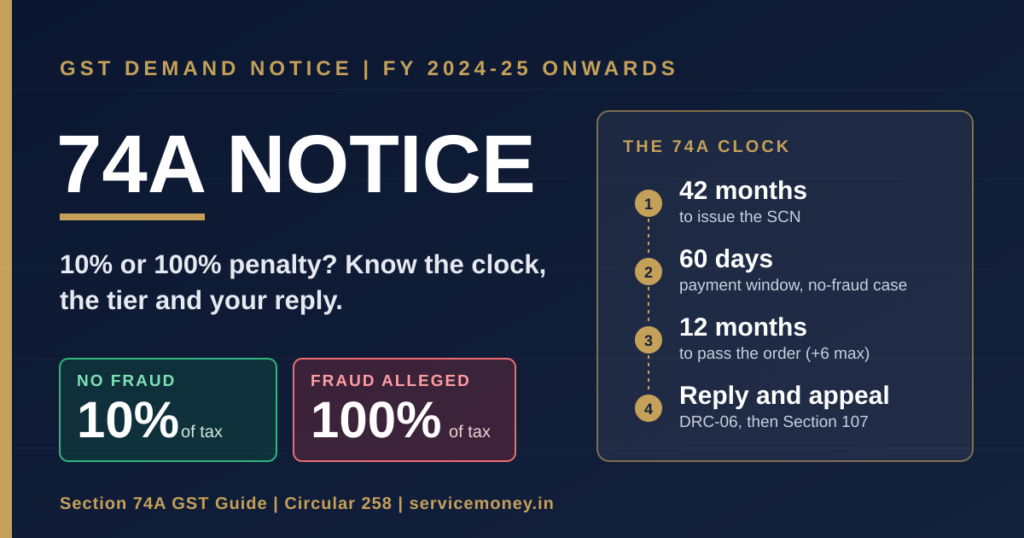
From FY 2024-25, a GST demand notice is no longer a Section 73 or Section 74 matter. It is a Section 74A GST matter. The change looks procedural, but it moves the fight. The time limit no longer depends on whether fraud is alleged, so the real contest is the penalty tier: 10% or 100%.
If you have followed this series, from ASMT-10 notices under Section 61 to ITC disputes under Section 16(2) and IMS and Rule 16(4aa), this is the stage where those problems become a formal demand. Everything below is built from the Act text, CBIC circulars and the GST Council press release listed at the end. Law as on 14 November 2026.
Quick answers
- Section 74A applies to tax periods from FY 2024-25. Sections 73 and 74 now apply only to periods up to FY 2023-24.
- The notice (SCN) must be issued within 42 months of the annual return due date. The order must follow within 12 months of the SCN, extendable by up to 6 months.
- Penalty is the higher of 10% of tax or ₹10,000 without fraud, and 100% of tax with fraud, wilful misstatement or suppression.
- In a non-fraud case, paying tax and interest within 60 days of the SCN means no penalty and the proceedings end.
- A fraud charge needs specific evidence set out in the SCN. Non-payment alone is not enough (CBIC Circular 258, para 5.3).
What changed: Section 73/74 vs Section 74A
← Swipe sideways to read the full table →
| Point | Sections 73 and 74 | Section 74A |
|---|---|---|
| Tax periods | Up to FY 2023-24 | FY 2024-25 onwards |
| SCN time limit | Separate limits for non-fraud and fraud | One limit: 42 months |
| Effect of a fraud allegation | Unlocks the extended time limit | Raises the penalty from 10% to 100% |
| Order deadline | Set by Sections 73(10) and 74(10) | 12 months, plus up to 6 months |
Sources: Finance (No. 2) Act, 2024 (Section 74A(12)); CBIC Circular 254/11/2025-GST, para 2; Circular 258/04/2026-GST, para 6.
“Suppression” has a defined meaning in Section 74A (Explanation 2): not declaring facts or information that must be declared in a return, statement, report or other document, or not furnishing information asked for in writing by the proper officer. Circular 258 (para 5.2) adds that the fraud route needs an intent to evade tax. The same idea appeared in CBIC’s 2023 instruction on the old Section 74(1), and Circular 258 (para 5.3) now carries it to Section 74A(5)(ii).
Section 74A GST clock: SCN, order and extension
← Swipe sideways to view the full diagram →
Dates are approximate. The Act does not say how the 42 months are counted day by day. The FY 2024-25 annual return due date was 31 December 2025; always use the due date notified for the year in question.
Order after an appellate direction: where an order must be issued because an Appellate Authority, Tribunal or court directed it, it must be issued within two years of communication of the direction (Section 75(3)).
SCN deadline = Annual return due date + 42 months | Order deadline = SCN date + 12 months (+ max 6 months)
- Extension: only the Commissioner, or an officer authorised by the Commissioner who is senior in rank to the proper officer and not below Joint Commissioner of Central Tax, can extend. Reasons must be recorded in writing before the period expires (Section 74A(7) proviso).
- Deemed conclusion: if no order is issued in time, the adjudication proceedings are deemed concluded (Section 75(10)).
- Stay: the period a court or Tribunal stay is in force is excluded from both clocks (Section 75(1)).
- Erroneous refund: the 42 months run from the date of the refund.
Penalty maths: what each route costs
Take hypothetical tax of ₹10,00,000, with no real case behind it. Interest under Section 50 is payable on top in every route and is not shown here.
← Swipe sideways to view the full diagram →
Hypothetical tax of ₹10,00,000. Green bars are non-fraud routes. Red bars are fraud, wilful misstatement or suppression routes. Interest under Section 50 is payable on top in every route and is not shown.
← Swipe sideways to read the full table →
| Payment window | Non-fraud: Section 74A(8) | Fraud: Section 74A(9) |
|---|---|---|
| Before the SCN | Tax + interest. No notice, no penalty | Tax + interest + 15% penalty |
| Within 60 days of SCN issue | Tax + interest. No penalty, case closed | Tax + interest + 25% penalty |
| Within 60 days of the order | No such route in Section 74A(8) | Tax + interest + 50% penalty |
| Order passed (Section 74A(5)) | 10% of tax or ₹10,000, higher | 100% of tax |
The 60 days run from the issue of the SCN, but from the communication of the order for the 50% route.
Four traps
- The ₹10,000 floor bites on small demands. On hypothetical tax of ₹50,000, 10% is ₹5,000, so the penalty is ₹10,000, which is 20% of the tax.
- The 30-day rule (Section 74A(11)). If self-assessed tax, or tax collected, is not paid within 30 days of its due date, the non-fraud penalty applies even if you use the Section 74A(8) routes.
- Payment does not close prosecution. “All proceedings in respect of the said notice” excludes proceedings under Section 132 (Explanation 1).
- A short payment invites a fresh notice (Section 74A(10)). If the amount you pay under Section 74A(8) or (9) falls short of what is payable, the officer can issue a notice for the shortfall.
Two more rules from Section 75: when a penalty is imposed under Section 74A, no other penalty can be imposed on the same person for the same act or omission (Section 75(13)). And unpaid self-assessed tax in a filed return can be recovered under Section 79 without a notice (Section 75(12)), which is the route covered in our Section 75(12) and DRC-01B guide.
Workflow: from DRC-01A to GSTAT
← Swipe sideways to view the full diagram →
Paying instead of contesting. Before the SCN, you pay through DRC-03 and receive an acknowledgement in DRC-04 (Rule 142(2)). Within the 60-day window, DRC-03 is followed by DRC-05 concluding the proceedings (Rule 142(3)). DRC-01A is optional for the officer: under Rule 142(1A) the proper officer may send it. You can respond in Part B, with a submission or part-payment, and the officer may accept it in Part C (Rule 142(2A)). Circular 258 (para 2) asks officers to use it wherever feasible.
Is the notice valid? The SCN checklist
← Swipe sideways to read the full table →
| Check | What to verify | Source |
|---|---|---|
| Section and year | Section 74A for FY 2024-25 onwards | Section 74A(12) |
| Time limit | SCN within 42 months of the return due date | Section 74A(2) |
| Threshold | Act: no notice below ₹1,000 a year. CBIC: no SCN below ₹10,000 | Section 74A(1); Instruction 02/2026, para 3.3 |
| Proper officer | Demand within the officer’s monetary limit | Circular 254, Table II |
| Facts and evidence | Specific facts and grounds, with a reply date | Circular 258, para 4.1 to 4.6 |
| Quantification | Amount and basis stated, year-wise where possible | Circular 258, para 4.5 |
| Fraud charge | Material behind fraud or suppression is in the SCN | Circular 258, para 5.1, 5.3 |
| Mixed notice | Fraud and non-fraud demands quantified separately | Circular 258, para 6 |
| Parallel action | No State and Central action on the same subject | Section 6; Circular 258, para 7 |
| Order vs notice | No higher amount or new ground in the order | Section 75(7) |
Fraud is the high-stakes argument
Circular 258 (para 5.3) says Section 74A(5)(ii) cannot be invoked merely because GST is unpaid, and that a discrepancy found in scrutiny is not by itself a reason to presume fraud. Para 5.5 adds that a second SCN on the same facts invoking fraud is generally not valid unless there are new and independent grounds. If the charge fails, the penalty falls to Section 74A(5)(i): Section 75(2A) says so where an appellate authority, Tribunal or court decides it, and Circular 258 (para 13) tells adjudicating officers to do the same.
One caution for your reply. The Circular quotes the Supreme Court’s G.R. Infra decision on the “extended time” under the old regime. Under Section 74A there is no extended period, so use the Circular’s own para 5.3 and the statutory text of Section 74A(5) as your anchor, and quote the judgment only as cited by CBIC. Circular 258 (para 17) also calls its guidelines illustrative and non-exhaustive, and says officers must not cite them in SCNs or orders. So build your main argument on the Act and court decisions.
Clubbed notices: do not treat this as a sure win
Section 74A(3) and (4) let the officer send a statement for other periods after one notice, and it counts as an SCN if the grounds are the same. Its summary goes in FORM GST DRC-02 (Rule 142(1)(b)). Circular 258 (para 4.5) says only that efforts “should be made” to split demands year-wise. The Council has also recommended a validation clause for notices that courts struck down for covering several years (PIB press release, para 18(3)). Take professional advice before relying on this argument.
Who can issue it: officer and monetary limits
← Swipe sideways to read the full table →
| Central Tax officer | CGST tax | IGST tax | CGST + IGST together |
|---|---|---|---|
| Superintendent | Up to ₹10 lakh | Up to ₹20 lakh | Up to ₹20 lakh |
| Deputy / Assistant Commissioner | ₹10 lakh to ₹1 crore | ₹20 lakh to ₹2 crore | ₹20 lakh to ₹2 crore |
| Additional / Joint Commissioner | Above ₹1 crore | Above ₹2 crore | Above ₹2 crore |
Limits are based on the tax amount (including cess) only, not penalty (Circular 254, para 5.3(d)). Where both CGST and IGST are demanded, the combined column decides. For later statements, the highest tax amount across periods decides, and a corrigendum shifts the case to the higher officer.
Source: Circular 254/11/2025-GST, Table II and para 5. These limits are for Central Tax officers only.
Reply and hearing: the steps that matter
- Note the SCN issue date. It starts the 60-day payment windows.
- Run the checklist above before you decide whether to pay or contest.
- If a DRC-01A arrives, respond in Part B with your submission or part-payment.
- File the reply in DRC-06 on the GST Portal by the date in the SCN, with documents.
- Ask for a personal hearing in writing. Section 75(4) requires one when you request it, or when an adverse decision is contemplated. Adjournments cannot exceed three (Section 75(5)), so at most four hearings in all (Circular 258, para 10.1).
- Track the 12-month order clock and check whether an extension was recorded before it ended.
- On receiving the order, compare it to the SCN under Section 75(7). Interest runs until actual payment (Section 75(9)).
Rectification of an apparent error is under Section 161: apply within three months, and the officer passes the order in DRC-08 within six months (the six-month limit does not apply to purely clerical or arithmetical errors). It does not replace an appeal (Circular 258, para 14).
Appeals and pre-deposit
← Swipe sideways to read the full table →
| Forum | Time limit | Pre-deposit | Also note |
|---|---|---|---|
| First appeal, Section 107 | 3 months, plus 1 month if sufficient cause | Admitted amount + 10% of disputed tax (max ₹20 crore) | Appellate authority cannot remand |
| GSTAT, Section 112 | 3 months, or the notified date if later | Admitted amount + a further 10% (max ₹20 crore) | May refuse appeals of ₹50,000 or less |
| Penalty-only order | As above | 10% of the penalty at each stage | In force from 1 Oct 2025 |
Sources: Sections 107 and 112 as amended. The ₹20 crore cap is the CGST figure; the State GST Act carries its own matching provision. Paying the pre-deposit stays recovery of the balance (Sections 107(7) and 112(9)).
Illustration with hypothetical numbers: disputed tax ₹1,00,00,000 with nothing admitted. The first appeal needs ₹10,00,000, and the Tribunal appeal a further ₹10,00,000, so ₹20,00,000 in total. A late Tribunal appeal can be admitted within three more months if sufficient cause is shown (Section 112(6)).
Law today vs changes only recommended
← Swipe sideways to read the full table →
| Item | Status on 14 Nov 2026 | Source |
|---|---|---|
| ₹10,000 SCN floor | CBIC instruction for central officers. Act not yet amended | Instruction 02/2026-GST |
| No arrests under GST | CBIC instruction for central formations | Instruction 02/2026-GST |
| 5% non-fraud penalty (pay within 60 days of order) | Council recommendation only | PIB press release, para 7.2(3) |
| No ₹10,000 minimum penalty | Council recommendation only | PIB press release, para 7.2 |
| ₹40 crore pre-deposit cap | Council recommendation only | PIB press release, para 7.4 |
| Proposed start date | 1 April 2027, as recommended | Instruction 02/2026-GST, para 3 |
State GST readers. Instruction 02/2026 is addressed to CBIC officers. It was copied to the GST Council Secretariat so States may issue similar instructions “if deemed appropriate”. The Act changes also need matching State GST Act amendments. Check your own State’s Act and instructions. The PIB release itself says only circulars, notifications and law amendments carry legal force.
Frequently asked questions
Does Section 74A apply to FY 2023-24?
No. Sections 73 and 74 cover periods up to FY 2023-24, and Section 74A covers FY 2024-25 onwards.
Can an officer allege fraud just because tax is unpaid?
According to Circular 258 (para 5.3), no. Specific evidence of fraud, wilful misstatement or suppression with intent to evade tax must be set out in the SCN.
If I pay within 60 days of a non-fraud SCN, is anything left?
No penalty is payable and the notice proceedings end, but interest is payable and Section 132 proceedings are not covered.
Is the ₹10,000 floor part of the law?
Not yet. The Act’s proviso still says no notice where tax in a financial year is below ₹1,000. The ₹10,000 floor is a CBIC instruction for central officers until the Act is amended.
Sources and verification
Checked against primary documents on 14 November 2026:
- Finance (No. 2) Act, 2024 (No. 15 of 2024, dated 16 August 2024): sections 138 (Section 74A), 139 (Section 75), 141 (Section 107) and 143 (Section 112), available on India Code.
- Notification 17/2024-Central Tax, 27 September 2024 (S.O. 4253(E)): Section 74A in force from 1 November 2024.
- CGST Rules, Rule 142, with Section 74A references from 1 November 2024 (Notification 20/2024-Central Tax, 8 October 2024).
- Finance (No. 7) Act, 2025: sections 129 and 130 (pre-deposit rule for penalty-only orders under Sections 107 and 112, in force from 1 October 2025).
- Circular 254/11/2025-GST (27 October 2025), Circular 258/04/2026-GST (26 October 2026) and Instruction 02/2026-GST (30 October 2026), published on CBIC.
- CBIC Instruction 05/2023-GST (13 December 2023), background on the old Section 74(1).
- PIB: Recommendations of the 57th GST Council Meeting (8 October 2026).
Court decisions are mentioned only as cited by CBIC in Circular 258. If you spot an error, tell us and we will correct it. Related reading: Section 83 provisional attachment and Rule 88C/88D bank freezes.
Disclaimer
This article is for general information and education only. It is not legal, tax, accounting or other professional advice, and reading it does not create any advisor–client or professional relationship between you and the author or publisher.
The content reflects the law, CBIC circulars and instructions, and GST Council recommendations as on 14 November 2026. GST law changes often through amendments, notifications, circulars, instructions and court decisions, so some points may be outdated by the time you read this. Items marked as Council recommendations are not law until they are enacted or notified.
The rupee amounts, dates and workflows shown in the tables, timeline and penalty chart are hypothetical or approximate and are given only to explain how the rules work. They are not a calculation for your case. Every notice depends on its own facts, the officer’s grounds, the tax period and your State’s GST Act, so the outcome in your case may differ.
Before you reply to a notice, make a payment, or file an appeal, please consult a qualified Chartered Accountant or advocate and check the latest position on the official sources (CBIC, GST Portal and your State tax department). Court decisions are mentioned only as cited by CBIC. The author and publisher accept no liability for any loss or action arising from reliance on this article.

Anurag Panchal
Founder & Editor at ServiceMoney.in & AllRoundUpdate.com.
I am an independent freelancer and researcher. I am not a chartered accountant, lawyer or tax professional. I wrote this guide by studying public sources: the Finance (No. 2) Act, 2024 (Sections 74A, 75, 107 and 112), CGST Rules (Rule 142), CBIC Circulars 254/11/2025-GST and 258/04/2026-GST, CBIC Instruction 02/2026-GST, and the PIB release on the 57th GST Council meeting.
This article explains how a GST demand notice works under Section 74A: the SCN time limit, penalty tiers, reply, appeal and pre-deposit. It is for education only and is not tax or legal advice. Please consult a qualified Chartered Accountant or advocate before making decisions.
Found an error? Please let me know. I review this article regularly and correct mistakes, and the date at the top shows when the law was last checked. More explainers on my YouTube channel.

Post navigation

I'm the ServiceMoney knowledge guide for GST, business compliance, calculators, ERP, technology and the questions in between.