

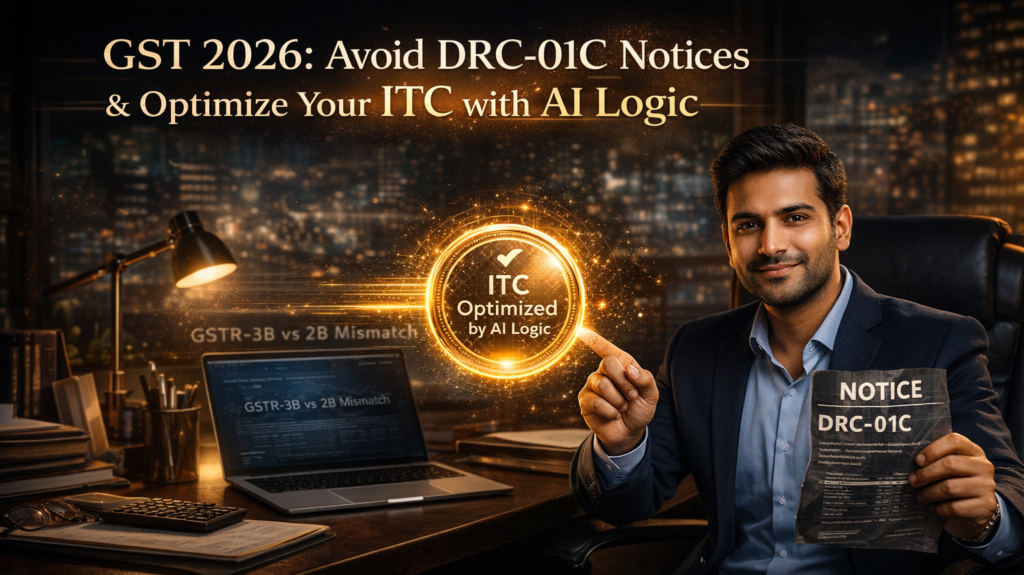
As a content creator and taxation blogger at servicemoney.in, I have closely monitored how GST has evolved from a simple tax to a complex AI-driven ecosystem. In this 2026 guide, I am sharing my practical observations on how to Avoid DRC-01C Notices & Optimize your ITC in an era where compliance is no longer about just filing—it’s about financial survival
Your Guide to the Future of GST in 2026!
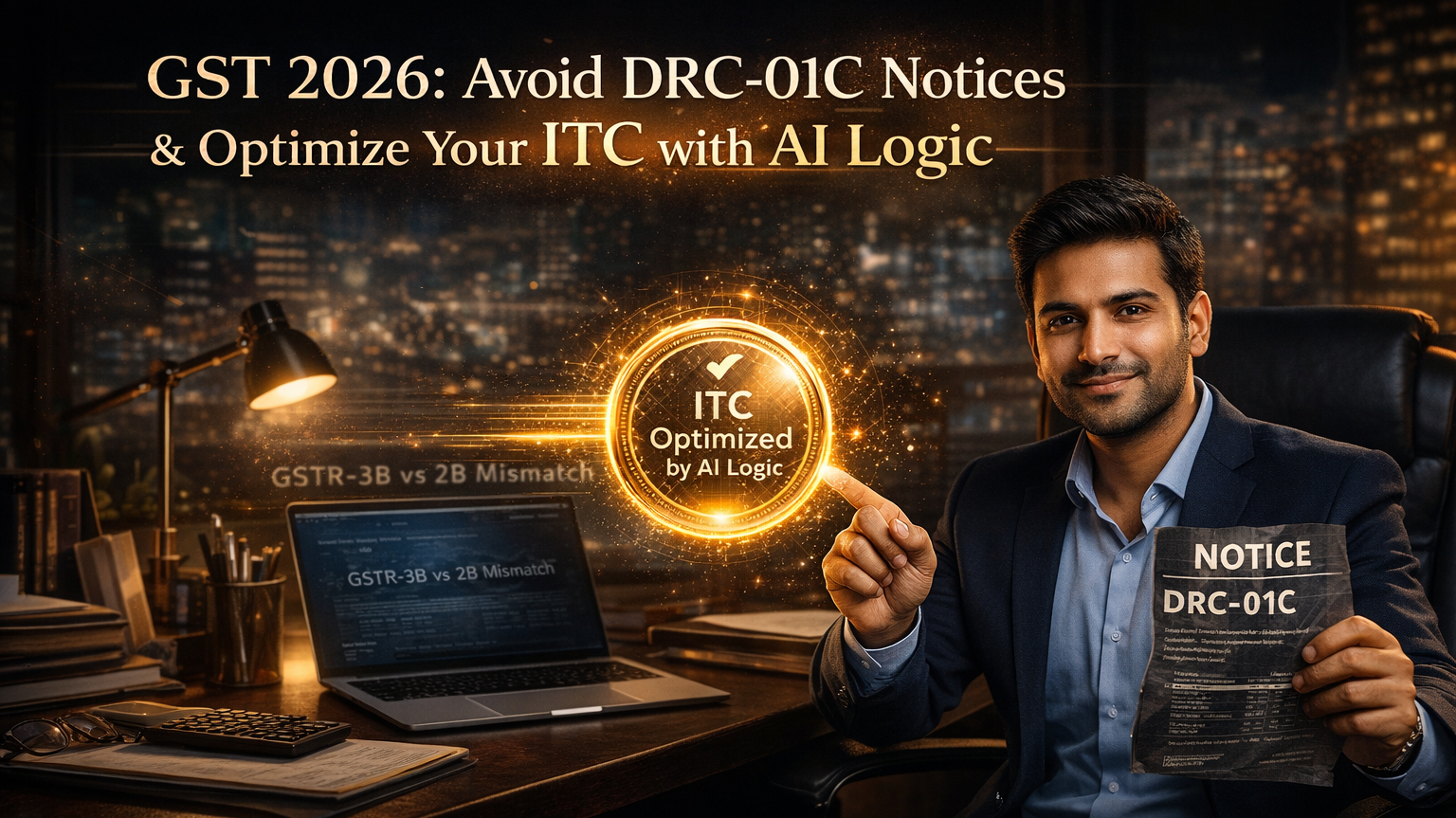
Caption : Visualizing the new era of GST. Learn how to crush outdated DRC-01C notices and secure maximum value for Your ITC with advanced AI-driven compliance logic.
If you are a Chartered Accountant, a tax professional, or a business owner, you’ve likely noticed a massive shift. The GST Portal is no longer a simple filing website; it is an AI-driven enforcement engine. With the maturity of Rule 88D, the Invoice Management System (IMS), and the automated Form DRC-01C, the window for clerical errors has officially closed.
While most guides focus on basic steps, this guide dives into the “Financial Engineering” and AI-led oversight required to handle DRC-01C notices and optimize your Input Tax Credit (ITC) for the 2026 landscape.
1. The 2026 Reality: Why “Basic Recon” Triggers Automated Notices
By 2026, the GSTN system has integrated predictive analytics. Earlier, a mismatch between GSTR-3B and GSTR-2B might have gone unnoticed until a manual audit. Now, the system triggers an Automated Intimation (DRC-01C) the moment your ITC claim in GSTR-3B exceeds your GSTR-2B by a calibrated threshold—currently 5%.
To maintain a clean Risk Index, precise calculation is non-negotiable. If you are struggling with manual errors, you can check out our guide on Smart Excel GSTR-2B Reconciliation Automation for 2026. This tool ensures your 3B vs 2B data stays within the safe 5% threshold automatically.
The Mathematical “Red Flag” Formula:
Before hitting ‘File’, run this Risk Index calculation:
Swipe Left to Right ⬆️
Think of this Risk Index as your ‘Credit Score’ for GST. If you cross that 5% line, the system doesn’t wait for a human officer; the AI sends an automated alert. In my experience, keeping a buffer of 1-2% is the safest way to avoid any technical glitches from the portal’s side.
2. IMS (Invoice Management System): The New Control Tower
In 2026, you don’t just “receive” ITC; you “manage” it. The IMS is the biggest change for accountants. Every invoice uploaded by your vendor now sits in a “Action Required” bucket.
Invoice Management System (IMS) Action Logic

Caption : Visualizing the ‘IMS Control Tower’. Taking actions—Accept, Reject, or Pending—on inward invoices has now become a mandatory compliance process for every taxpayer in 2026.
Actionable Logic in IMS:
- Accept: Invoice flows to GSTR-2B for that month.
- Reject: Invoice is sent back to the vendor; no ITC is claimed.
- Pending: ITC is deferred to the next month (Perfect for “Goods in Transit” scenarios).
Pro Tip :- Don’t ignore the ‘Pending’ bucket. In 2026, I suggest my readers audit their IMS every Friday. If you leave it to ‘Auto-Accept’, you might end up claiming ITC for goods that haven’t even reached your warehouse, leading to unnecessary litigation.
Technical Tip: If you don’t take action, the system Auto-Accepts invoices at the end of the month. This is risky! An auto-accepted invoice without physical receipt of goods is a violation of Section 16(2)(b), which AI-scanners now detect by cross-referencing E-Way Bill dates.
If you want to explore the official step-by-step workflow of this new system, you can refer to the Official GST Portal IMS User Manual. It provides a deep dive into how the backend handles ‘Pending’ invoices for different tax periods.
3. Advanced ITC Optimization: The “Eligible ITC” Logic
Advanced ITC Optimization Engine 2026

Caption : Conceptualizing the ITC Optimization Engine. This visual demonstrates the synchronization of multiple data streams—ICEGATE, RCM, and GSTR-2B—to determine the ‘Maximum Eligible ITC’.
You must transition from reactive reconciliation to Proactive Optimization. Claiming what is in your books is no longer enough; it must be system-justified.
Advanced optimization requires real-time data syncing between your books and the portal. We have previously discussed how to perform an Automatic GSTR-2B vs Purchase Register AI Match in Tally Prime 2026. Using AI for internal audits is the fastest way to identify eligible ITC before the system flags it.
The Master Formula for 2026 Compliance:
Swipe Left to Right ⬆️
Technical Deep-Dive on Rule 37A:
If your vendor filed GSTR-1 (so it’s in your 2B) but failed to file GSTR-3B by September 30th of the next year, you must reverse that ITC.
- The 2026 Automation: Advanced ERPs now use APIs to track the “3B Filing Status” of every vendor. If the status is ‘No’, the Excel automation should automatically debit that ITC from your current month’s claim.
- The Rule 37A : “The biggest headache for accountants in 2026 is the vendor’s 3B filing status. My advice? Don’t just rely on the portal. Set up an automated email reminder for your vendors. If their 3B is not filed by the 20th, your system should automatically flag their future payments.
4. Handling DRC-01C: A Practical 2026 Case Study
Scenario: Anurag Enterprises claimed ₹1,10,000 ITC. GSTR-2B shows ₹1,00,000.
- The Mismatch: ₹10,000 (10%).
- The Result: Instant DRC-01C Notice.
GST Risk Index & DRC-01C Trigger Visualization
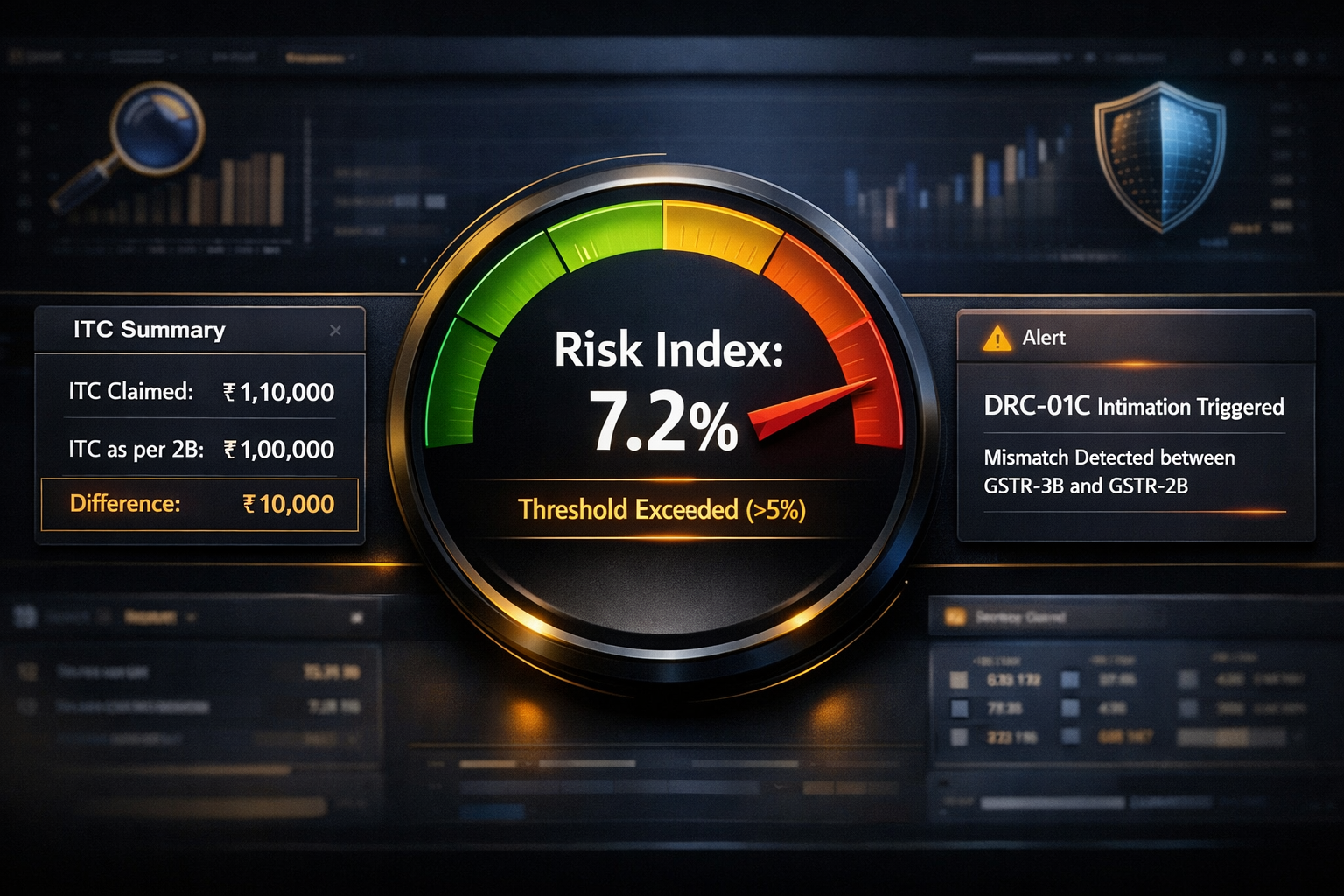
Caption : Visualizing the Automated Notice System. When the ITC mismatch exceeds the 5% threshold, the portal automatically triggers a DRC-01C intimation.
How to Resolve via Part B Reply (Practical Examples):
- Reason: Import of Goods: Often ICEGATE and GSTN sync lags. Use logic:
Swipe Left to Right ⬆️
- Reason: ITC Reclaimed: If you reversed ITC last month (Rule 37A) and the vendor filed it this month, you are reclaiming it. Mention the previous month’s ARN.
- Reason: Clerical Error: If you made a mistake, pay the tax + interest via DRC-03 and provide the ARN in the reply.
5. The Financial Impact: Why Compliance Saves Capital
GST is a Cash Flow issue. The “True Cost” of a mismatch is high due to Automated Interest Recovery.
The “Total Liability” Formula:
Swipe Left to Right ⬆️
Why this matters in 2026:
In Table 5.1 of GSTR-3B, interest is now auto-calculated based on your net cash shortfall. It is non-editable downwards. Accurate Excel automation isn’t just “neat”—it prevents direct profit leakage.
The 18% interest mandate is strictly governed by the law. For a detailed breakdown of the latest notifications regarding interest on net cash liability, visit the CBIC Official Notifications Page. Staying updated with these circulars is vital to protect your business capital.
Save Money Phycology :- Calculation is one thing, but losing 18% interest on a mismatch is a direct hit to your company’s net profit. I always tell my fellow professionals: GST compliance is no longer a ‘Compliance Cost’; it is now a ‘Capital Protection Strategy
6. Futuristic Vendor Management: The “Trust Score”
In 2026, your ITC safety depends on your vendors. Implement a Weighted Vendor Compliance Score:
- Score > 0.9: High Trust. Release 100% payment.
- Score < 0.7: High Risk. Hold the GST component until it reflects as “Accepted” in IMS.
7. AI in GST: The Silent Auditor
The GSTN is deploying “Sovereign LLMs” and Graph Networks to scan for:
AI Sovereign LLM as GST Silent Auditor

Caption : AI as the Silent Auditor. Leveraging Sovereign LLMs and Graph Networks to scan for non-genuine traders, circular trading, and price benchmarking mismatches in real-time.
- Circular Trading: Detecting fake invoices between connected parties.
- HSN Price Benchmarking: If you buy at ₹100 and a competitor buys at ₹150, AI flags potential undervaluation.
- Predictive Forecasting: Tools now predict your next month’s liability by scanning “Pending” invoices in IMS.
The integration of Sovereign LLMs in taxation is a global trend. Organizations like the OECD on Digital Transformation of Tax Administration are already discussing how graph networks and AI-driven forensic audits are shaping the future of global tax compliance.
8. Frequently Asked Questions (FAQs)
Q1. What is the biggest risk of IMS “Auto-Acceptance ?
If goods haven’t arrived, auto-acceptance violates Section 16. In 2026, the portal compares GSTR-2B dates with E-Way Bill delivery dates to catch these “Paper-only” ITC claims.
Q2. Can I manually reduce the auto-calculated interest in GSTR-3B ?
No. From 2026, the system computes interest on the Electronic Cash Ledger (ECL) balance. This figure is mandatory.
Q3. How does Rule 88C differ from DRC-01C ?
Rule 88C deals with GSTR-1 vs GSTR-3B (Liability mismatch), while DRC-01C deals with GSTR-2B vs GSTR-3B (ITC mismatch). Both result in blocked filings if ignored.
Beyond mastering complex AI compliance, speed is what sets a professional apart. To further boost your productivity, don’t forget to master the 1.5-Second Golden Shortcut for Tally Prime 2026. Combining fast data entry with smart AI oversight is the ultimate strategy for financial survival.
Conclusion
The era of manual filing is dead. In 2026, success belongs to the “Tech-Savvy Professional.” By mastering IMS, Rule 37A, and DRC-01C, you protect your capital and build a high “Trust Rating” with the department.
Remember: In 2026, your Excel tool is your first line of defense against an AI-driven notice.
Disclaimer
This content is provided for educational purposes by servicemoney.in. GST laws are dynamic. Please consult a qualified Chartered Accountant before making financial decisions.

